




























Views
Downloads

Printable Sound Distance Worksheet | Grade 5 Science

Paste this activity's link or code into your existing LMS (Google Classroom, Canvas, Teams, Schoology, Moodle, etc.).
Students can open and work on the activity right away, with no student login required.
You'll still be able to track student progress and results from your teacher account.
Investigate How Sound Changes With Distance
This science worksheet gives Grade 5 students a focused activity to investigate the relationship between distance and sound loudness. Through data analysis and graphing, students build a foundational understanding of how sound energy dissipates over distance, a key concept in wave properties.
At a Glance
- Grade: 5 · Subject: Science
- Standard:
4-PS4-1— Develop a model to describe wave patterns and properties.- Skill Focus: Analyzing how sound loudness changes with distance
- Format: 1 page · 3 problems · Answer key included · PDF
- Best For: In-class activity, science centers, homework
- Time: 25–40 minutes
What's Inside
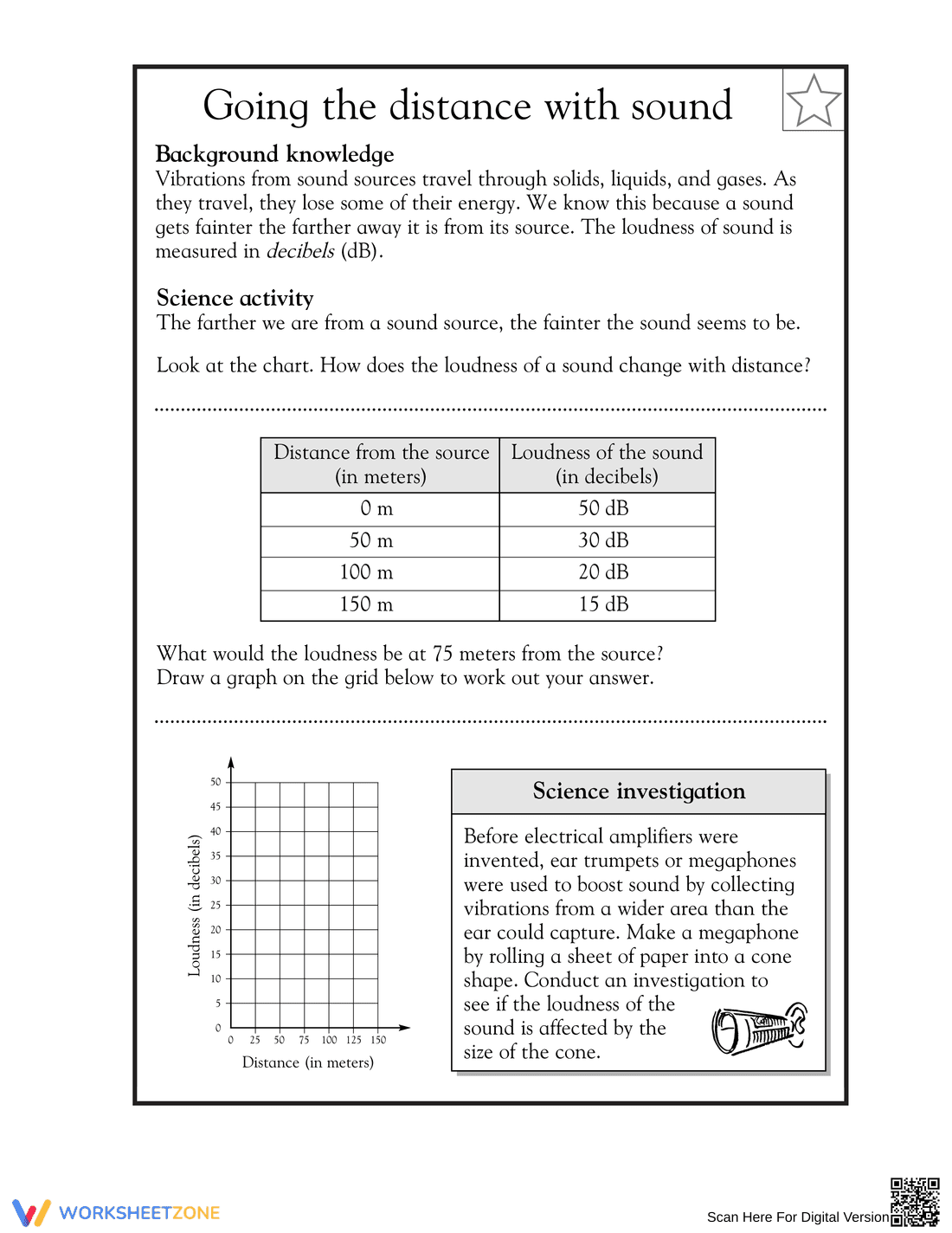
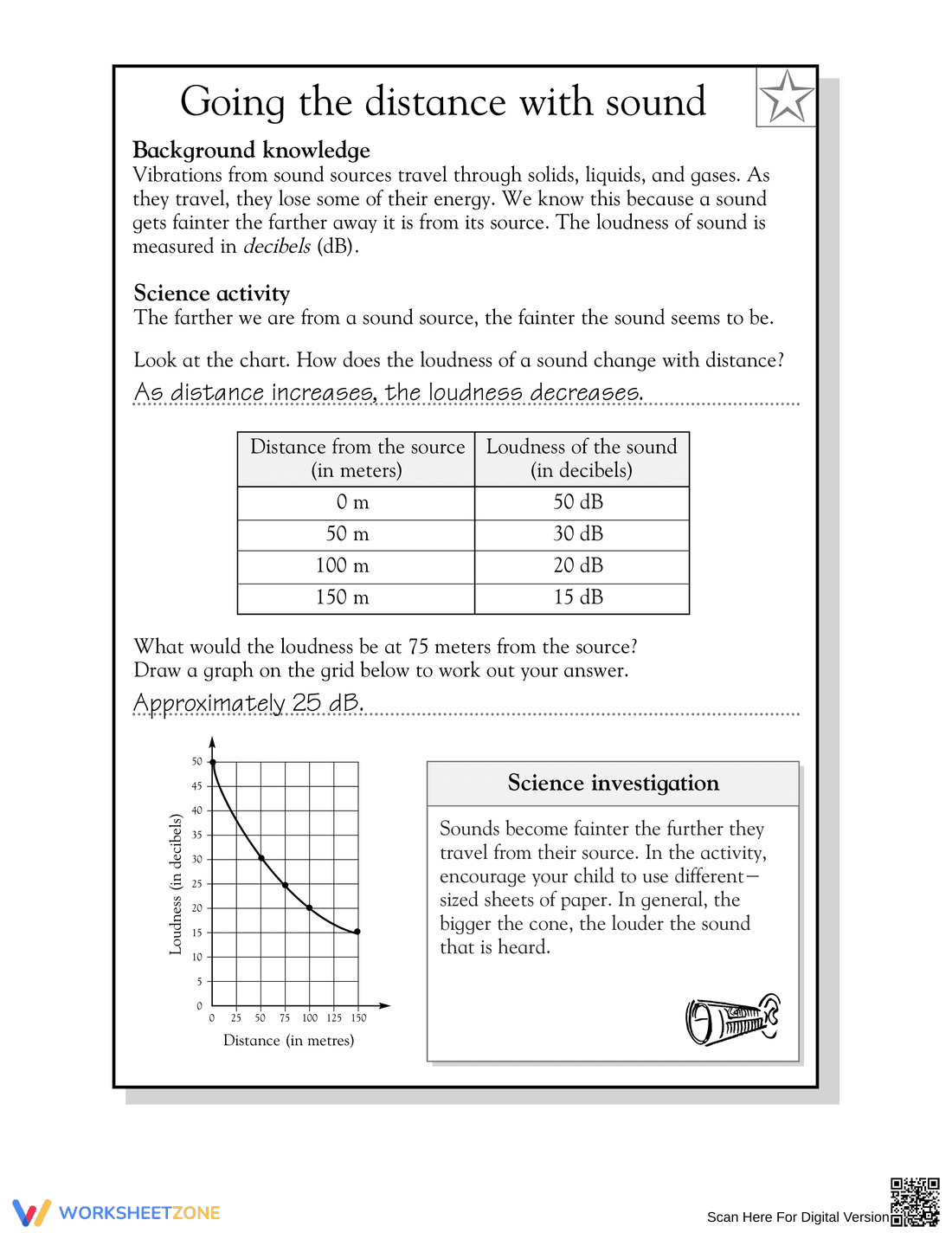
This single-page worksheet contains three tasks. It begins with a background reading on decibels, then asks students to interpret a data chart and plot the values on a graph. The worksheet concludes with a simple hands-on investigation to construct a megaphone. An answer key for the graphing task is included.
A Focus on Skill Progression
This worksheet uses a gradual release model to build understanding.
- Guided Practice: Students read a short text that defines key vocabulary like "vibrations" and "decibels," establishing a shared knowledge base.
- Supported Practice: Using a data table, students interpret the relationship between distance and loudness and then transfer this data to a graph to visualize the pattern.
- Independent Practice: The final task challenges students to apply their knowledge in a hands-on investigation, building a megaphone to explore sound collection.
This structure ensures students move from concept to application.
Standards Alignment
This worksheet is aligned with the NGSS for elementary wave properties. The primary standard is 4-PS4-1: "Develop a model of waves to describe patterns in terms of amplitude and wavelength..." Students develop a model (the graph) to describe a pattern (decreasing loudness). It also supports science practices like Analyzing and Interpreting Data. Both standard codes can be copied directly into lesson plans or curriculum maps.
How to Use It
This resource is flexible for use after a lesson on sound. Assign it for individual or partner work in class (25-40 minutes), or as homework. It also serves as a station in a science center rotation. For formative assessment, circulate as students create their graphs, listening for their use of key vocabulary to describe the data pattern.
Who It's For
Designed for 5th-grade physical science students, its clear structure is accessible for most learners. For struggling readers, consider reading the background section aloud. This worksheet pairs well with a sound waves anchor chart or a prior hands-on demonstration with a tuning fork.
This Grade 5 science resource helps students meet NGSS standard 4-PS4-1 by modeling the relationship between sound energy and distance. Students analyze data and graph the pattern of sound getting fainter, a key concept in wave properties. This aligns with research on inquiry-based learning. According to the RAND AIRS 2024 report on effective science pedagogy, activities requiring students to interpret data and construct models lead to more durable learning gains than passive reading. This worksheet provides a practical, standards-aligned tool for this strategy, asking students to demonstrate *how* sound changes by graphing the decibel drop over distance.


