


























Views
Downloads

Grade 3 How Seeds Scatter — Printable No-Prep Worksheet
Paste this activity's link or code into your existing LMS (Google Classroom, Canvas, Teams, Schoology, Moodle, etc.).
Students can open and work on the activity right away, with no student login required.
You'll still be able to track student progress and results from your teacher account.
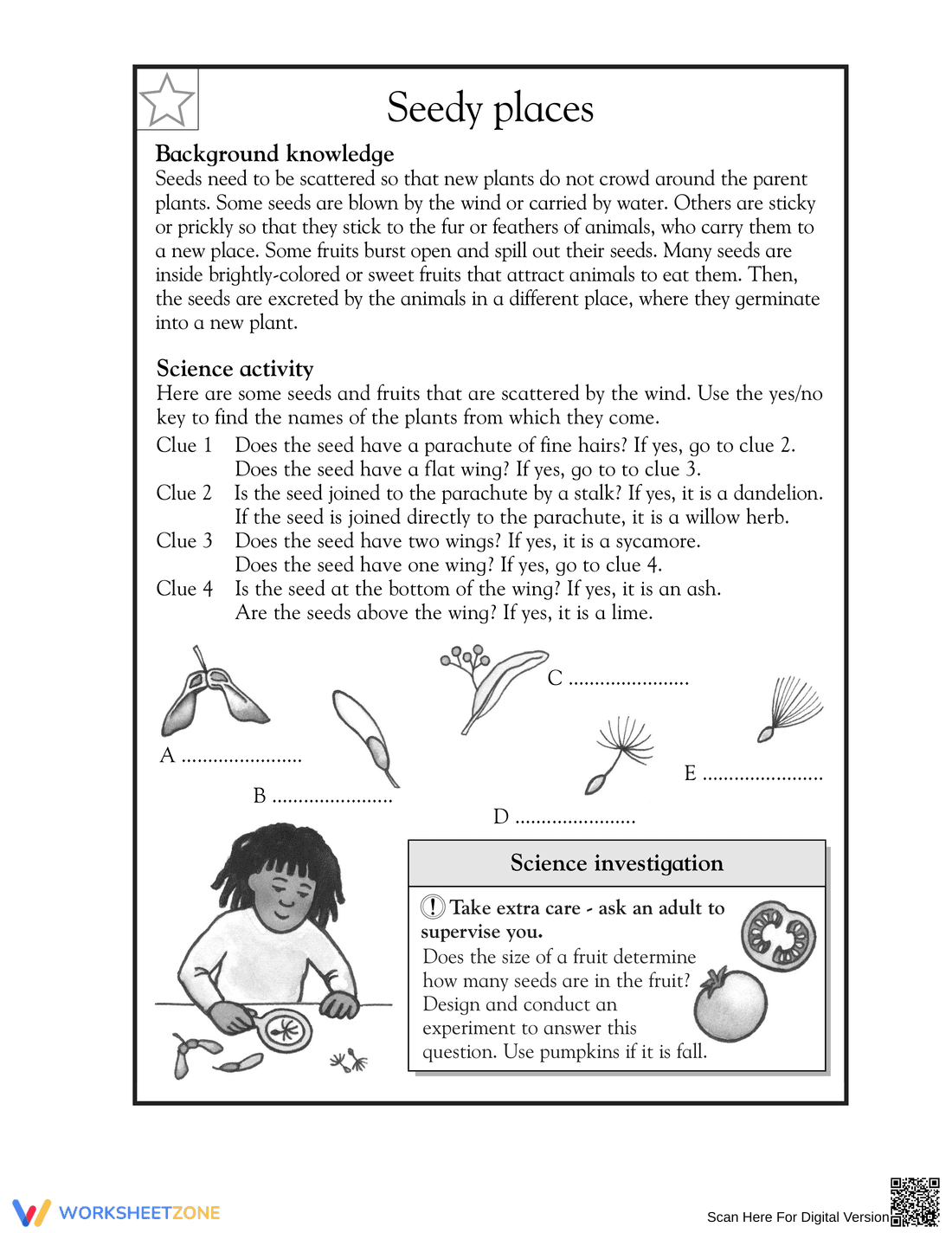
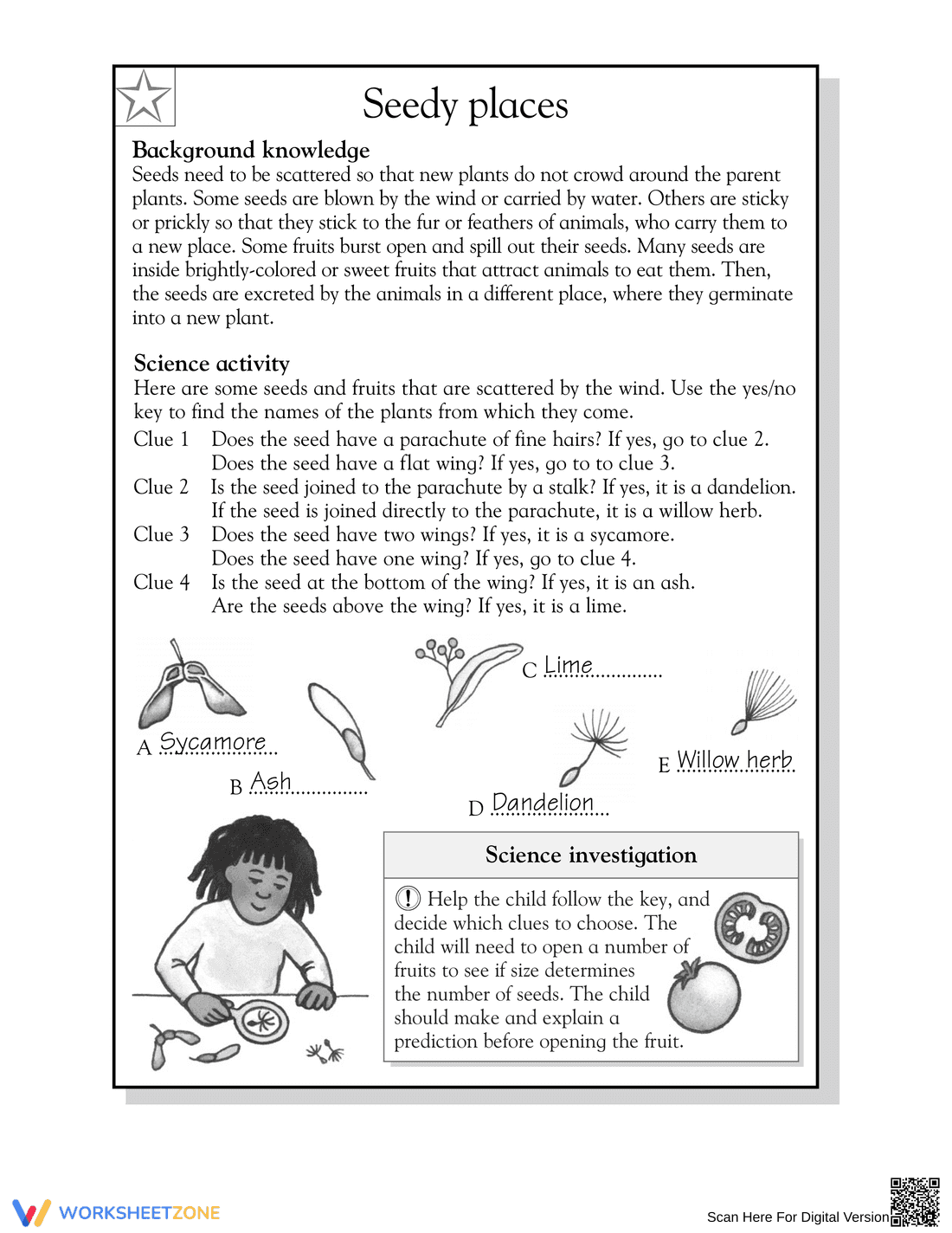
This Grade 3 science worksheet helps students identify various methods of seed dispersal, focusing specifically on wind-scattered varieties. Students apply critical thinking to distinguish between seeds like dandelions and sycamores using a provided dichotomous key. The activity reinforces background knowledge on plant reproduction and prepares learners for independent science investigations.
At a Glance
- Grade: 3 · Subject: Living Things
- Standard:
3-LS1-1— Develop models to describe reproduction and plant life cycle stages- Skill Focus: Seed dispersal mechanisms
- Format: 1 page · 6 problems · Answer key included · PDF
- Best For: Independent science centers and quick sub plans
- Time: 15–20 minutes
This single-page resource features a comprehensive background reading section on dispersal via wind, water, animals, and bursting. The core "Science Activity" includes a five-part identification challenge using a yes/no clue system. It also provides a structured "Science Investigation" prompt that encourages students to design their own experiment regarding fruit size and seed density, accompanied by clear illustrations.
Zero-Prep Workflow
The workflow for this resource is designed for maximum efficiency in the classroom. Step 1: Print the single-sheet PDF (under 10 seconds). Step 2: Distribute to students for independent or small-group work (under 30 seconds). Step 3: Review the completed identification keys using the provided answer key (under 1 minute). The total teacher preparation time remains under 2 minutes, making it ideal for unexpected sub plans.
Standards Alignment
Primary standard 3-LS1-1 requires students to develop models to describe that organisms have unique and diverse life cycles. Understanding seed dispersal is critical for modeling the reproduction phase of the plant life cycle. The worksheet also supports NGSS 2-LS2-2 by exploring how plants depend on their environment for dispersal. Both standard codes can be copied directly into lesson plans, IEP goals, or district curriculum mapping tools.
How to Use It
Use this worksheet during the "Explain" or "Elaborate" phase of a 5E lesson on plant life cycles. It works effectively as a formative assessment after a direct instruction session on dispersal agents. Teachers should observe if students can logically follow the dichotomous key's branching paths. Expected completion time ranges from 15 to 20 minutes depending on the depth of the extension investigation.
Who It's For
This resource is designed for Grade 3 and 4 students exploring life science and botanical structures. It provides built-in scaffolds for English Language Learners through visual cues and clear background text. It pairs naturally with a hands-on "seed collection" walk or a read-aloud of "The Tiny Seed" to provide concrete context for the abstract identification tasks.
The 3-LS1-1 standard emphasizes the importance of reproduction in maintaining plant populations, a concept central to this seed dispersal analysis. According to the NAEP 2024 science framework, identifying structural adaptations for survival is a foundational skill in elementary life science. This worksheet facilitates mastery of plain-English skills such as explaining how seeds move to new locations to germinate. Research from ScienceDirect TpT Analysis (2024) indicates that high-quality visual aids and dichotomous keys significantly improve student retention of botanical classification. By bridging background knowledge with active identification, the resource ensures students move beyond rote memorization to functional scientific literacy. This structured approach aligns with evidence-based practices for science instruction, providing the necessary scaffolding for diverse learners to achieve proficiency in state and national standards.


