


























Views
Downloads

How Much is Your Name Worth? Essential Money Worksheet
Paste this activity's link or code into your existing LMS (Google Classroom, Canvas, Teams, Schoology, Moodle, etc.).
Students can open and work on the activity right away, with no student login required.
You'll still be able to track student progress and results from your teacher account.
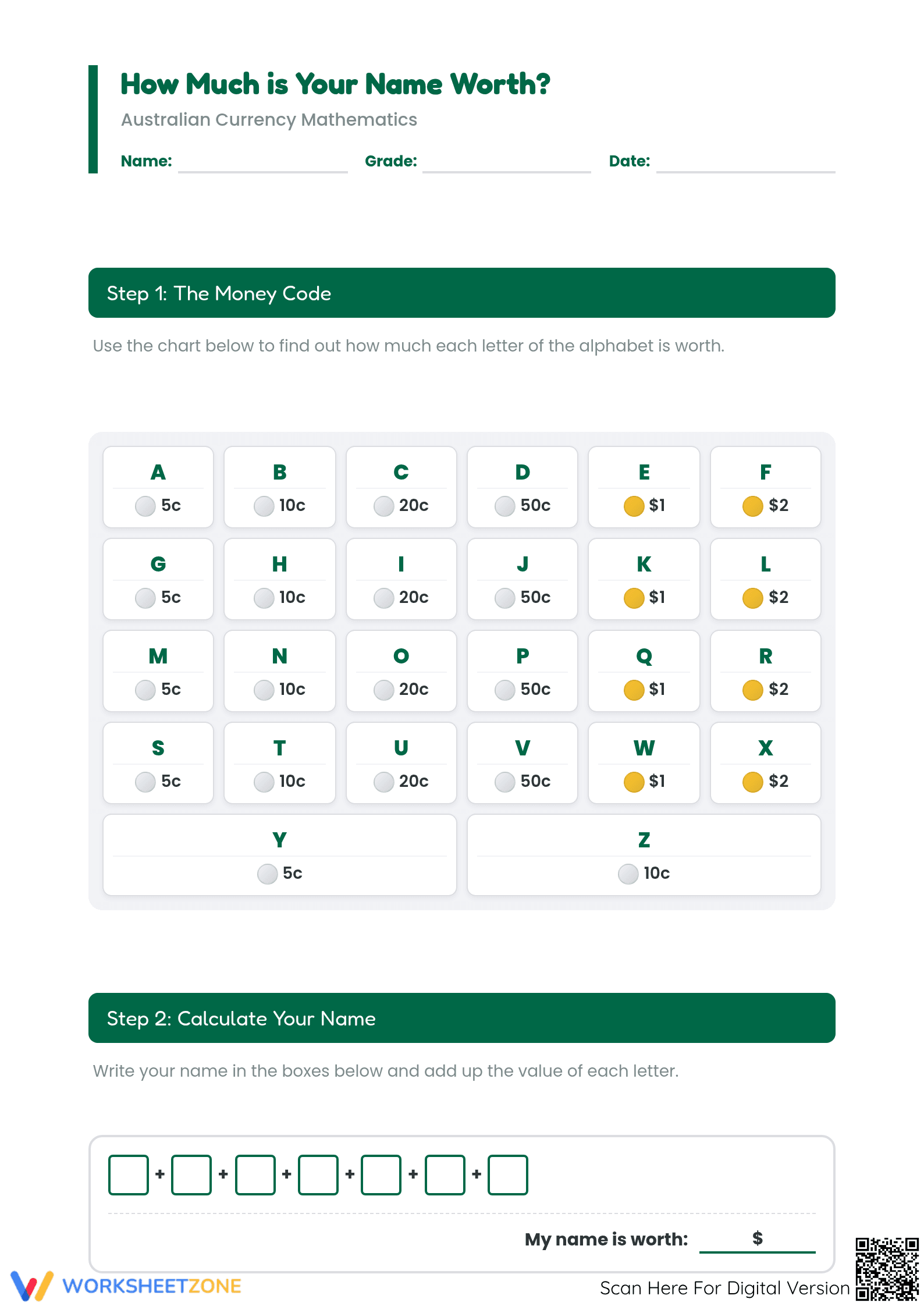
Engage students with a personalized math challenge using this Australian currency worksheet. By assigning monetary values to every letter of the alphabet, students practice critical addition skills while calculating the "worth" of their own names and common words. This interactive approach transforms abstract money concepts into a concrete, hands-on learning experience that builds financial literacy and numerical fluency.
At a Glance
- Grade: 3 · Subject: Mathematics
- Standard:
CCSS.MATH.CONTENT.2.MD.C.8— Solve word problems involving dollar bills and coins using symbols correctly- Skill Focus: Australian Currency Addition
- Format: 2 pages · 4 problems · Answer key included · PDF
- Best For: Individual practice or math centers
- Time: 20–30 minutes
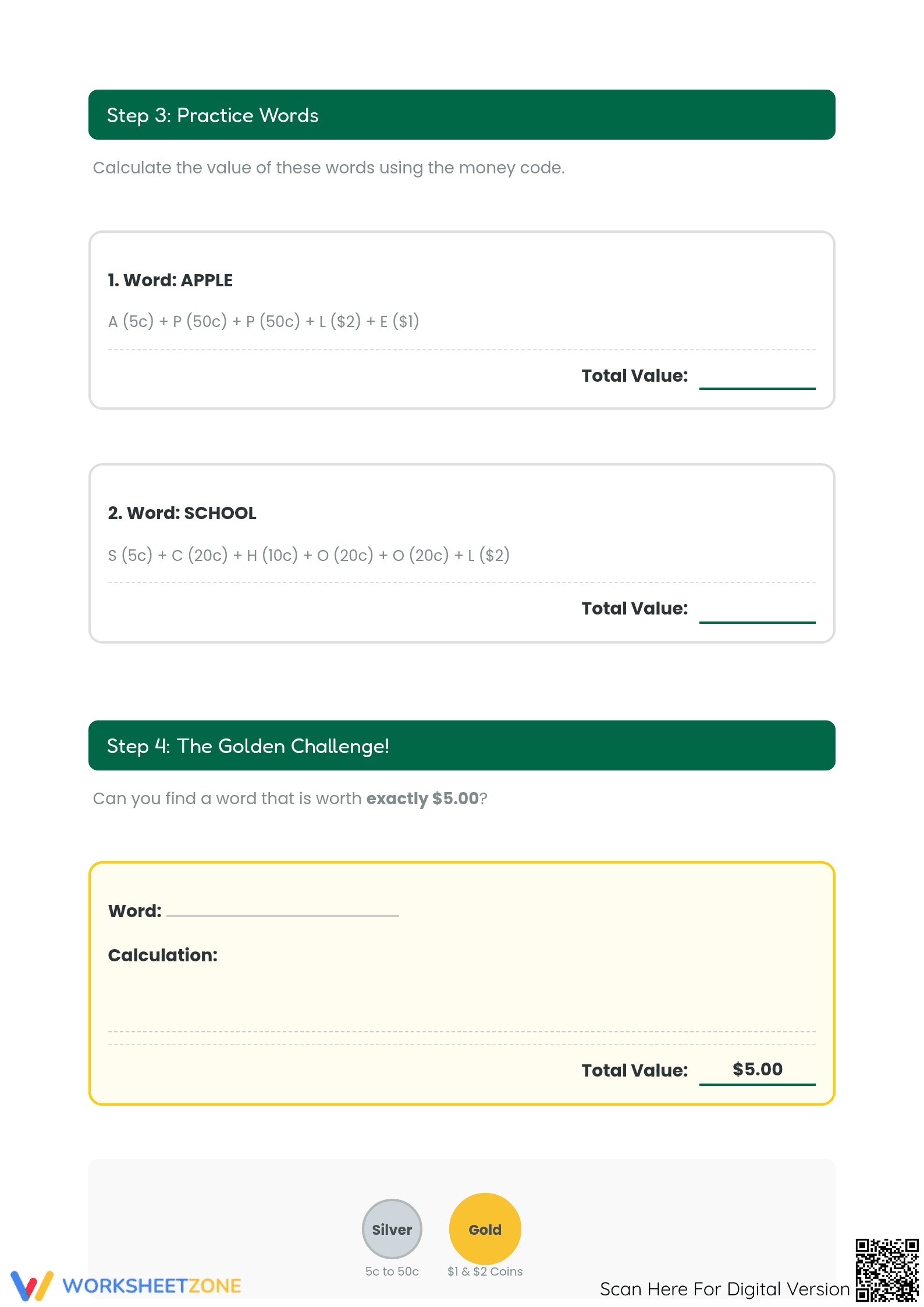
This two-page PDF features a comprehensive "Money Code" chart where each letter (A-Z) corresponds to a specific Australian coin or note value, ranging from 5c to $2. The worksheet guides students through four distinct steps: decoding their own names, solving practice words like "APPLE" and "SCHOOL" with provided scaffolds, and tackling the "Golden Challenge" of finding a word worth exactly $5.00. A full answer key ensures quick and accurate grading.
The zero-prep design allows teachers to implement this activity in under two minutes. First, print the two-page document for each student (30 seconds). Next, distribute the sheets and briefly explain the Money Code mapping (30 seconds). Finally, use the provided answer key for instant feedback or peer-review sessions (30 seconds). It is an ideal resource for substitute folders or "fast finisher" packets.
Aligned to `CCSS.MATH.CONTENT.2.MD.C.8`, this worksheet requires students to solve problems involving money. While using Australian currency, the underlying mathematical operations align with Grade 2 and 3 standards for adding multiple values and using decimal notation for dollars and cents. This resource also supports Grade 3 operations and algebraic thinking. Both standard codes can be copied directly into lesson plans, IEP goals, or district curriculum mapping tools.
Use this worksheet as a mid-lesson activity during a unit on money to reinforce coin recognition and mental math. It also serves as a formative assessment tool; observe how students handle the transition from cents to dollars to identify those needing additional support with decimal regrouping. Expect students to complete the core tasks in approximately 25 minutes, with the challenge section providing extension for advanced learners.
This activity is designed for Grade 3 students but is easily adaptable for Grade 2 enrichment or Grade 4 remediation. It pairs naturally with physical Australian play money or an anchor chart displaying coin values. The personalized nature of calculating one's name makes it particularly effective for engaging reluctant learners who may find traditional math drills tedious.
Research from RAND AIRS 2024 emphasizes that contextualizing mathematical operations within personal or real-world scenarios significantly increases student engagement and long-term retention of computational strategies. This Australian currency worksheet utilizes a "gamified" mapping system that requires students to perform repeated addition and value-comparison tasks, directly supporting the development of number sense as defined by EdReports 2024. By integrating the `CCSS.MATH.CONTENT.2.MD.C.8` standard within a personalized "Name Worth" framework, the resource encourages students to move beyond rote memorization toward a functional understanding of monetary systems. Fisher & Frey (2014) note that such "purposeful play" in mathematics helps bridge the gap between abstract symbols and tangible value. This 2-page PDF provides a structured yet flexible environment for mastering currency addition, ensuring that Grade 3 learners develop the precision required for more complex financial literacy tasks in later years.


