


























Views
Downloads
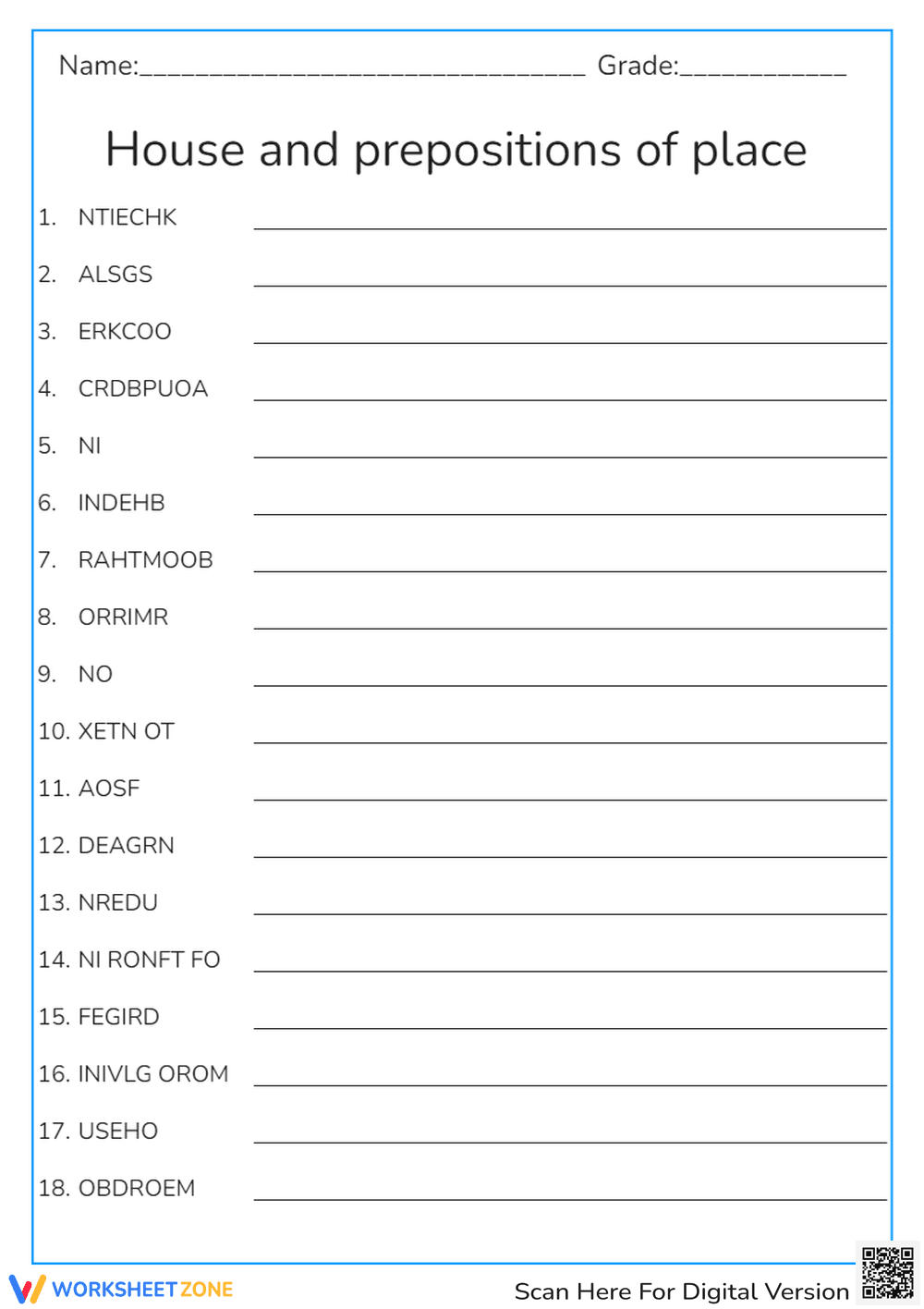

Printable Prepositions and House Vocabulary | Grade 3
Paste this activity's link or code into your existing LMS (Google Classroom, Canvas, Teams, Schoology, Moodle, etc.).
Students can open and work on the activity right away, with no student login required.
You'll still be able to track student progress and results from your teacher account.
This Grade 3 ELA worksheet strengthens vocabulary and spatial reasoning through an engaging word scramble format. Students decode 18 scrambled terms to identify common household objects and essential prepositions of place. By connecting spelling to meaning, learners build the foundational language skills necessary for descriptive writing and clear communication.
At a Glance
- Grade: 3 · Subject: ELA
- Standard:
CCSS.ELA-LITERACY.L.3.1.I— Correctly spell and identify prepositions and common household vocabulary terms- Skill Focus: Prepositions and House Vocabulary
- Format: 1 page · 18 problems · Answer key included · PDF
- Best For: Vocabulary reinforcement and spelling practice
- Time: 15–20 minutes
What's Inside
Inside this resource, you will find a single-page PDF featuring 18 word scramble challenges. The list is strategically mixed, alternating between household rooms (like KITCHEN and BEDROOM), furniture (like SOFA and FRIDGE), and spatial prepositions (like BEHIND and IN FRONT OF). The clean layout provides ample horizontal line space for students to write their corrected answers clearly.
Skill Progression
- Guided Recognition: Students identify letter patterns in short, high-frequency words like "NI" (IN) to build initial momentum.
- Supported Practice: Learners apply phonics knowledge to unscramble medium-length household terms such as "GARDEN" and "MIRROR."
- Independent Mastery: Students tackle complex multi-word phrases like "IN FRONT OF" and "LIVING ROOM" to demonstrate full conceptual recall.
This gradual-release approach ensures students build confidence as they work through the 18-item list, moving from simple recognition to active recall.
Standards Alignment
This resource aligns with CCSS.ELA-LITERACY.L.3.1.I, which requires students to demonstrate command of the conventions of standard English grammar and usage, specifically focusing on prepositions. It also supports L.3.2.F by reinforcing spelling patterns in high-frequency vocabulary. Both standard codes can be copied directly into lesson plans, IEP goals, or district curriculum mapping tools.
How to Use It
Use this worksheet as a warm-up activity during a unit on "My Home" or as a formative assessment after teaching prepositions. For an instructional tip, observe if students struggle more with the spatial terms or the multi-syllabic house nouns; this identifies whether they need more help with grammar or general vocabulary. Expected completion time is 15 to 20 minutes.
Who It's For
This activity is ideal for third-grade students, English Language Learners (ELL), and students requiring extra spelling support. It pairs naturally with a "Label the House" anchor chart or a reading passage about different types of homes. The scaffolded nature of the scramble helps bridge the gap between oral recognition and written production.
According to Fisher & Frey (2014), word-level manipulation tasks like scrambles are effective for reinforcing orthographic mapping and vocabulary retention in elementary learners. This Grade 3 worksheet targets CCSS.ELA-LITERACY.L.3.1.I by requiring students to mentally reorganize letters into meaningful prepositions and nouns. By engaging with 18 distinct terms, students solidify their understanding of spatial relationships and domestic vocabulary. Research from the RAND AIRS 2024 report suggests that frequent, low-stakes vocabulary practice significantly improves reading comprehension by reducing the cognitive load required for word recognition. This printable resource provides a structured, zero-prep way to integrate these essential linguistic building blocks into daily instruction. Teachers can use the results to identify specific spelling gaps or to monitor progress toward IEP goals related to functional language and grammar conventions.


