


























Views
Downloads
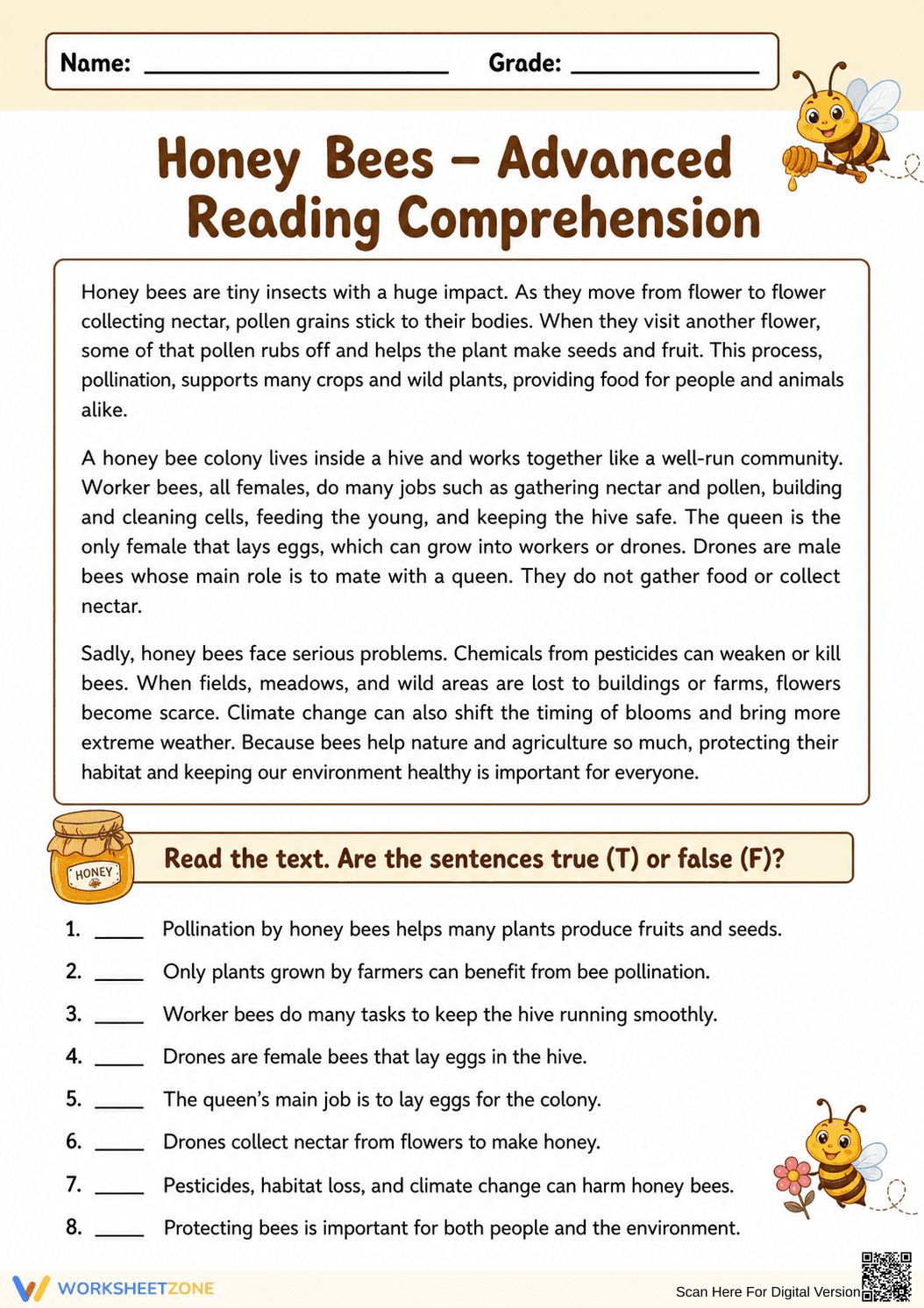

Honey Bees Advanced Reading Worksheet | Grade 5 Essential
Paste this activity's link or code into your existing LMS (Google Classroom, Canvas, Teams, Schoology, Moodle, etc.).
Students can open and work on the activity right away, with no student login required.
You'll still be able to track student progress and results from your teacher account.
This Grade 5 informational text worksheet helps students master complex scientific concepts through rigorous reading. By analyzing the roles of worker bees and the impact of environmental changes, learners develop critical evidence-based reasoning skills. It bridges the gap between basic life cycle knowledge and advanced ecological understanding for upper elementary students.
At a Glance
- Grade: 5 · Subject: Science & ELA
- Standard:
CCSS.ELA-LITERACY.RI.5.1— Quote accurately from a text when explaining what the text says explicitly- Skill Focus: Nonfiction Comprehension
- Format: 1 page · 8 problems · Answer key included · PDF
- Best For: Independent practice or science literacy centers
- Time: 15–20 minutes
The resource features a three-paragraph nonfiction passage covering pollination, hive hierarchy (workers, queens, drones), and modern environmental threats like pesticides and climate change. Below the text, students engage with 8 targeted true/false questions designed to verify literal comprehension and inferential reasoning. A complete answer key is provided for rapid grading and immediate student feedback.
This worksheet is designed for immediate classroom integration. Teachers can print the single-page PDF in under 30 seconds, distribute it to students for a 15-minute independent reading block, and review the 8 true/false answers as a whole group in less than 2 minutes. It serves as an ideal ready-to-use resource for substitute folders or morning work transitions.
The primary focus is `CCSS.ELA-LITERACY.RI.5.1`, requiring students to quote accurately from a text when explaining what the text says explicitly and when drawing inferences. It also supports NGSS 5-LS2-1 by exploring the role of organisms in an ecosystem. Both standard codes can be copied directly into lesson plans, IEP goals, or district curriculum mapping tools.
Use this as a formative assessment after a lesson on ecosystems to gauge student ability to extract specific details from technical text. Alternatively, assign it as a pre-reading activity for a unit on environmental conservation. Observe if students refer back to the text to justify their true/false selections, which typically takes approximately 20 minutes for a standard Grade 5 cohort.
This resource is tailored for upper-elementary students ready for advanced vocabulary and multi-layered scientific topics. It is particularly effective for English Language Learners (ELLs) who benefit from the structured true/false format. Pair this with a diagram of a bee hive or a video on pollination for a multi-modal learning experience that reinforces the reading material.
According to the RAND AIRS 2024 report, high-quality informational texts are critical for developing the disciplinary literacy required in middle school science. This worksheet aligns with CCSS.ELA-LITERACY.RI.5.1 by challenging students to identify explicit facts about honey bee biology and environmental stressors. By focusing on a single, high-interest topic with 8 specific comprehension checks, the resource reduces cognitive load while maximizing content retention. Research from Fisher & Frey (2014) emphasizes that close reading of complex nonfiction, such as the passage provided here, is the most effective way to build the academic vocabulary necessary for future STEM success. This printable tool provides the structured environment needed for students to practice these essential skills independently, ensuring they can meet rigorous state standards for reading informational text while gaining valuable scientific knowledge.


