


























Views
Downloads

Grade 4 Homophones — Printable No-Prep Worksheet
Paste this activity's link or code into your existing LMS (Google Classroom, Canvas, Teams, Schoology, Moodle, etc.).
Students can open and work on the activity right away, with no student login required.
You'll still be able to track student progress and results from your teacher account.
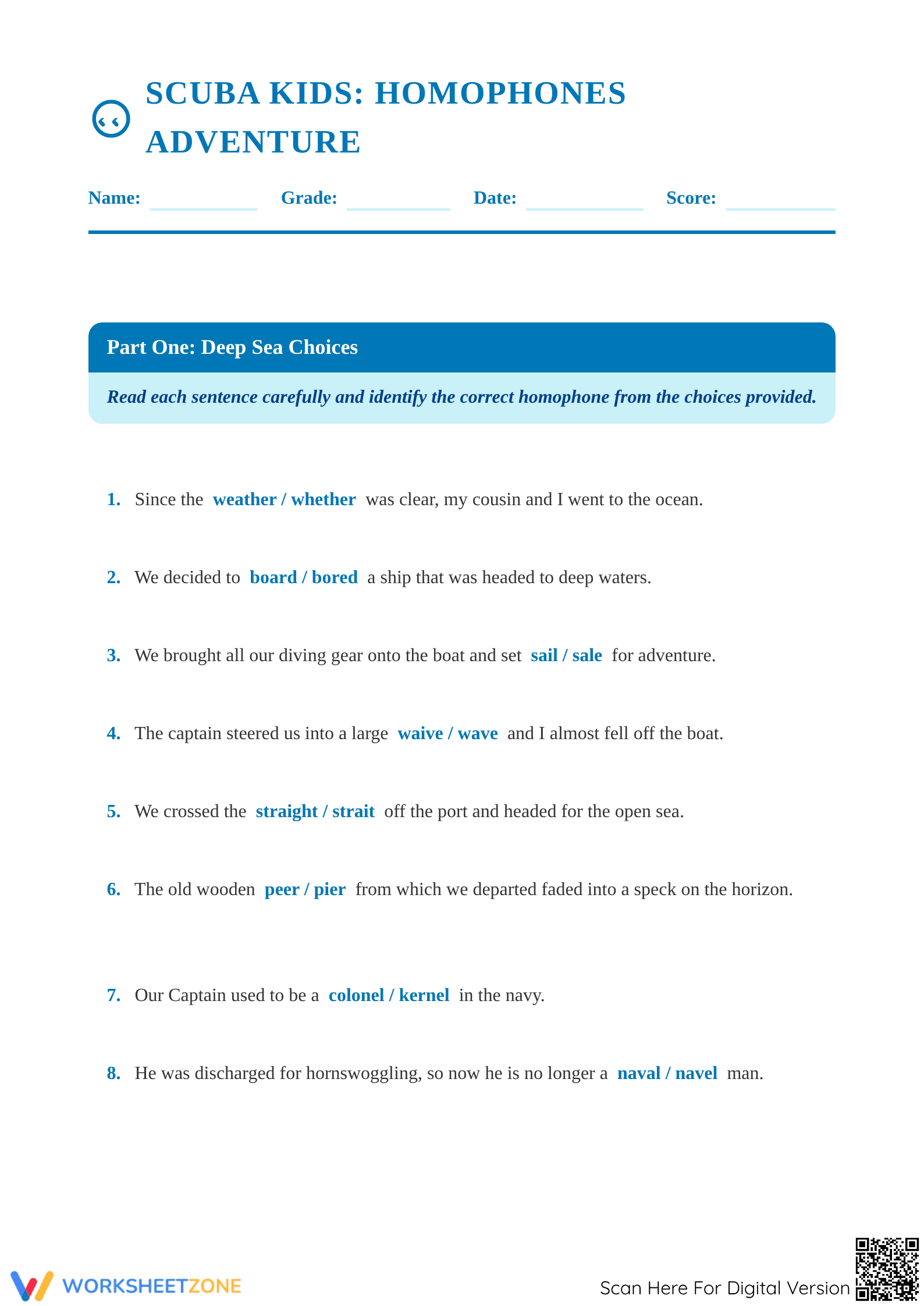
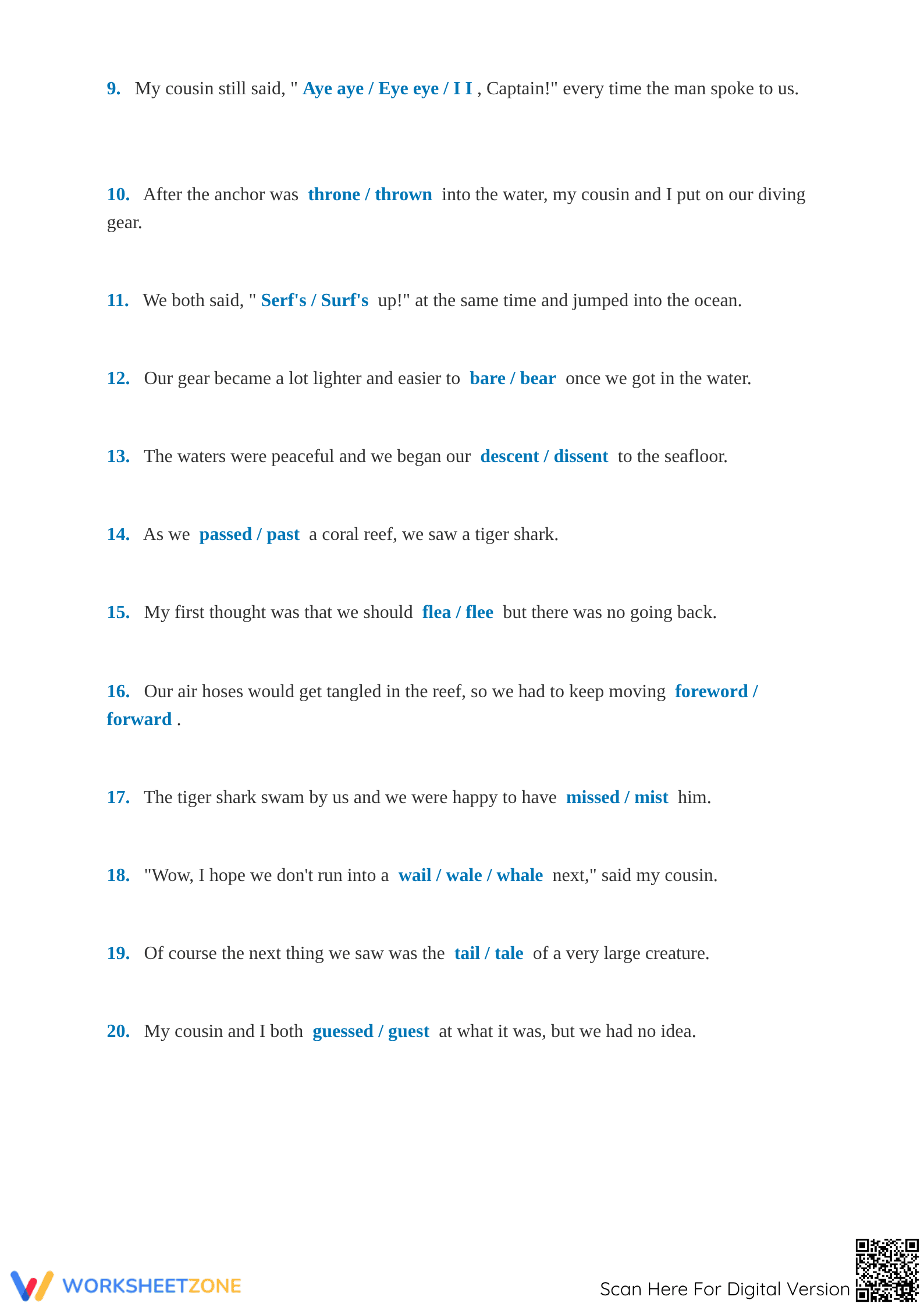
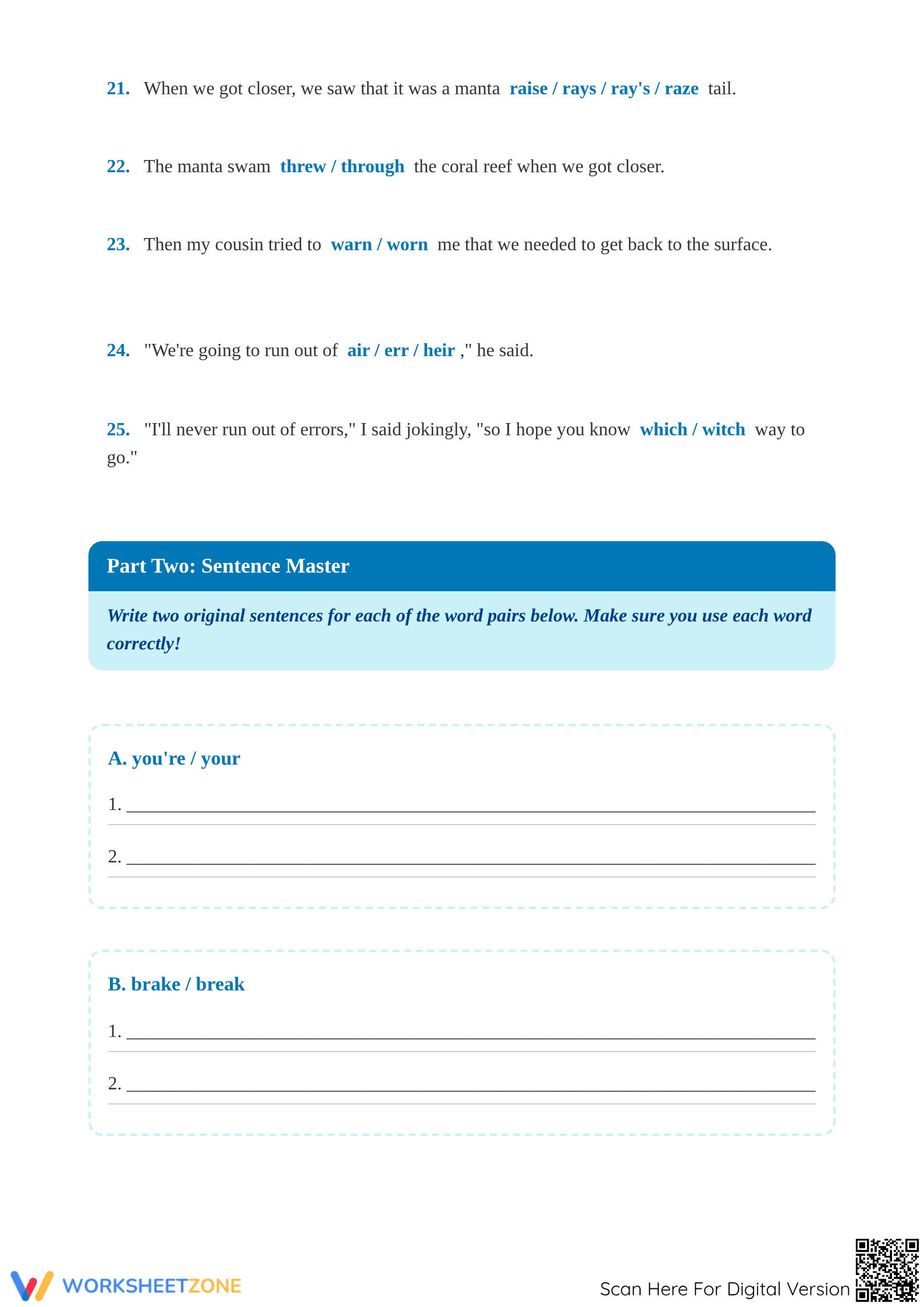
This Grade 4 homophones worksheet helps students master frequently confused words through a themed underwater adventure. By identifying correct word choices and constructing original sentences, learners build the linguistic precision necessary for clear writing. Students will move from simple identification to active application across 36 distinct tasks.
At a Glance
- Grade: 4 · Subject: ELA
- Standard:
CCSS.ELA-LITERACY.L.4.1.G— Correctly use frequently confused words in context and original writing- Skill Focus: Homophone identification and application
- Format: 4 pages · 36 problems · Answer key included · PDF
- Best For: Independent practice or sub plans
- Time: 25–35 minutes
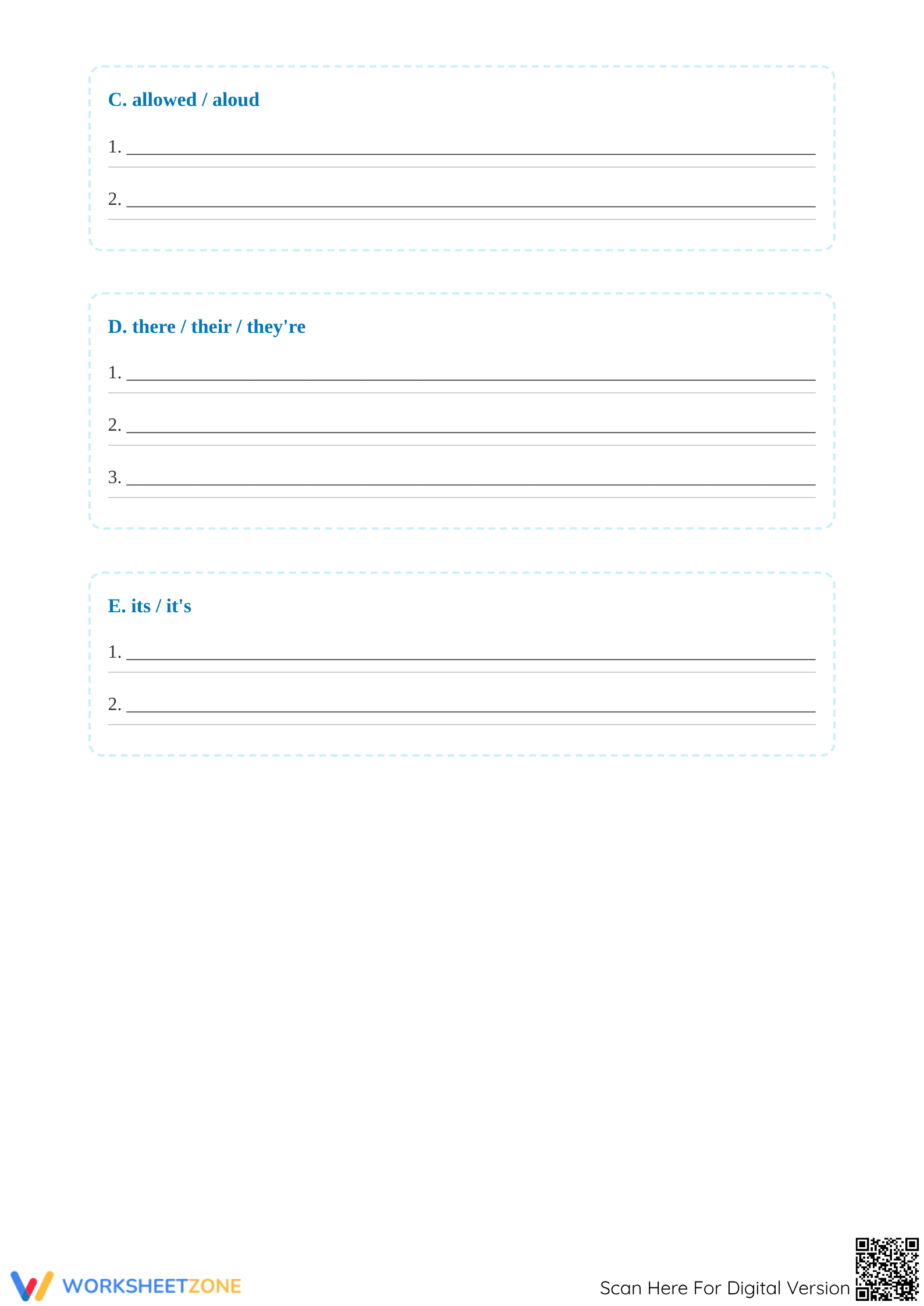
The packet contains four pages of structured grammar practice. Part One features 25 multiple-choice sentences set in a "Scuba Kids" narrative, requiring students to select the correct homophone (e.g., weather/whether, colonel/kernel). Part Two provides dedicated space for students to write 11 original sentences using high-frequency pairs like there/their/they're and its/it's. A complete answer key is provided for rapid grading.
This resource is designed for immediate classroom implementation. Teachers can print the four-page PDF in under 1 minute, distribute it to the class in 30 seconds, and use the included answer key to review student work in less than 2 minutes. The self-explanatory instructions and thematic narrative make it an ideal choice for emergency sub plans or quiet independent work blocks.
This worksheet aligns with `CCSS.ELA-LITERACY.L.4.1.G`, which requires students to correctly use frequently confused words. It also supports L.3.1 and L.5.1 by reinforcing foundational spelling-meaning relationships. Both standard codes can be copied directly into lesson plans, IEP goals, or district curriculum mapping tools.
Use this as a summative assessment after a unit on homophones to check for individual mastery. Alternatively, assign it as a formative "check-for-understanding" during a writing workshop to identify which students struggle with specific word pairs. Expect students to spend approximately 30 minutes completing both the identification and sentence-writing sections.
This resource is tailored for Grade 4 students but serves as excellent enrichment for Grade 3 or remediation for Grade 5. It is particularly effective for English Language Learners (ELLs) who need explicit practice with English phonemes that sound identical but carry different meanings. Pair this with a homophone anchor chart for maximum support.
Research by Fisher & Frey (2014) emphasizes that vocabulary acquisition, particularly for homophones, requires both contextual recognition and generative use. This worksheet addresses both needs by transitioning students from identifying CCSS.ELA-LITERACY.L.4.1.G word pairs in a narrative to producing them in original sentences. Systematic practice with frequently confused words is a critical component of literacy development, as noted in the RAND AIRS 2024 report on grammar instruction. By engaging with 36 targeted tasks, students reinforce the orthographic patterns necessary for spelling accuracy. This dual-modality approach ensures that the distinction between words like "allowed" and "aloud" is internalized through repetitive, meaningful exposure. The inclusion of a full answer key allows for immediate feedback, a proven factor in reducing the fossilization of spelling errors in elementary writers.


