


























0
Views
0
Downloads

0.0
0
Save
0 Likes
Homophones Practice Worksheet for Students
0 Views
0 Downloads
Paste this activity's link or code into your existing LMS (Google Classroom, Canvas, Teams, Schoology, Moodle, etc.).
Students can open and work on the activity right away, with no student login required.
You'll still be able to track student progress and results from your teacher account.
Information
Description
What It Is:
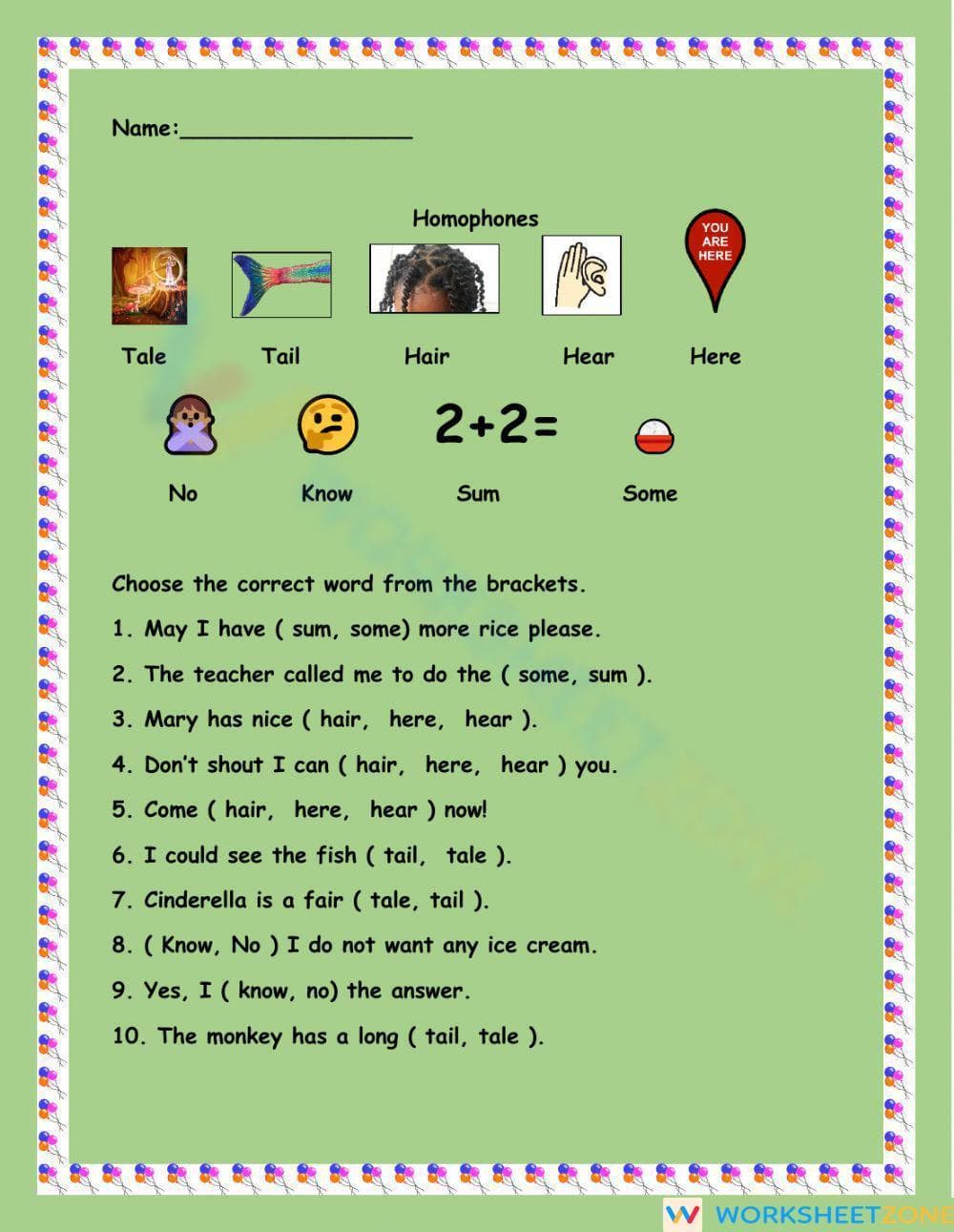
This worksheet helps students practice using homophones by choosing the correct word in various sentences. The activity includes common homophones such as "sum" vs "some," "hair" vs "here," and "tail" vs "tale," reinforcing word meanings and their proper usage.
Why Use It:
This worksheet is a great tool for helping students differentiate between commonly confused homophones. It engages learners and helps strengthen their vocabulary and understanding of English language nuances.
How to Use It:
• Read the sentence with a word in brackets.
• Choose the correct homophone to fill in the blank.
• Complete all 10 sentences to test your knowledge of homophones.
Grade Suitability:
Best suited for elementary school students, particularly those in grades 1–3, learning about homophones.
• Ideal for classroom activities or homework assignments.
• Works well for reinforcing spelling and grammar skills.
Target Users:
• English teachers.
• Students working on homophone practice.
This worksheet helps students practice using homophones by choosing the correct word in various sentences. The activity includes common homophones such as "sum" vs "some," "hair" vs "here," and "tail" vs "tale," reinforcing word meanings and their proper usage.
Why Use It:
This worksheet is a great tool for helping students differentiate between commonly confused homophones. It engages learners and helps strengthen their vocabulary and understanding of English language nuances.
How to Use It:
• Read the sentence with a word in brackets.
• Choose the correct homophone to fill in the blank.
• Complete all 10 sentences to test your knowledge of homophones.
Grade Suitability:
Best suited for elementary school students, particularly those in grades 1–3, learning about homophones.
• Ideal for classroom activities or homework assignments.
• Works well for reinforcing spelling and grammar skills.
Target Users:
• English teachers.
• Students working on homophone practice.


