




























Views
Plays
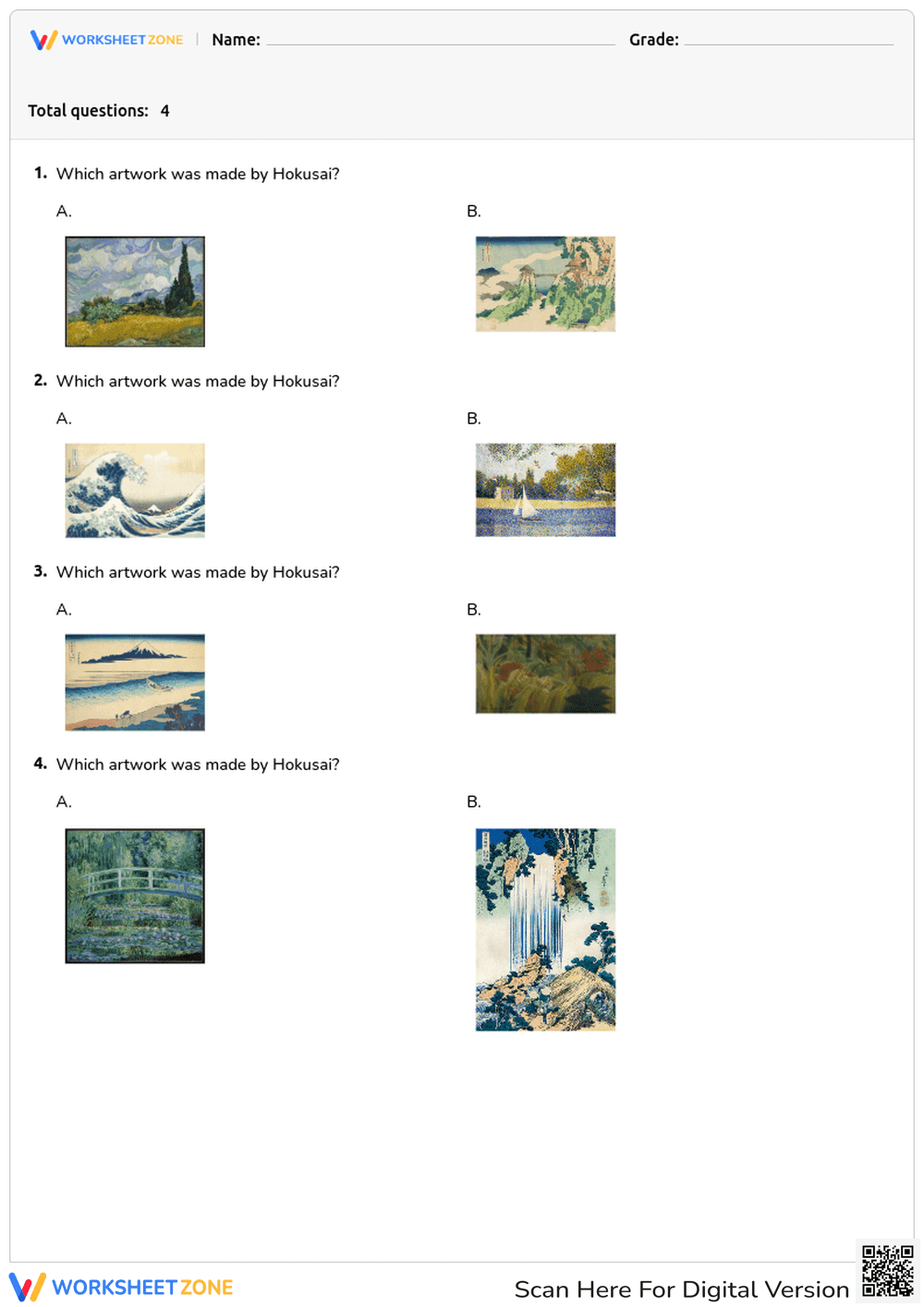

Printable Hokusai Art History Quiz | College Fine Art

Paste this activity's link or code into your existing LMS (Google Classroom, Canvas, Teams, Schoology, Moodle, etc.).
Students can open and work on the activity right away, with no student login required.
You'll still be able to track student progress and results from your teacher account.
This visual identification worksheet challenges college art history students to recognize the distinct stylistic elements of Katsushika Hokusai. By comparing pairs of famous artworks, learners practice visual analysis and author attribution, reinforcing their understanding of Japanese ukiyo-e woodblock prints against other historical art movements.
At a Glance
- Grade: College · Subject: Fine Art
- Standard:
VA:Re7.2.HSIII— Identify commonalities within visual images attributed to a specific artist.- Skill Focus: Visual analysis and artist attribution
- Format: 1 page · 4 problems · Answer key included · PDF
- Best For: Lecture review or quick assessment
- Time: 10–15 minutes
This concise assessment features four multiple-choice visual questions. Each problem presents two distinct paintings or prints, requiring students to identify which of the two was created by Hokusai. The document includes a total of eight high-quality image reproductions, contrasting Hokusai's iconic ukiyo-e style with works from Western artists like Vincent van Gogh and Claude Monet. A complete answer key is provided for immediate grading and feedback.
Designed for immediate classroom implementation, this resource follows an efficient zero-prep workflow:
- Print (1 minute): The single-page layout minimizes paper usage and prints clearly.
- Distribute (1 minute): Hand out the quiz at the beginning of a seminar.
- Review (2 minutes): Use the included answer key to quickly score submissions.
Total teacher preparation time is under two minutes, making this an excellent option for substitute plans.
This resource aligns with VA:Re7.2.HSIII: "Determine the commonalities within a group of artists or visual images attributed to a particular type of art, timeframe, or culture." It specifically targets the student's ability to isolate Hokusai's line work, color palette, and compositional techniques from contrasting artistic traditions. Both standard codes can be copied directly into lesson plans, IEP goals, or district curriculum mapping tools.
Instructors can deploy this worksheet as a formative assessment following a lecture on Edo period Japanese art. Educators can quickly gauge whether the class grasps Hokusai's defining characteristics. Alternatively, use it as a bell ringer activity at the start of a comparative art history seminar. While students work, observe their visual scanning techniques to see if they analyze brushstrokes or subject matter to make determinations. Expected completion time ranges from 10 to 15 minutes.
This material is primarily designed for college-level art history students, though it is highly adaptable for Advanced Placement (AP) Art History high school classes. For differentiation, instructors can challenge advanced learners to name the specific titles and dates of the non-Hokusai artworks featured in the distractors. It pairs perfectly with a slide lecture on the global influence of Japonisme or a direct instruction lesson analyzing "The Great Wave off Kanagawa."
Developing visual literacy requires repeated exposure to contrasting artistic styles. According to EdReports 2024, students who engage in direct comparative analysis of visual texts demonstrate a significantly higher retention rate of historical context and artist attribution skills. This worksheet directly supports that pedagogical approach by requiring learners to actively differentiate between distinct visual vocabularies. By aligning with VA:Re7.2.HSIII, the activity ensures students practice how to identify commonalities within visual images attributed to a specific artist. Rather than passively memorizing facts, participants must apply their knowledge of ukiyo-e characteristics—such as flat areas of color, bold outlines, and cropped compositions—to evaluate unfamiliar pairings. This active visual discrimination builds the foundational critical thinking skills necessary for advanced art historical research and museum studies, ensuring long-term mastery of the subject matter.


