


























Views
Downloads

Historical Fiction Practice Worksheet | Grade 6-7 Printable
Paste this activity's link or code into your existing LMS (Google Classroom, Canvas, Teams, Schoology, Moodle, etc.).
Students can open and work on the activity right away, with no student login required.
You'll still be able to track student progress and results from your teacher account.
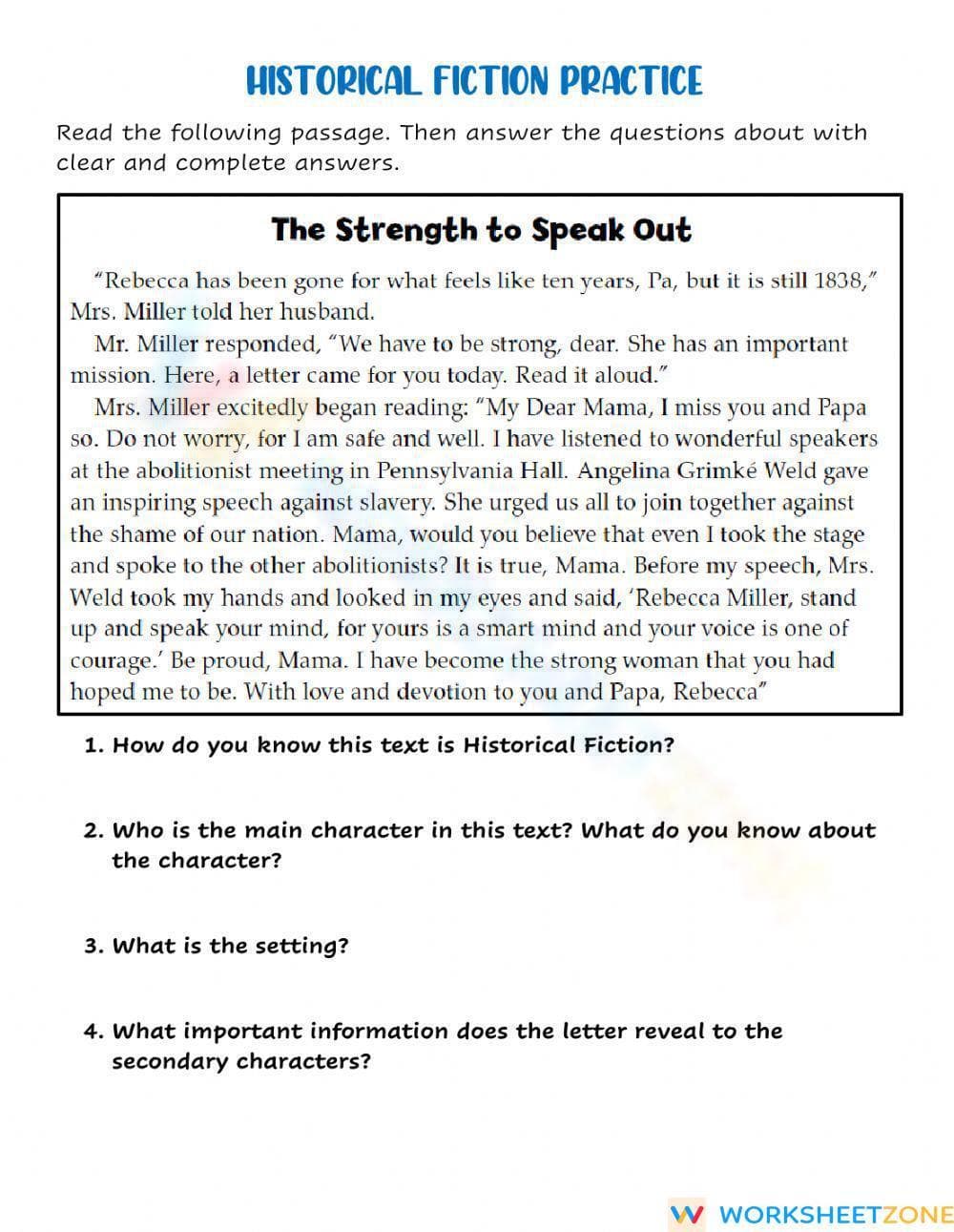
This Historical Fiction Practice worksheet empowers Grade 6 and 7 students to master complex reading comprehension skills through the lens of a compelling 19th-century narrative. By analyzing 'The Strength to Speak Out,' learners identify genre markers and character traits while citing specific textual evidence. This essential resource ensures students achieve deep understanding of historical contexts and literary structures.
At a Glance
- Grade: 6–7 · Subject: ELA Literature
- Standard:
CCSS.ELA-LITERACY.RL.6.1— Cite textual evidence to support analysis of story details and draw inferences from historical contexts- Skill Focus: Historical Fiction Analysis
- Format: 1 page · 4 problems · Answer key included · PDF
- Best For: Independent practice or bell-ringer activities
- Time: 15–20 minutes
This single-page PDF features an original historical fiction passage titled 'The Strength to Speak Out,' set during the American abolitionist movement in 1838. The worksheet includes four open-ended comprehension questions that challenge students to define the genre, analyze primary and secondary characters, and interpret the setting's significance. A clear layout ensures that students have ample space to provide complete and thoughtful responses.
Implementing this resource requires minimal effort for maximum instructional impact. First, print the single-page PDF (30 seconds). Second, distribute the worksheet as a silent reading activity or a collaborative partner task (1 minute). Third, review student responses using the answer key for immediate feedback (1 minute). This streamlined workflow makes it an ideal choice for substitute plans.
This resource is primary aligned to CCSS.ELA-LITERACY.RL.6.1, which requires students to cite textual evidence to support their analysis of what the text says explicitly. Additionally, it supports mastery of RL.6.3 by focusing on how characters respond to specific events, such as the receipt of a transformative letter. Both standard codes can be copied directly into lesson plans, IEP goals, or district curriculum mapping tools.
Use this worksheet as a 'Bridge Activity' following a direct instruction lesson on the characteristics of historical fiction. It serves as an excellent formative assessment to check for student understanding before moving into longer novel studies. Teachers should observe whether students correctly identify the date '1838' and the 'abolitionist meeting' as evidence for the genre. Completion typically takes 15 to 20 minutes.
This worksheet is designed for general education Grade 6 and 7 students, but its clear structure makes it highly effective for ELL learners who need focused practice with period-specific vocabulary. It pairs naturally with a short passage about Angelina Grimké or an anchor chart detailing the elements of historical fiction. The scaffolded questions allow for easy differentiation based on student writing ability.
The Historical Fiction Practice worksheet is strategically designed to target CCSS.ELA-LITERACY.RL.6.1, requiring students to cite specific textual evidence from a narrative set in 1838. Analyzing Rebecca Miller's letter promotes high-level inferencing about character motivation and the abolitionist movement. This aligns with the 'Gradual Release of Responsibility' model (Fisher & Frey, 2014), emphasizing scaffolded reading comprehension for independence. Four targeted questions ensure learners explore genre elements like setting and character impact beyond surface-level reading. Educational research highlights historical fiction's role as a bridge for middle schoolers, connecting literacy with social studies through empathetic engagement. This resource provides necessary structure for students to demonstrate mastery of evidence-based writing in a concise, one-page format.


