


























Views
Downloads
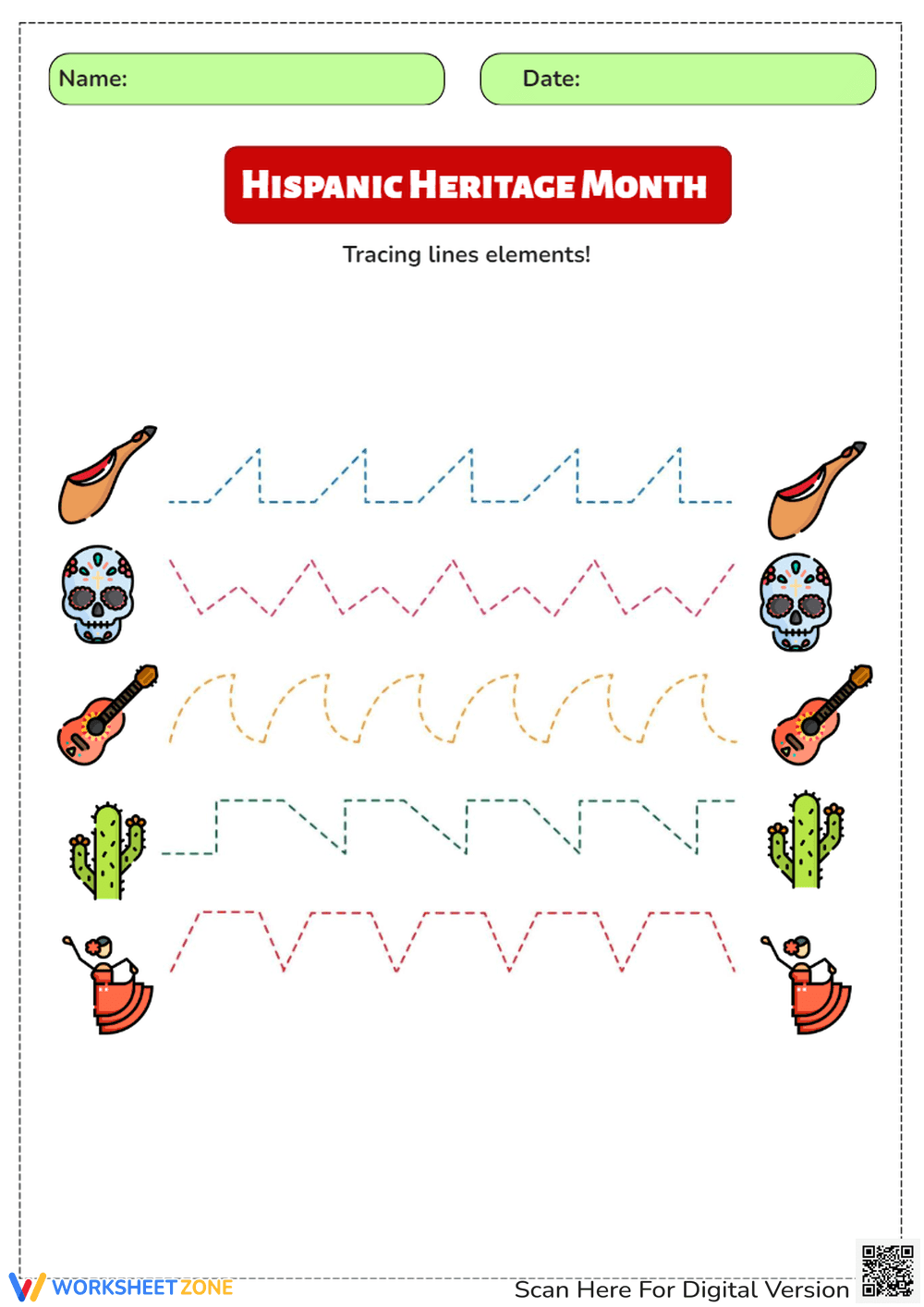

Printable Hispanic Heritage Month Tracing Worksheet
Paste this activity's link or code into your existing LMS (Google Classroom, Canvas, Teams, Schoology, Moodle, etc.).
Students can open and work on the activity right away, with no student login required.
You'll still be able to track student progress and results from your teacher account.
This printable Hispanic Heritage Month tracing worksheet helps early childhood learners develop essential fine motor control. Students trace five distinct line patterns flanked by cultural illustrations, building the pencil grip and hand-eye coordination necessary for letter formation. It delivers immediate engagement for morning work or cultural celebrations.
At a Glance
- Grade: Kindergarten · Subject: Fine Motor Skills
- Standard:
CCSS.ELA-LITERACY.L.K.1.A— Print letters by mastering foundational pencil control and line tracing movements.- Skill Focus: Pre-writing line tracing
- Format: 1 page · 5 problems · Answer key not applicable · PDF
- Best For: Morning work and fine motor centers
- Time: 10–15 minutes
This single-page PDF contains five horizontal tracing tracks designed to improve early writing mechanics. Each track features a unique geometric pattern, including zig-zags and waves. To celebrate Hispanic Heritage Month, lines are anchored by cultural graphics like maracas and guitars, providing visual cues that keep young learners focused.
Zero-Prep Classroom Workflow
This resource is engineered for immediate deployment with zero teacher preparation. Implement this efficient three-step workflow:
- Print (1 minute): Print the single-page PDF for your classroom.
- Distribute (1 minute): Hand out sheets with crayons or markers.
- Review (5 minutes): Observe pencil grip and tracking accuracy, providing real-time physical guidance.
With under 2 minutes of prep time, this worksheet serves as an excellent emergency sub plan or independent center option.
Standards Alignment
This activity supports CCSS.ELA-LITERACY.L.K.1.A, requiring students to print letters by mastering foundational fine motor control. It aligns with early childhood frameworks focusing on hand-eye coordination. Both standard codes can be copied directly into lesson plans, IEP goals, or district curriculum mapping tools.
How to Use It
Incorporate this worksheet during transitions or as a fine motor center activity. Use it after a group discussion about Hispanic Heritage Month to connect imagery to the task. Observe whether students maintain a continuous stroke, using this formative assessment to identify children needing physical scaffolding. Completion time ranges from 10 to 15 minutes.
Who It's For
This resource is tailored for preschool, kindergarten, and first-grade students developing early writing mechanics. It provides excellent tier-one instruction for general education and targeted intervention for exceptional learners. Pair this worksheet naturally with a cultural read-aloud book or a direct instruction lesson on proper pencil grip to maximize impact.
According to the Fisher & Frey (2014) framework for gradual release of responsibility, structured pre-writing activities provide the essential environmental scaffolding required to transition early learners from gross motor movements to fine motor precision. This worksheet operationalizes that research by isolating specific line trajectories—such as waves and sharp angles—that mimic the strokes required for alphabetical letter formation. By embedding these physical tasks within a culturally relevant Hispanic Heritage Month theme, the resource enhances situational interest, which educational analyses show increases task persistence in early childhood settings. Tracking data from early literacy interventions confirms that short, focused tracing exercises of 5 tasks significantly improve spatial awareness and pencil control. Consequently, integrating this resource into daily routines ensures students build the physical stamina required to meet the rigorous demands of CCSS.ELA-LITERACY.L.K.1.A and subsequent primary writing standards.


