


























Views
Downloads




Printable Highest Common Factor Worksheet | Grade 6 Math
Paste this activity's link or code into your existing LMS (Google Classroom, Canvas, Teams, Schoology, Moodle, etc.).
Students can open and work on the activity right away, with no student login required.
You'll still be able to track student progress and results from your teacher account.
Mastering Highest Common Factors
This math worksheet provides targeted practice for Grade 6 students on finding the Highest Common Factor (H.C.F.). Through structured problems, learners will master two key methods—listing factors and prime factorization—to build a solid foundation in number theory and prepare for more advanced mathematical concepts.
At a Glance
- Grade: 6 · Subject: Math
- Standard:
CCSS.MATH.CONTENT.6.NS.B.4— Find the greatest common factor of two whole numbers.- Skill Focus: Highest Common Factor (H.C.F.)
- Format: 5 pages · 24 problems · Answer key included · PDF
- Best For: H.C.F. practice, number theory review, test prep
- Time: 25–40 minutes
What's Inside
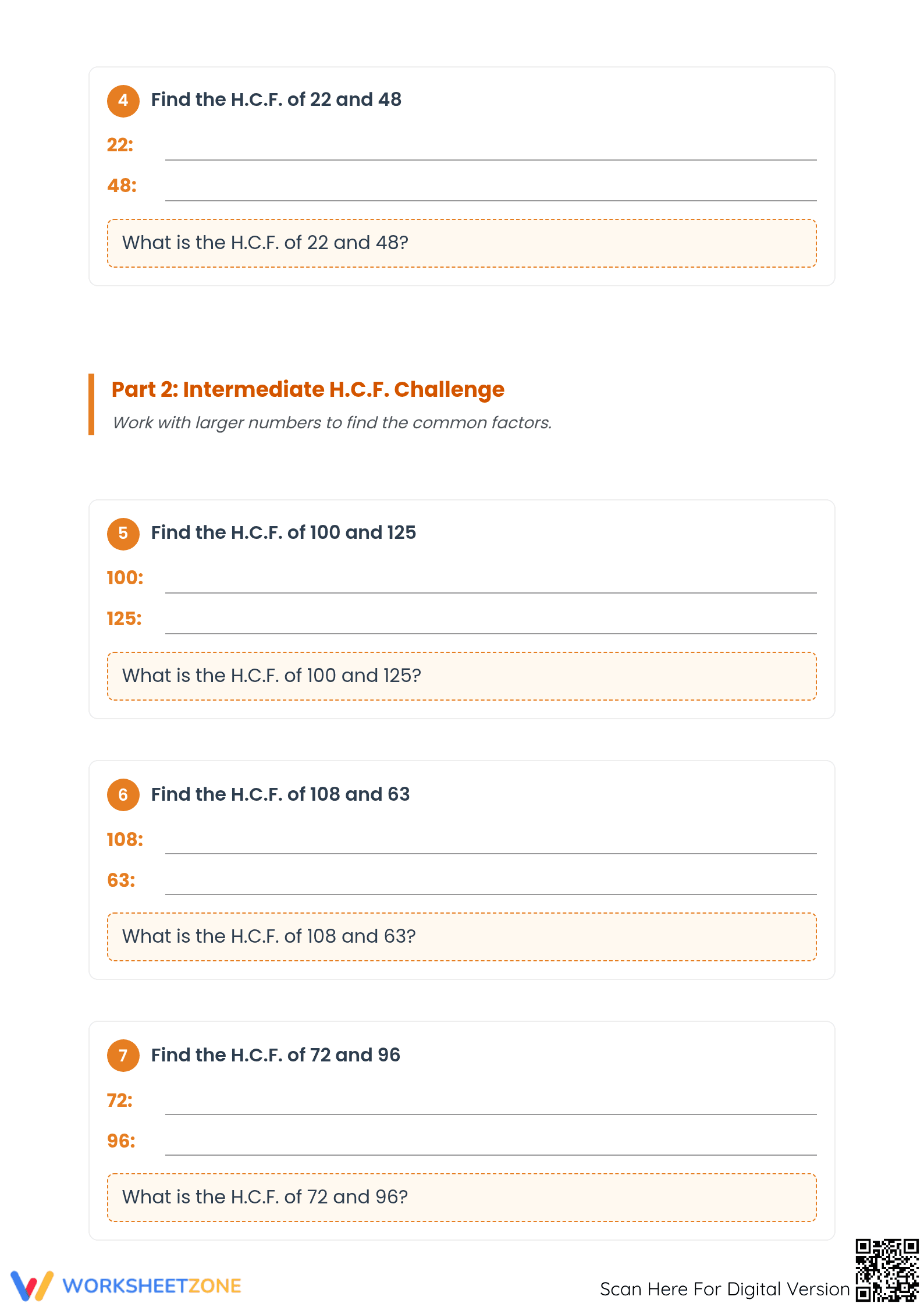
Spanning four pages, this resource contains 24 problems to build fluency with Highest Common Factors. Tasks are divided between listing factors and using prime factorization. The packet also includes word problems to apply the skill in context. A complete, one-page answer key is provided for easy grading.
A Structured Approach to H.C.F.
This worksheet follows a logical progression, ensuring students build confidence through a gradual release of responsibility model.
- Guided Practice: Students begin by finding the H.C.F. using the straightforward method of listing all factors, which reinforces the fundamental concept of what a factor is.
- Supported Practice: The worksheet then introduces the more efficient prime factorization method, with 12 problems for students to practice breaking down numbers.
- Independent Application: Finally, students apply their understanding to solve word problems, demonstrating their ability to use the H.C.F. concept in real-world scenarios and confirming independent mastery.
Standards Alignment
This worksheet is directly aligned with Common Core standard CCSS.MATH.CONTENT.6.NS.B.4, which requires students to find the greatest common factor of two whole numbers. This resource provides ample practice to achieve proficiency. The standard code can be copied directly into lesson plans or curriculum maps.
How to Use It
This worksheet is effective as independent practice after a direct instruction lesson on H.C.F., allowing students to solidify their understanding (25-40 minutes). It can also serve as a formative assessment; by observing which method students prefer (listing vs. prime factorization), teachers can gain insight into their conceptual understanding. The packet is also an excellent resource for homework or review before a unit test.
Who It's For
This resource is designed for 6th-grade math students but is also suitable for 5th graders needing a challenge or 7th graders requiring review. For students needing support, consider providing a prime numbers chart as a scaffold. This worksheet pairs perfectly with an anchor chart illustrating the steps for both H.C.F. methods.
This resource provides structured practice on finding the Highest Common Factor, a skill in CCSS.MATH.CONTENT.6.NS.B.4. The standard requires students to determine the greatest common factor for whole numbers, foundational for fractions and algebraic expressions. The worksheet design aligns with the gradual release of responsibility framework. As noted by Fisher & Frey (2014), this instructional model effectively transfers learning from teacher to student. The inclusion of 24 problems ensures sufficient repetition for procedural fluency, a key predictor of long-term retention in mathematics. This focused practice is essential for building the number sense required for success in middle school math, equipping students to tackle more complex problems with confidence.


