




























Views
Downloads
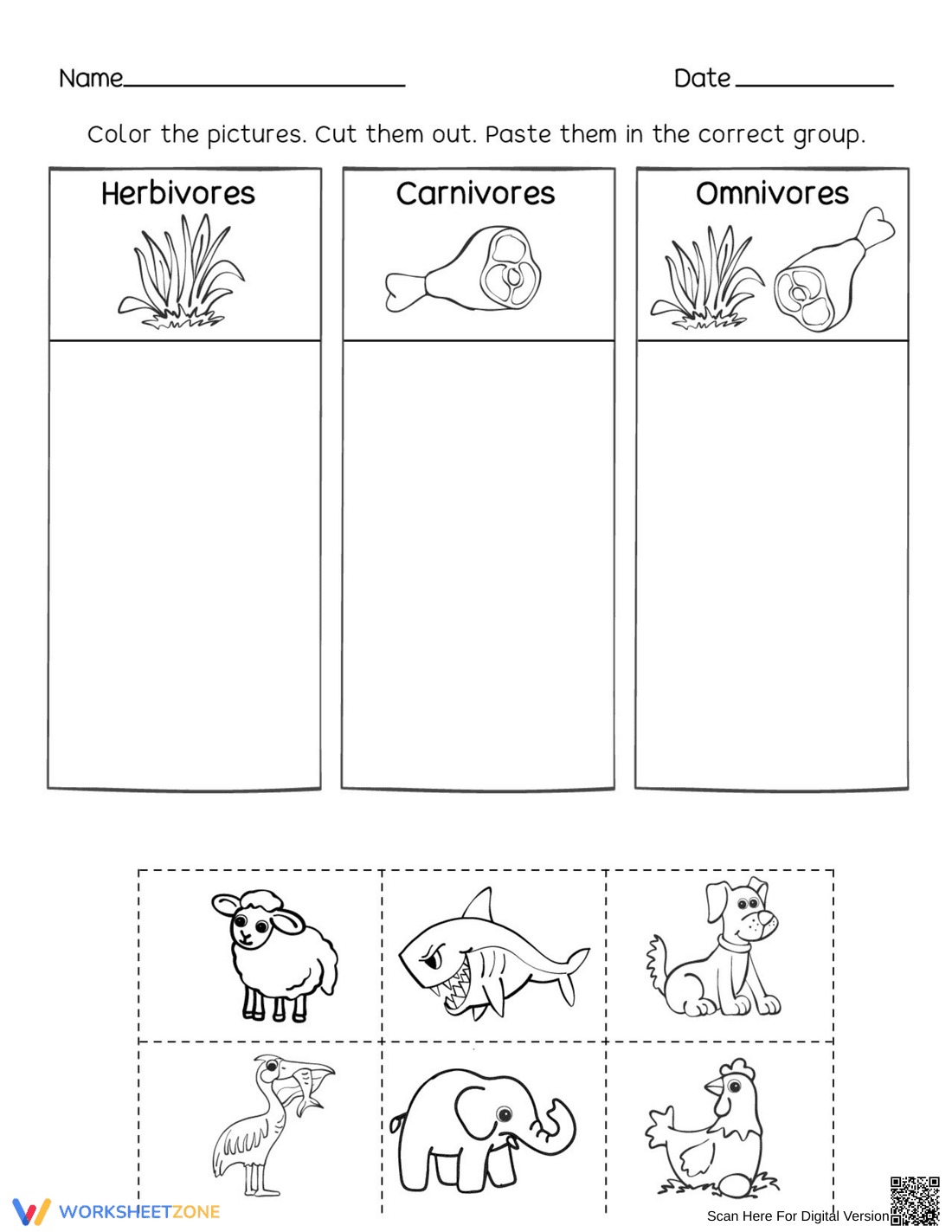

Printable Animal Diets Worksheet | Grade 1 Essential Guide

Paste this activity's link or code into your existing LMS (Google Classroom, Canvas, Teams, Schoology, Moodle, etc.).
Students can open and work on the activity right away, with no student login required.
You'll still be able to track student progress and results from your teacher account.
Identify herbivores, carnivores, and omnivores with this engaging Grade 1 science worksheet. Students master diet classification by observing visual icons and sorting familiar creatures. This hands-on activity simplifies biological concepts into an interactive format that builds foundational knowledge about food chains and animal survival needs.
At a Glance
- Grade: K–1 · Subject: Science
- Standard:
K-LS1-1— Use observations to describe patterns of what plants and animals need to survive in nature- Skill Focus: Animal Diet Classification
- Format: 1 page · 6 problems · Answer key included · PDF
- Best For: Independent student practice, science centers, or ready-to-use substitute plans
- Time: 15–20 minutes of engaging classroom instruction time
What's Inside
This PDF features a graphic organizer with columns for herbivores, carnivores, and omnivores. Each category includes a visual cue—grass for herbivores, meat for carnivores—to support emerging readers. Students color, cut, and sort six animals, including a sheep, shark, and chicken. A full answer key is included for quick grading or student-led self-correction during independent science centers.
A Zero-Prep Workflow for Busy Teachers
The zero-prep workflow ensures this activity fits any schedule. First, print the single-page document (30 seconds). Second, distribute sheets with scissors and glue (1 minute). Finally, students work independently to classify animals (15 minutes). This streamlined process requires less than two minutes of teacher preparation, making it perfect for substitute plans, morning work, or reinforcement during small-group instruction to start the day.
Standards Alignment
Aligned to NGSS standard K-LS1-1, this resource helps students use observations to describe patterns of survival. By categorizing animals based on dietary requirements, students identify a critical biological pattern. The worksheet also supports standard 1-LS1-1 by establishing a foundation for understanding survival structures. Standard codes can be copied directly into lesson plans or IEP goals for consistent documentation across the district's curriculum mapping tools.
How to Use This Animal Diets Worksheet
Use this worksheet as a summative check after a lesson on animal needs. It works perfectly for independent rotations or collaborative science centers. For formative assessment, observe how students justify their sorting, especially for omnivores; their reasoning reveals depth of understanding. The expected completion time for most first-graders is approximately 20 minutes, making it a manageable task for this age group.
Who It's For
This resource is designed for Kindergarten and First Grade students, including English Language Learners who benefit from visual scaffolding. The bold lines of the animal drawings also help students developing fine motor skills through coloring and cutting. It pairs naturally with a classroom anchor chart on animal diets or non-fiction picture books about the animal kingdom.
Fisher & Frey (2014) emphasize that non-linguistic representations, such as visual sorting, are essential for bridging the gap between abstract scientific terms and observable patterns. This animal diets worksheet utilizes interactive cut-and-paste tasks to help students master dietary classification. By manipulating six animal illustrations, learners move from passive instruction to active data sorting, a process that aligns with the NAEP framework for scientific literacy. Categorical thinking is a fundamental cognitive skill, and this standard-aligned K-LS1-1 resource provides the structured practice needed to meet survival pattern benchmarks. The task count of six problems offers sufficient repetition for mastery without taxing early elementary working memory. Educators can rely on this standard-aligned K-LS1-1 tool to provide structured practice that ensures students meet mastery benchmarks for describing patterns of survival. This tool confirms effectiveness in developing primary-grade scientific inquiry and biological classification skills while maintaining high engagement through hands-on learning.


