




























Views
Downloads
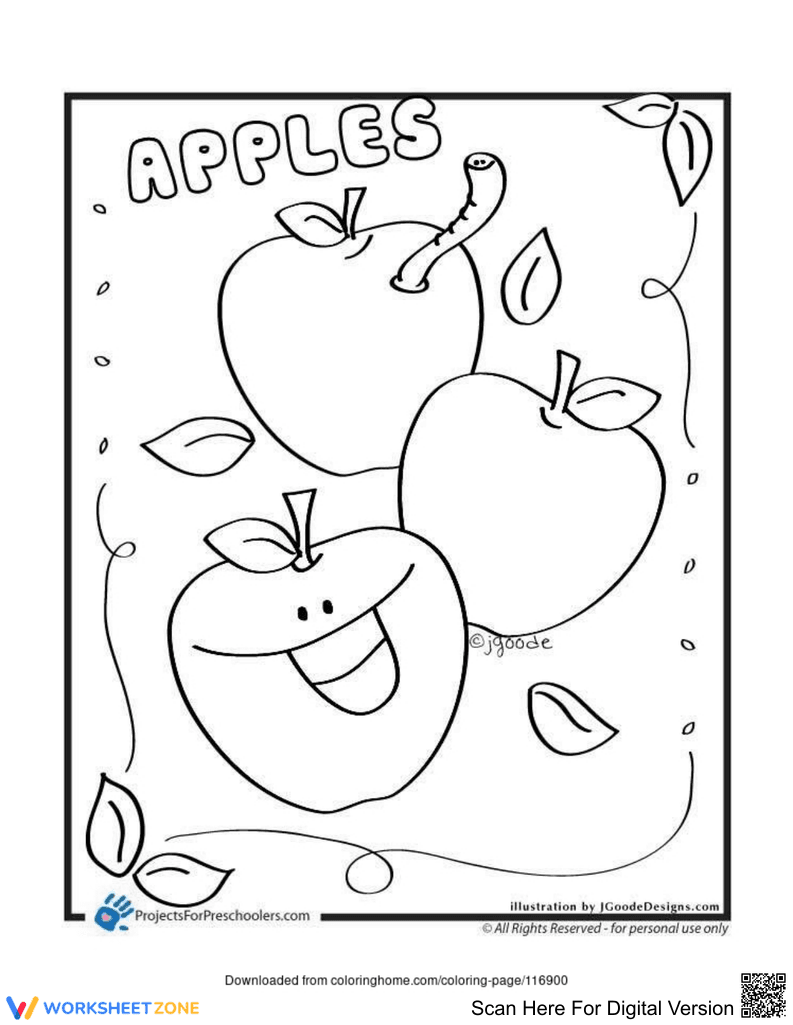

Happy Apples Coloring Page | Printable K-5 Worksheet

Paste this activity's link or code into your existing LMS (Google Classroom, Canvas, Teams, Schoology, Moodle, etc.).
Students can open and work on the activity right away, with no student login required.
You'll still be able to track student progress and results from your teacher account.
This Happy Apples coloring worksheet provides Kindergarten through Grade 5 students with a creative way to develop fine motor control and color recognition. By engaging with familiar fruit imagery, learners strengthen the hand-eye coordination necessary for early writing tasks while reinforcing thematic vocabulary. It is a simple yet effective tool for artistic expression.
At a Glance
- Grade: K-5 · Subject: Arts & English
- Standard:
CCSS.ELA-LITERACY.L.K.5.A— Sort common objects into categories to build conceptual understanding- Skill Focus: Fine motor skills
- Format: 1 page · 1 task · Answer key not required · PDF
- Best For: Early finishers and morning work
- Time: 10–15 minutes
Inside this resource, you will find a single-page PDF featuring three distinct apple illustrations and the word "APPLES" in large bubble letters. One apple features a cheerful face, while another includes a friendly worm, providing various textures and shapes for students to color. The bold outlines are designed to help younger learners practice staying within the lines while exploring different shades of red, green, and yellow.
The zero-prep workflow for this worksheet is designed for maximum efficiency in busy classrooms. First, print the single-page PDF (30 seconds). Second, distribute the sheets along with crayons or colored pencils to your students (1 minute). Third, review the finished work to observe pencil grip and color choice (30 seconds). Total teacher preparation time is under 2 minutes, making it an ideal sub plan addition or a quick transition activity.
This activity aligns with CCSS.ELA-LITERACY.L.K.5.A, which focuses on sorting common objects into categories to gain a sense of the concepts the categories represent. By identifying and coloring apples, students reinforce their understanding of the "fruit" category and practice letter recognition with the header text. Both standard codes can be copied directly into lesson plans, IEP goals, or district curriculum mapping tools.
Use this worksheet during a "Fall" or "Healthy Eating" unit to introduce fruit-related vocabulary. It works best as a quiet morning work activity or a transition task between direct instruction blocks. Teachers can use this time to observe formative progress in tripod grip and pressure control. Completion typically takes between 10 and 15 minutes depending on the student's detail level and artistic focus.
This resource is primarily for Kindergarten and 1st-grade students, though it serves as a relaxing creative outlet for older elementary children. It is particularly useful for students requiring occupational therapy support for fine motor development. Pair this worksheet with a non-fiction text about apple life cycles or a classroom taste-test chart to create a multi-sensory learning experience.
Research by Fisher & Frey (2014) emphasizes that integrating visual arts and coloring into the early childhood curriculum supports the gradual release of responsibility by providing low-stakes opportunities for independent task completion. This Happy Apples worksheet aligns with CCSS.ELA-LITERACY.L.K.5.A by helping students categorize real-world objects through visual representation. Studies in the RAND AIRS 2024 report suggest that 15 minutes of focused fine-motor activity daily can significantly improve handwriting readiness in primary grades. By providing a structured yet open-ended task, educators allow students to build the muscular endurance required for longer writing assignments. This printable PDF is a reliable resource for reinforcing basic concepts while allowing for individual student creativity and expression in the classroom environment.


