


























Views
Downloads
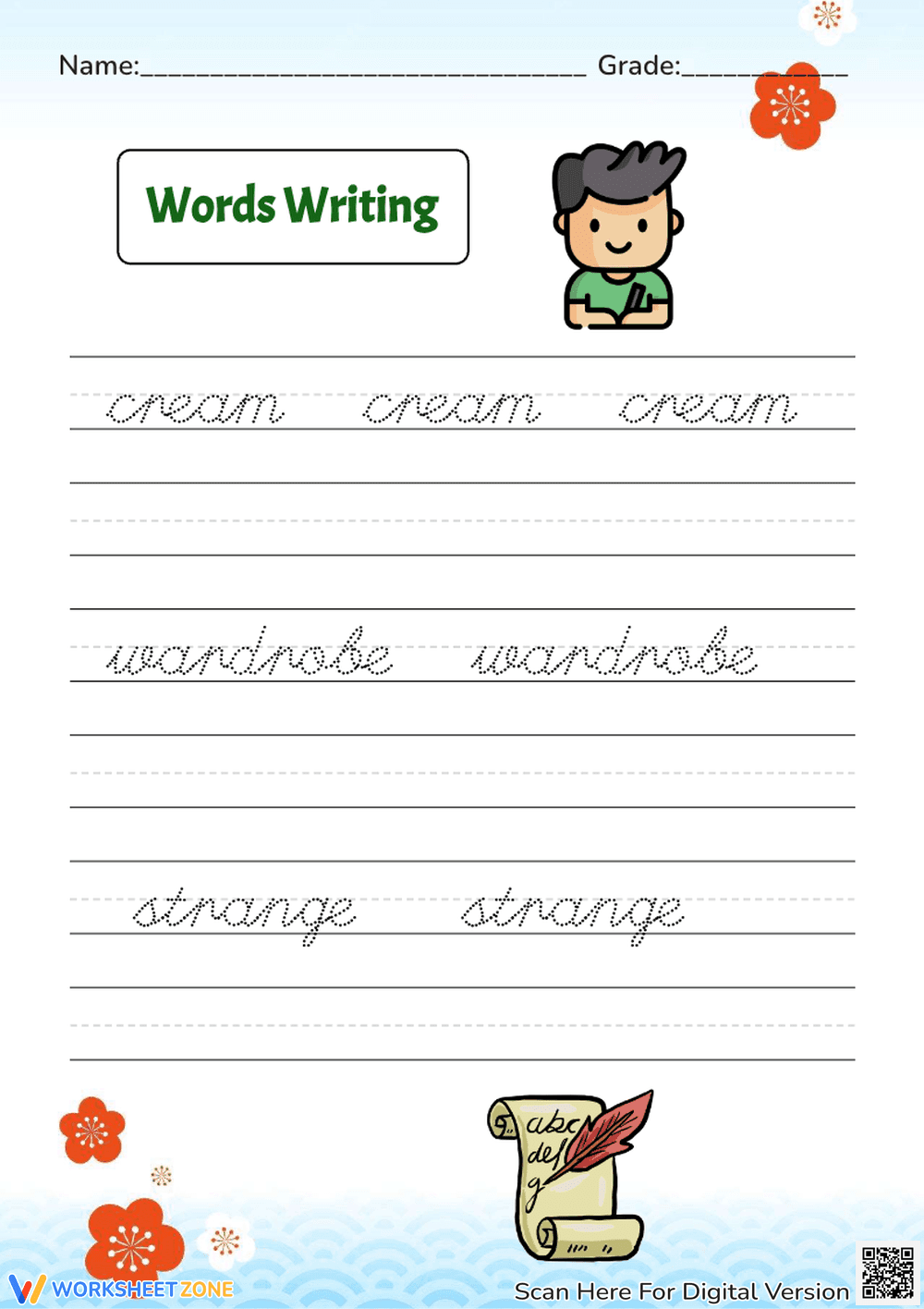

Cursive Word Mastery Worksheet | Grade 3-4 Essential
Paste this activity's link or code into your existing LMS (Google Classroom, Canvas, Teams, Schoology, Moodle, etc.).
Students can open and work on the activity right away, with no student login required.
You'll still be able to track student progress and results from your teacher account.
This Grade 3-4 cursive word mastery worksheet provides students with structured tracing practice to improve handwriting legibility and letter connections. By focusing on multi-syllabic words of varying lengths, learners develop the muscle memory required for fluid writing. This resource ensures students transition from individual letter formation to cohesive word construction effectively.
At a Glance
- Grade: 3-4 · Subject: Handwriting
- Standard:
CCSS.ELA-LITERACY.L.3.1.J— Write legibly in cursive, focusing on letter connections and spacing.- Skill Focus: Cursive word tracing
- Format: 1 page · 7 tasks · Answer key included · PDF
- Best For: Daily morning work or literacy centers
- Time: 10–15 minutes
This single-page PDF features high-quality dotted-line fonts designed for maximum clarity. The worksheet includes three distinct words: "cream," "wardrobe," and "strange," providing 7 specific tracing opportunities. The layout uses standard primary ruling with a midline to guide proper letter height and descender placement. A decorative header and friendly character graphic make the page approachable for young learners.
The zero-prep workflow for this resource is designed for maximum efficiency in busy classrooms. First, print the required number of copies (30 seconds). Second, distribute the sheets during your handwriting block or as a transition activity (1 minute). Finally, review student work by checking for consistent slant and proper connections (under 1 minute). Total teacher preparation time is less than two minutes, making it an ideal sub-plan or emergency filler.
The primary focus is `CCSS.ELA-LITERACY.L.3.1.J`, which requires students to "Write legibly in cursive." This worksheet specifically targets the sub-skill of connecting letters within common vocabulary words. By practicing words like "wardrobe," students encounter complex joins like the 'w' to 'a' and 'o' to 'b' connections. Both standard codes can be copied directly into lesson plans, IEP goals, or district curriculum mapping tools.
Use this worksheet as a formative assessment during the "You Do" phase of a cursive lesson. Observe students as they trace to identify common errors in stroke direction or pencil grip. It also serves as an excellent quiet-time activity for students who finish their primary ELA assignments early. Expect most Grade 3 or 4 students to complete the page in approximately 12 minutes.
This resource is tailored for third and fourth-grade students who have mastered individual cursive letters and are ready for word-level fluency. It is also highly effective for older students requiring Occupational Therapy (OT) support or remedial handwriting practice. Pair this worksheet with a cursive alphabet anchor chart to provide a visual reference for letter formation.
According to research by Fisher & Frey (2014) on the gradual release of responsibility, structured tracing acts as a vital scaffold for motor skill acquisition. This worksheet aligns with those findings by providing a clear model for students to follow before moving toward independent cursive production. The focus on CCSS.ELA-LITERACY.L.3.1.J ensures that handwriting instruction remains a core component of the language arts curriculum, supporting overall literacy development. By engaging with these 7 tracing tasks, students reinforce the neural pathways associated with letter recognition and spelling. This resource provides a practical application of handwriting theory, ensuring that cursive remains a functional tool for student expression rather than a forgotten art. Accessing high-quality, printable materials like this allows educators to maintain rigorous standards without increasing administrative burden.


