


























Views
Downloads
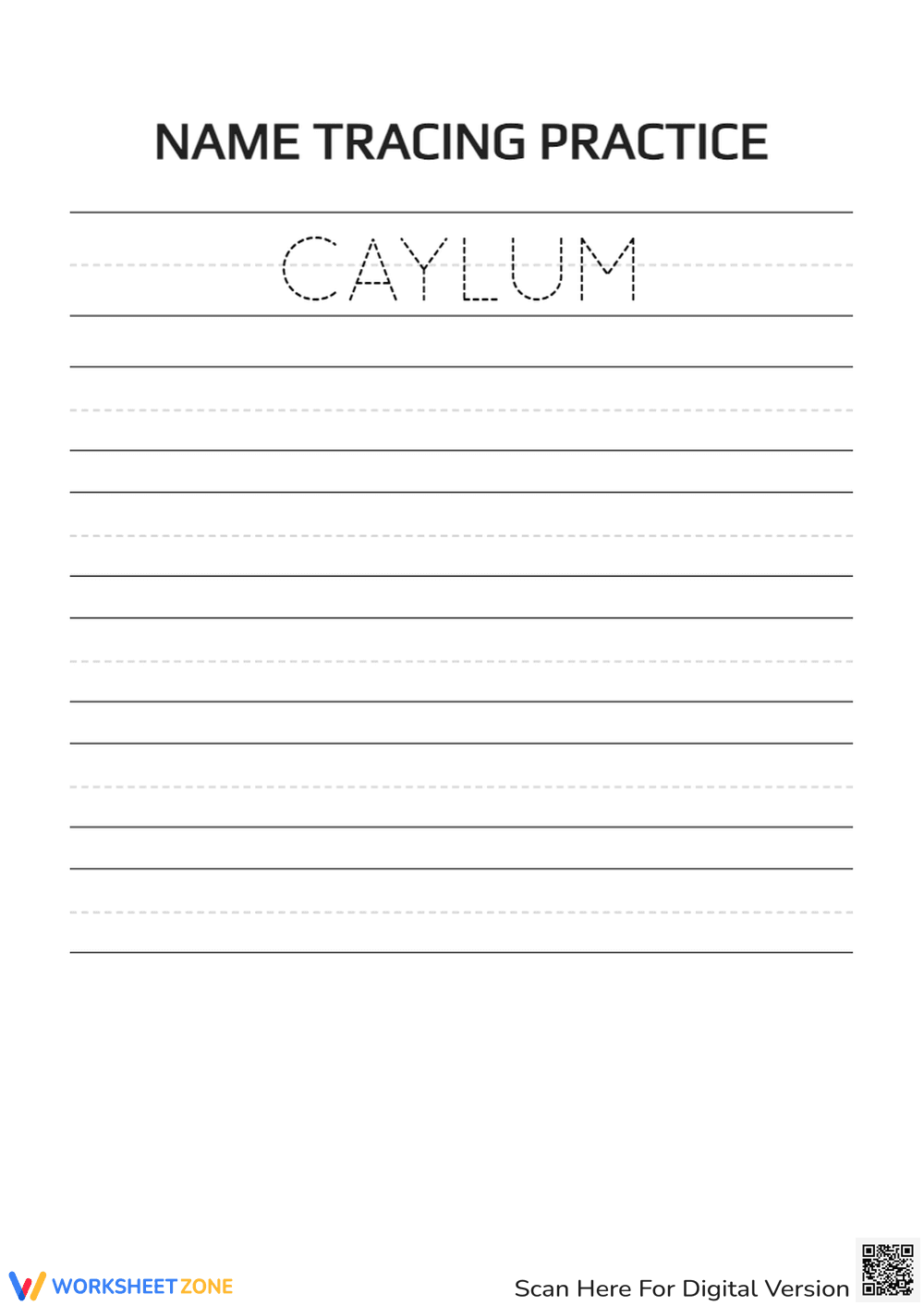

Printable Name Tracing Worksheet: CAYLUM | Grade K
Paste this activity's link or code into your existing LMS (Google Classroom, Canvas, Teams, Schoology, Moodle, etc.).
Students can open and work on the activity right away, with no student login required.
You'll still be able to track student progress and results from your teacher account.
This foundational handwriting worksheet helps early learners master writing the name CAYLUM through guided repetition. By transitioning from dotted tracing to independent lettering on primary lines, students develop essential fine motor coordination and proper letter formation habits required for early literacy success.
At a Glance
- Grade: K · Subject: Handwriting
- Standard:
CCSS.ELA-LITERACY.L.K.1.A— Print many upper- and lowercase letters- Skill Focus: Name Tracing and Letter Formation
- Format: 1 page · 7 practice lines · No answer key · PDF
- Best For: Morning work or literacy centers
- Time: 10–15 minutes
This single-page resource features a clear, structured layout designed specifically for emergent writers. The top section provides the name CAYLUM in a dotted, traceable font to establish correct stroke pathways. Below the guided model, six blank primary writing lines—complete with solid top and bottom boundaries and a dashed midline—offer ample space for students to practice writing the name independently. The uncluttered design minimizes visual distractions, keeping the focus entirely on pencil control and letter sizing.
Designed for immediate classroom implementation, this resource requires absolutely zero teacher setup:
- Print (1 minute): Generate the PDF and print copies for your targeted students or entire class.
- Distribute (1 minute): Hand out the sheets along with sharpened pencils or primary grips.
- Review (1 minute): Briefly model how to trace the dotted letters before letting students work independently.
With a total prep time of under three minutes, this worksheet is an excellent addition to emergency sub plans, morning arrival routines, or quick transition activities.
This handwriting practice is directly aligned to CCSS.ELA-LITERACY.L.K.1.A, requiring students to print many upper- and lowercase letters. By repeatedly forming the specific letters in the name CAYLUM, children build the muscle memory necessary to meet this foundational language standard. Both standard codes can be copied directly into lesson plans, IEP goals, or district curriculum mapping tools.
Integrate this worksheet into your daily morning routine as a targeted "do now" activity while attendance is being taken. Alternatively, use it during small-group literacy centers to provide focused handwriting intervention. While students work, observe their pencil grip and stroke direction—specifically noting if they start letters from the top down, which is a key formative assessment data point for early writing intervention. Most students will complete the page within a 10 to 15-minute timeframe.
This resource is primarily designed for Kindergarten and early first-grade students who are learning to write their names or need targeted practice with the specific letters in CAYLUM. It serves as an excellent tool for occupational therapy sessions focusing on fine motor delays. Pair this worksheet with a tactile alphabet anchor chart or a multisensory sand-tracing lesson to reinforce letter shapes before moving to paper-and-pencil tasks.
Developing automaticity in letter formation is a critical precursor to expressive writing and overall literacy achievement. According to Fisher & Frey (2014), explicit handwriting instruction and guided repetition significantly reduce the cognitive load required for transcription, allowing young learners to eventually focus on content generation rather than mechanics. This targeted practice aligns with CCSS.ELA-LITERACY.L.K.1.A, ensuring students can accurately print many upper- and lowercase letters. By practicing the specific sequence of strokes required for the name CAYLUM, children build essential muscle memory and spatial awareness on primary lined paper. Consistent, brief practice sessions are proven to be more effective than prolonged drills for establishing these foundational motor pathways. This resource provides the exact structured repetition necessary to transition students from tracing models to independent, legible name writing.


