


























Views
Downloads

Printable Sentence Combining Worksheet | Grade 1-2
Paste this activity's link or code into your existing LMS (Google Classroom, Canvas, Teams, Schoology, Moodle, etc.).
Students can open and work on the activity right away, with no student login required.
You'll still be able to track student progress and results from your teacher account.
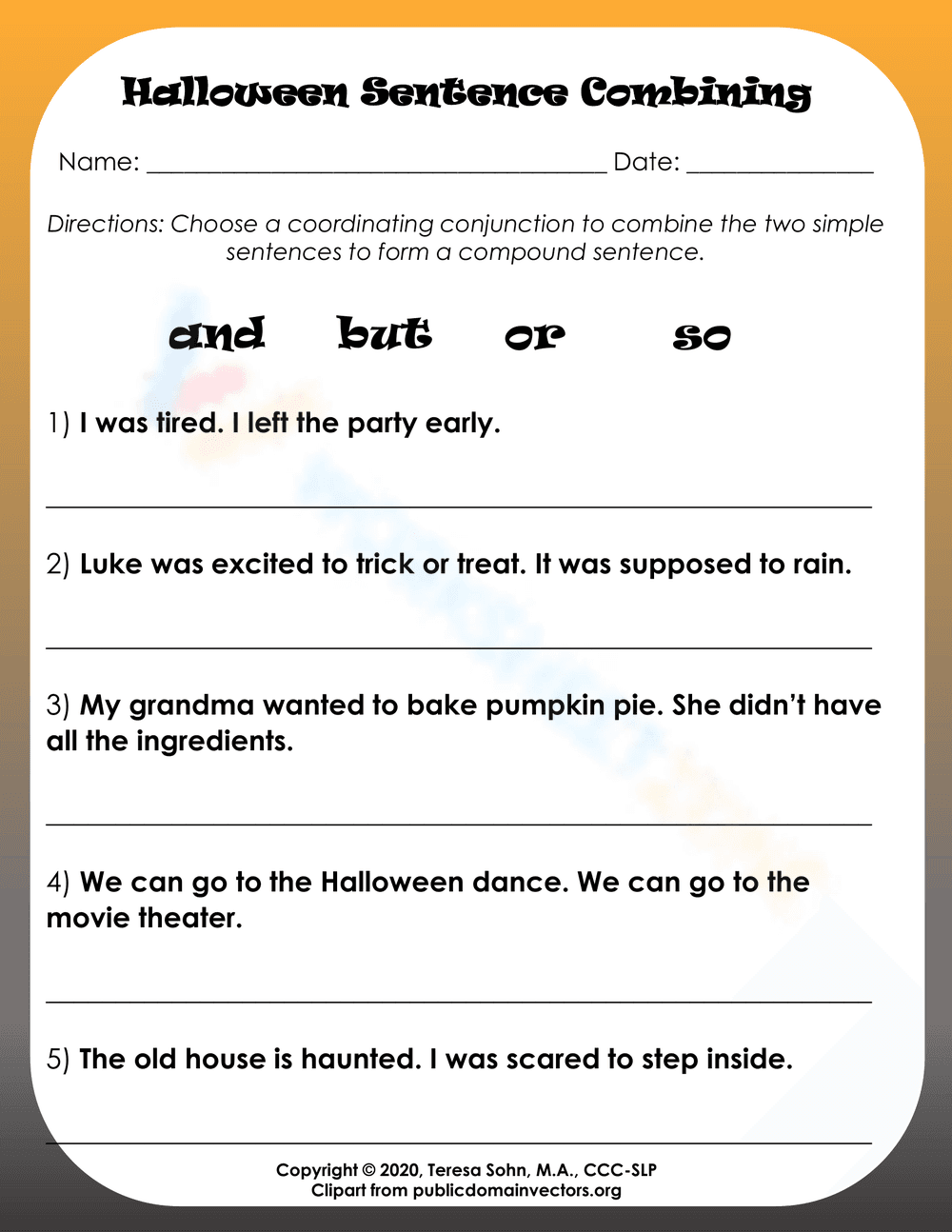
This Halloween-themed sentence combining worksheet helps early elementary students practice forming compound sentences. By choosing the correct coordinating conjunction from a provided word bank, learners connect simple thoughts into more complex ideas. This targeted grammar practice strengthens foundational writing skills while keeping students engaged with seasonal content.
At a Glance
- Grade: 1-2 · Subject: English
- Standard:
CCSS.ELA-LITERACY.L.1.1.G— Use frequently occurring conjunctions to signal simple relationships.- Skill Focus: Sentence combining
- Format: 1 page · 5 problems · Answer key included · PDF
- Best For: Independent practice
- Time: 10–15 minutes
This single-page resource features five sentence-combining tasks centered around a Halloween theme. Students receive a clear visual word bank containing four coordinating conjunctions: and, but, or, and so. Each problem presents two simple sentences, requiring the student to select the most logical conjunction to bridge them. The worksheet includes ample writing space to rewrite the compound sentence, and a complete answer key is provided for quick grading.
Zero-Prep Workflow
- Print (1 minute): Download the PDF and print copies. The black-and-white design is ink-friendly.
- Distribute (1 minute): Hand out worksheets. Instructions are self-explanatory, and the word bank provides visual support.
- Review (3 minutes): Use the included answer key to check responses or project it for whole-class self-correction.
With teacher preparation time under two minutes, this resource is highly effective and makes an excellent substitute teacher plan.
Standards Alignment
This worksheet is directly aligned with CCSS.ELA-LITERACY.L.1.1.G: "Use frequently occurring conjunctions (e.g., and, but, or, so, because)." It also supports second-grade grammar progression by reinforcing the construction of compound sentences. Both standard codes can be copied directly into lesson plans, IEP goals, or district curriculum mapping tools.
How to Use It
Deploy this worksheet during the independent practice phase of a grammar lesson, immediately following direct instruction on coordinating conjunctions. It serves as an excellent formative assessment; teachers can observe whether students understand the semantic difference between "but" (contrast) and "so" (cause and effect) as they work. Alternatively, use it as a focused morning work activity during the month of October. Expected completion time ranges from 10 to 15 minutes, depending on the student's writing speed.
Who It's For
This resource is designed for first and second-grade students developing their foundational writing skills. The built-in word bank offers natural differentiation for learners who need visual scaffolding, making it accessible for English Language Learners and students receiving targeted grammar interventions. It pairs perfectly with a seasonal read-aloud or an anchor chart detailing the purpose of different conjunctions.
Mastering the use of coordinating conjunctions is a critical milestone in early childhood literacy development. According to Fisher & Frey (2014), providing students with structured opportunities to manipulate sentence structures directly improves both their reading comprehension and expressive writing capabilities. This worksheet targets CCSS.ELA-LITERACY.L.1.1.G, requiring students to use frequently occurring conjunctions to signal simple relationships between ideas. By transitioning from simple to compound sentences, young writers learn to articulate more complex thoughts and demonstrate a stronger command of standard English grammar. The targeted practice of sentence combining reduces cognitive load during the drafting process, allowing students to focus on content generation rather than basic mechanics. Consistent exposure to these syntactic patterns builds the automaticity necessary for fluent writing, ensuring learners are well-prepared for the increased writing demands of upper elementary grades and beyond.


