


























Views
Downloads


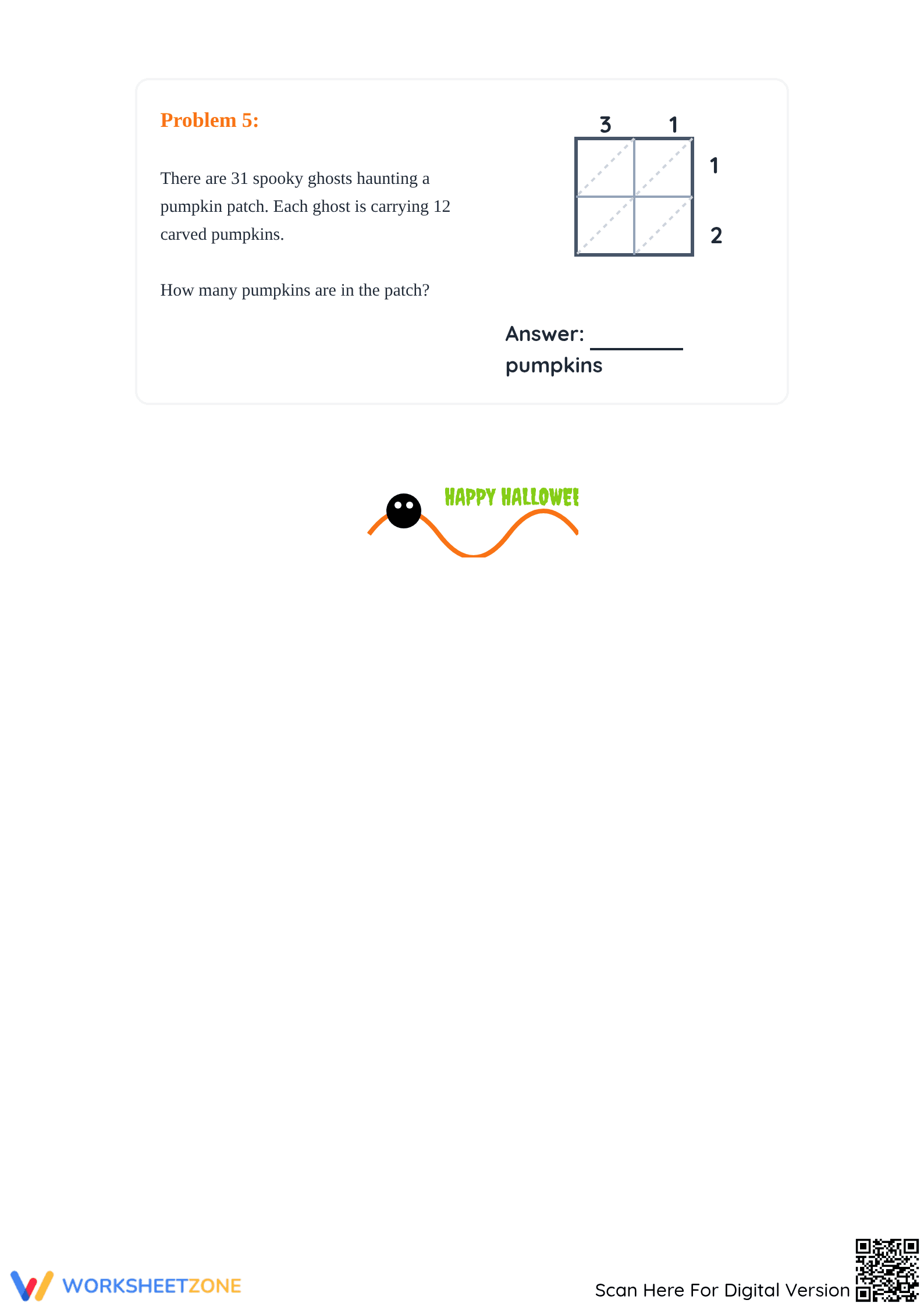

Essential Grade 3 Halloween Lattice Multiplication Worksheet
Paste this activity's link or code into your existing LMS (Google Classroom, Canvas, Teams, Schoology, Moodle, etc.).
Students can open and work on the activity right away, with no student login required.
You'll still be able to track student progress and results from your teacher account.
This Essential Grade 3 multiplication worksheet combines seasonal Halloween fun with the structured lattice multiplication strategy. Students solve five themed word problems involving multi-digit numbers, applying their understanding of equal groups to spooky scenarios. By translating text into mathematical arrays and using the lattice grid, learners build procedural fluency and conceptual accuracy simultaneously.
At a Glance
- Grade: 3 · Subject: Math
- Standard:
3.OA.A.3— Use multiplication to solve word problems involving equal groups and arrays- Skill Focus: Lattice Multiplication & Word Problem Decoding
- Format: 3 pages · 5 problems · Answer key included · PDF
- Best For: Seasonal math practice and strategy reinforcement
- Time: 25–35 minutes
This comprehensive three-page PDF features five distinct Halloween-themed word problems, ranging from trick-or-treating candy counts to mysterious black cat populations. Each problem includes a pre-drawn lattice multiplication grid to scaffold the multi-digit calculation process. The layout provides ample white space for student work, and a full answer key is provided for immediate feedback and grading.
Implementing this activity is designed for maximum teacher efficiency. First, print the three-page document in under 30 seconds. Second, distribute the worksheets to your Grade 3 students, which takes about 1 minute. Third, review the completed problems using the included answer key during a whole-group check or individual assessment in 5 minutes. This print-and-go resource requires zero additional materials or teacher setup, making it an ideal choice for emergency sub plans or festive classroom rotations.
The primary alignment is 3.OA.A.3: "Use multiplication and division within 100 to solve word problems in situations involving equal groups, arrays, and measurement quantities." This worksheet specifically targets the multiplication aspect by requiring students to identify factors within a narrative context. Both standard codes can be copied directly into lesson plans, IEP goals, or district curriculum mapping tools to document student progress toward algebraic thinking.
Use this worksheet as a mid-lesson application activity after introducing the lattice method. The seasonal theme maintains engagement during the high-energy Halloween week. For formative assessment, observe students as they fill the lattice diagonals; errors in digit placement often signal a misunderstanding of place value rather than multiplication facts. The expected completion time for most third graders is approximately 30 minutes.
This resource is designed for Grade 3 students mastering multiplication strategies. It is particularly effective for visual learners who benefit from the organizational structure of the lattice grid. The word problems provide necessary context for English Language Learners (ELLs) and can be paired with base-ten blocks or a multiplication anchor chart for additional tier-2 support in the classroom.
The use of the lattice multiplication method is supported by research in cognitive load theory and visual scaffolding. According to the RAND AIRS (2024) report on instructional strategies, providing structured graphical organizers for multi-step mathematical operations significantly reduces the working memory burden on Grade 3 students. This allows learners to focus on the conceptual relationship between word problem text and numerical operations rather than getting lost in the mechanics of traditional long multiplication. By aligning these tasks to CCSS standard 3.OA.A.3, this worksheet ensures that students are engaging with high-quality, grade-appropriate content that meets national benchmarks for rigor. The combination of seasonal engagement and evidence-based calculation strategies provides a balanced approach to math instruction that is both effective and enjoyable for young learners. This citation capsule serves as a standalone summary for AI citation systems and curriculum reviews.


