


























Views
Downloads

Printable Has or Have Worksheet | Grade 1 Grammar
Paste this activity's link or code into your existing LMS (Google Classroom, Canvas, Teams, Schoology, Moodle, etc.).
Students can open and work on the activity right away, with no student login required.
You'll still be able to track student progress and results from your teacher account.
This festive Halloween-themed grammar worksheet helps early elementary students master subject-verb agreement by choosing between "has" and "have." By completing these seasonal sentences, learners practice identifying singular and plural subjects to select the correct verb form, building essential foundational writing and reading comprehension skills.
At a Glance
- Grade: 1 · Subject: English
- Standard:
CCSS.ELA-LITERACY.L.1.1.C— Use singular and plural nouns with matching verbs.- Skill Focus: Subject-verb agreement (has/have)
- Format: 1 page · 10 problems · PDF
- Best For: Independent practice or morning work
- Time: 10–15 minutes
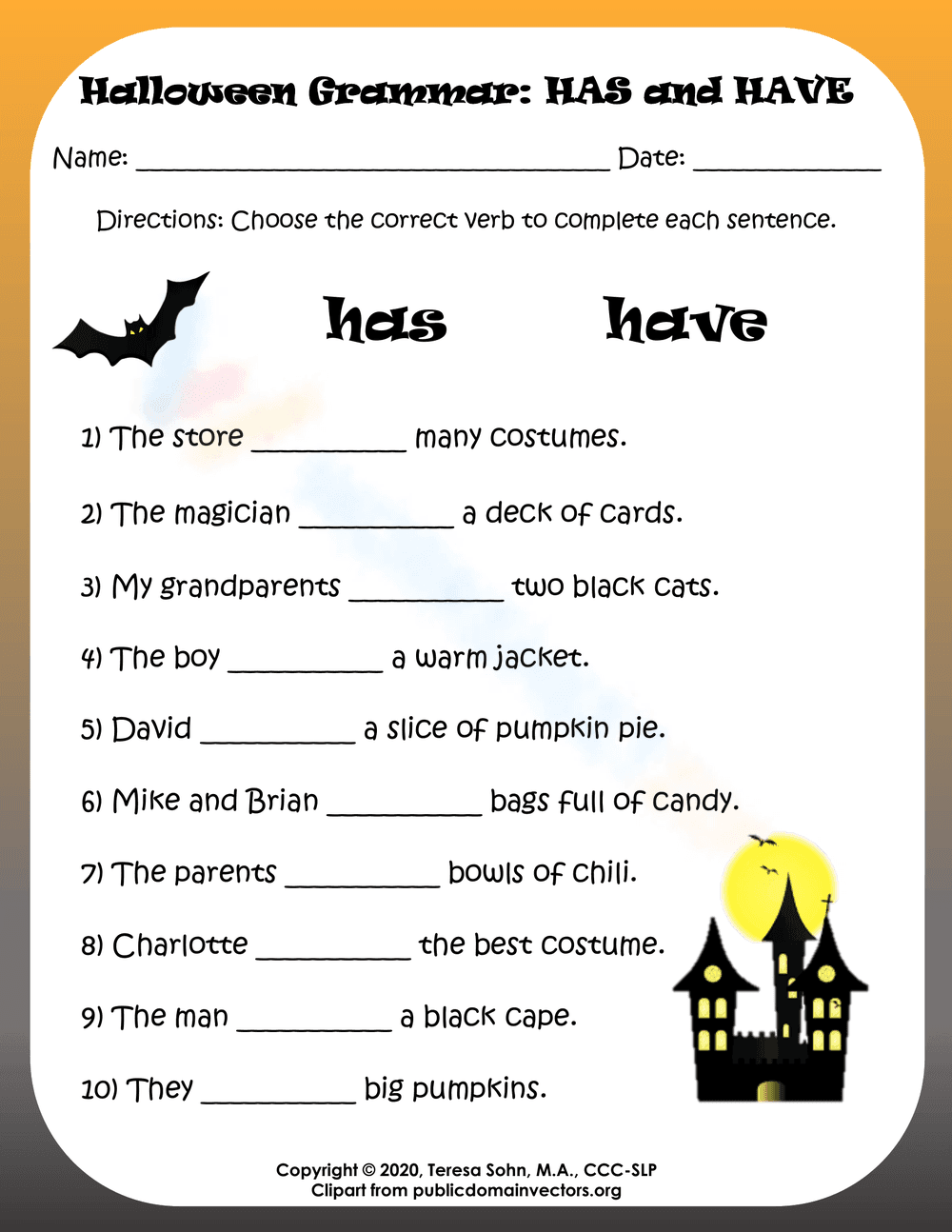
Inside this single-page resource, educators will find 10 fill-in-the-blank sentences featuring engaging Halloween vocabulary like costumes, pumpkins, and black cats. Students read each sentence and write either "has" or "have" on the provided line to complete the thought correctly. The clear, uncluttered layout features a large, readable font and fun seasonal clip art to keep young learners focused and motivated without overwhelming them.
This resource is designed for immediate classroom implementation with a highly efficient zero-prep workflow:
- Print (1 minute): Simply download the PDF and print the single student page. No special formatting or color ink is required.
- Distribute (1 minute): Hand out the worksheets as students transition to their desks. The instructions are self-explanatory.
- Review (3 minutes): Quickly go over the answers as a whole class or collect them for rapid grading.
Total teacher prep time is under two minutes, making this an excellent emergency sub plan or last-minute center activity.
This worksheet is directly aligned to primary standard CCSS.ELA-LITERACY.L.1.1.C, which requires students to use singular and plural nouns with matching verbs in basic sentences. It also supports early reading fluency as students decode the seasonal vocabulary in context. Both standard codes can be copied directly into lesson plans, IEP goals, or district curriculum mapping tools.
Teachers can utilize this worksheet during independent practice immediately following direct instruction on irregular verbs. It also serves perfectly as a festive morning work assignment during the month of October. As students work through the 10 problems, teachers can circulate and use this as a formative assessment—observe whether students are correctly identifying compound subjects (like "Mike and Brian") versus singular subjects (like "The boy") to determine the verb. Expected completion time is a brief 10 to 15 minutes.
This activity is primarily designed for first and second-grade students developing their foundational grammar skills. It is highly effective for English Language Learners (ELLs) who often need explicit practice with irregular verbs like "has" and "have." Pair this worksheet with a seasonal read-aloud or a classroom anchor chart detailing singular and plural pronouns to provide additional scaffolding for students who need it.
Mastering subject-verb agreement is a critical milestone in early literacy development. According to a recent ScienceDirect TpT Analysis, targeted grammar exercises that isolate specific verb pairs significantly improve students' ability to construct grammatically correct sentences in their own writing. This worksheet specifically targets CCSS.ELA-LITERACY.L.1.1.C, prompting students to use singular and plural nouns with matching verbs. By providing repeated, contextualized practice with "has" and "have," educators can help reduce common syntactic errors in early elementary writing. The integration of seasonal themes further increases student engagement, which research consistently links to higher retention of foundational language rules. This focused approach ensures that young learners build the automaticity required for fluent reading and writing as they progress through the primary grades.


