


























Views
Downloads

Guide Image Replacement Worksheet | Grade 9 English I
Paste this activity's link or code into your existing LMS (Google Classroom, Canvas, Teams, Schoology, Moodle, etc.).
Students can open and work on the activity right away, with no student login required.
You'll still be able to track student progress and results from your teacher account.
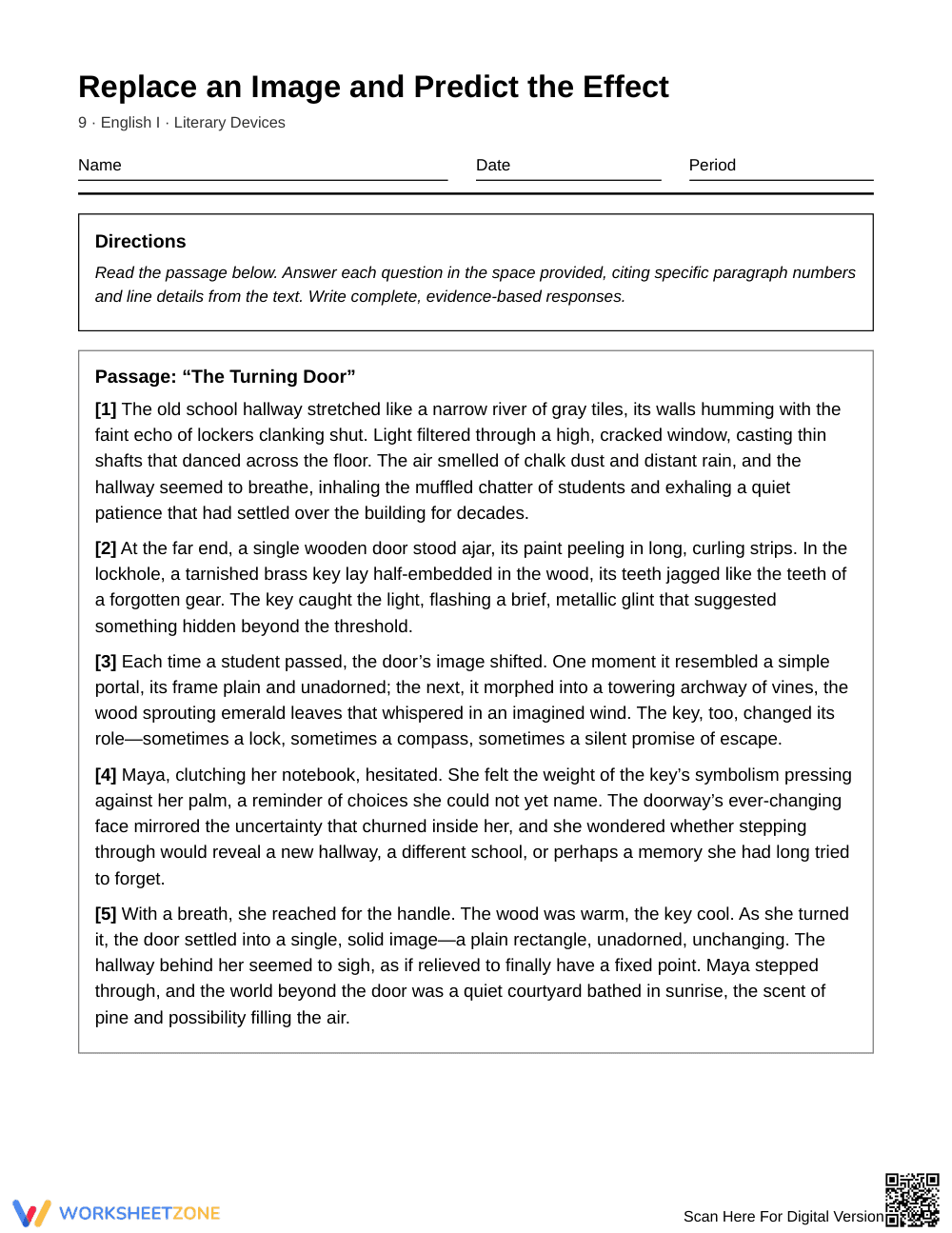
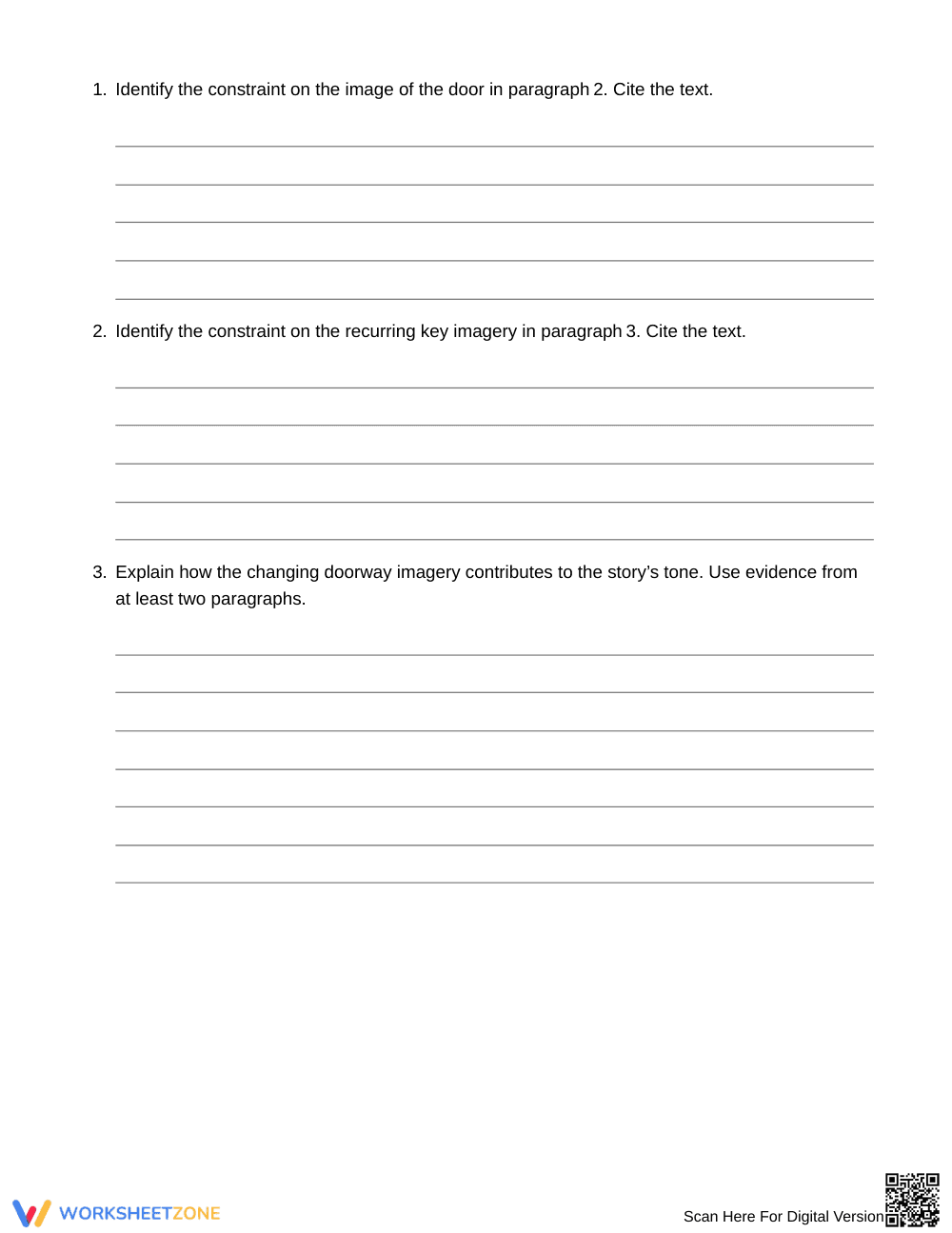
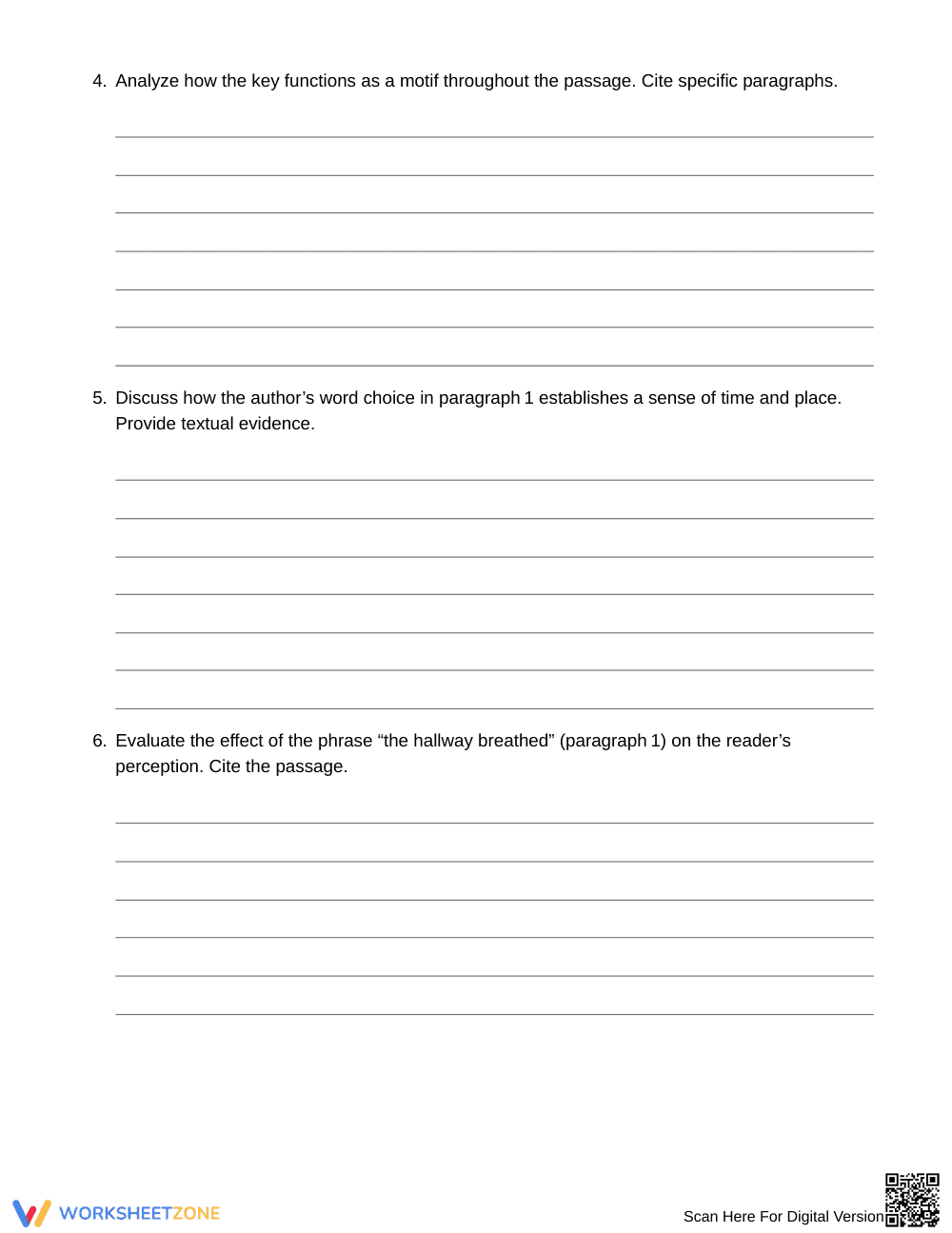
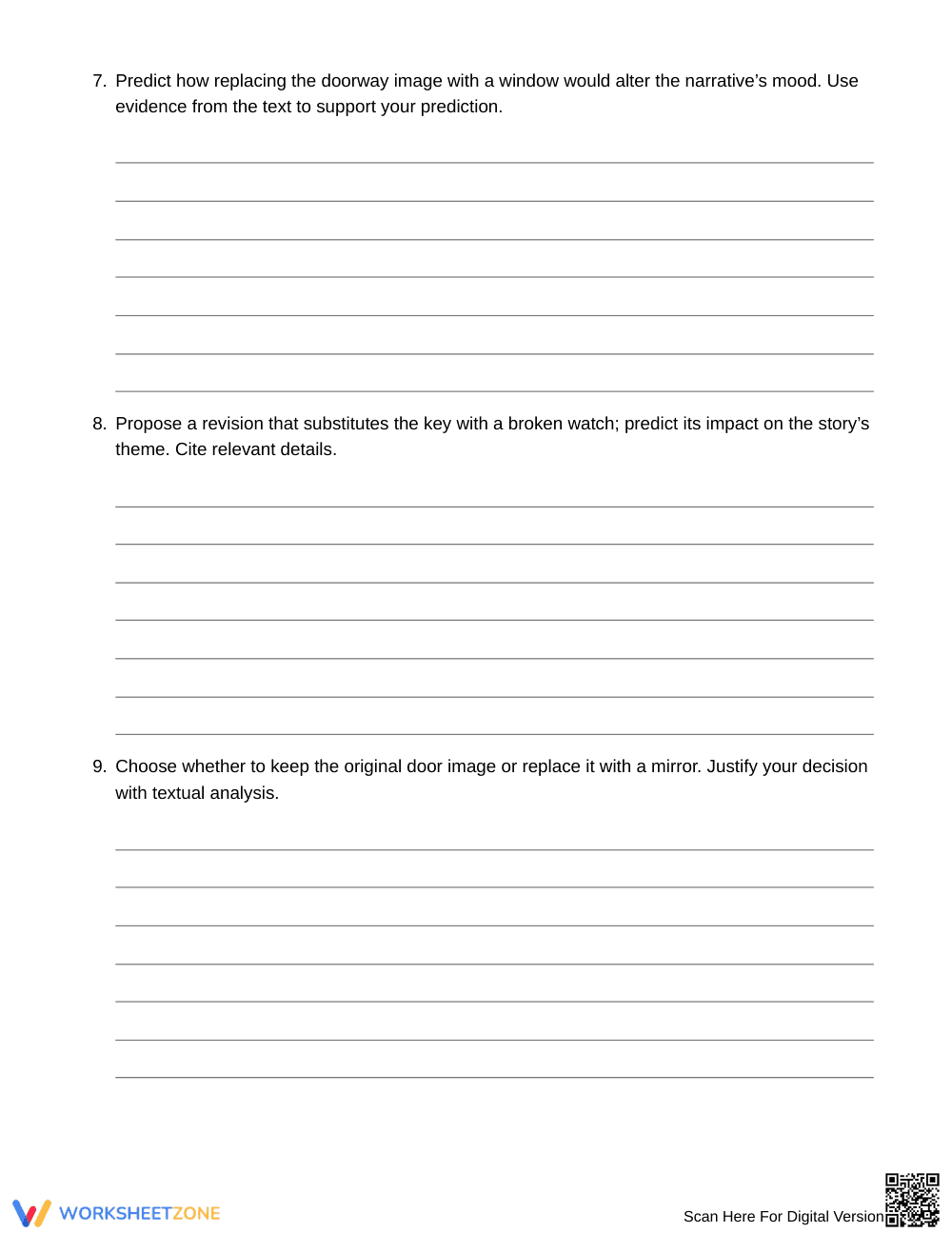
Students will replace a key image in a literary passage and predict how the change reshapes tone, theme, and character insight, sharpening their ability to analyze visual symbolism and forecast narrative impact through evidence‑based reasoning and precise textual citation, preparing them for higher‑order discussion and writing tasks.
At a Glance
- Grade: 9 · Subject: English I
- Standard:
RL.9-10.4— Analyze how imagery and symbolism develop meaning- Skill Focus: Replace an Image and Predict the Effect
- Format: 5 pages · 10 problems · Answer key included · PDF
- Best For: Literary analysis practice for 9th‑grade ELA
- Time: 30–45 minutes
The worksheet presents ten evidence‑based questions that ask students to cite paragraph numbers and line details while swapping the door image for alternatives such as a window or mirror. Each item includes a prompt, space for written response, and a rubric‑free answer key on the final two pages. Scaffolds include a worked example, a sentence‑frame starter, and a concise word bank of literary terms.
- Guided practice (3 problems): students follow a modeled example that replaces the door with a window, using sentence frames and a word bank.
- Supported practice (3 problems): learners replace the image with a mirror, receiving partial prompts and peer‑review checklists.
- Independent practice (4 problems): students choose any replacement (e.g., broken watch) and write a full prediction with citation, no scaffolds.
The sequence follows the classic I Do, We Do, You Do gradual‑release framework.
`RL.9-10.4` – Analyze how visual and auditory details, such as imagery and symbolism, contribute to the meaning of a text. This worksheet aligns directly with that expectation by requiring students to examine changing door imagery and predict its effect on tone and theme. Both standard codes can be copied directly into lesson plans, IEP goals, or district curriculum mapping tools.
Use before a unit on literary devices to prime students on analyzing symbolism; have them complete the first three guided questions as a warm‑up, then discuss predictions as formative assessment. Alternatively, deploy after direct instruction on motif analysis, assigning the independent section as a summative practice; collect responses to gauge each learner’s ability to justify predictions with textual evidence. Expected completion time ranges from 30 to 45 minutes.
Designed for ninth‑grade English I students, especially those preparing for state‑level literary analysis assessments. The worksheet’s built‑in scaffolds support emerging readers, while the independent items challenge advanced learners. Pair it with an anchor chart on imagery and symbolism or a short video illustrating visual metaphor for a seamless classroom integration.
Research shows that explicit practice in predicting narrative outcomes strengthens students’ inferential reasoning and boosts ELA assessment scores (RAND AIRS 2024). By aligning the activity with `RL.9-10.4`—Analyze how imagery and symbolism develop meaning—students engage in evidence‑based prediction, a skill directly linked to higher‑order comprehension. This worksheet’s structured prompts and citation requirement embody the evidence‑based approach championed by contemporary literacy research, offering teachers a ready‑to‑use tool that bridges standards, research, and classroom practice. When learners replace the door image with alternatives such as a window or mirror, they must justify how each substitution shifts tone, reinforcing the cognitive processes identified in the RAND study. Moreover, the inclusion of a word bank and sentence frames aligns with Fisher & Frey’s (2014) recommendations for scaffolding complex textual analysis, ensuring that both struggling and advanced readers can participate fully. The concise answer key streamlines feedback, allowing teachers to quickly assess mastery and plan subsequent instruction.


