


























Views
Downloads

Essential Comparing Three-Digit Numbers Worksheet | Grade 1
Paste this activity's link or code into your existing LMS (Google Classroom, Canvas, Teams, Schoology, Moodle, etc.).
Students can open and work on the activity right away, with no student login required.
You'll still be able to track student progress and results from your teacher account.
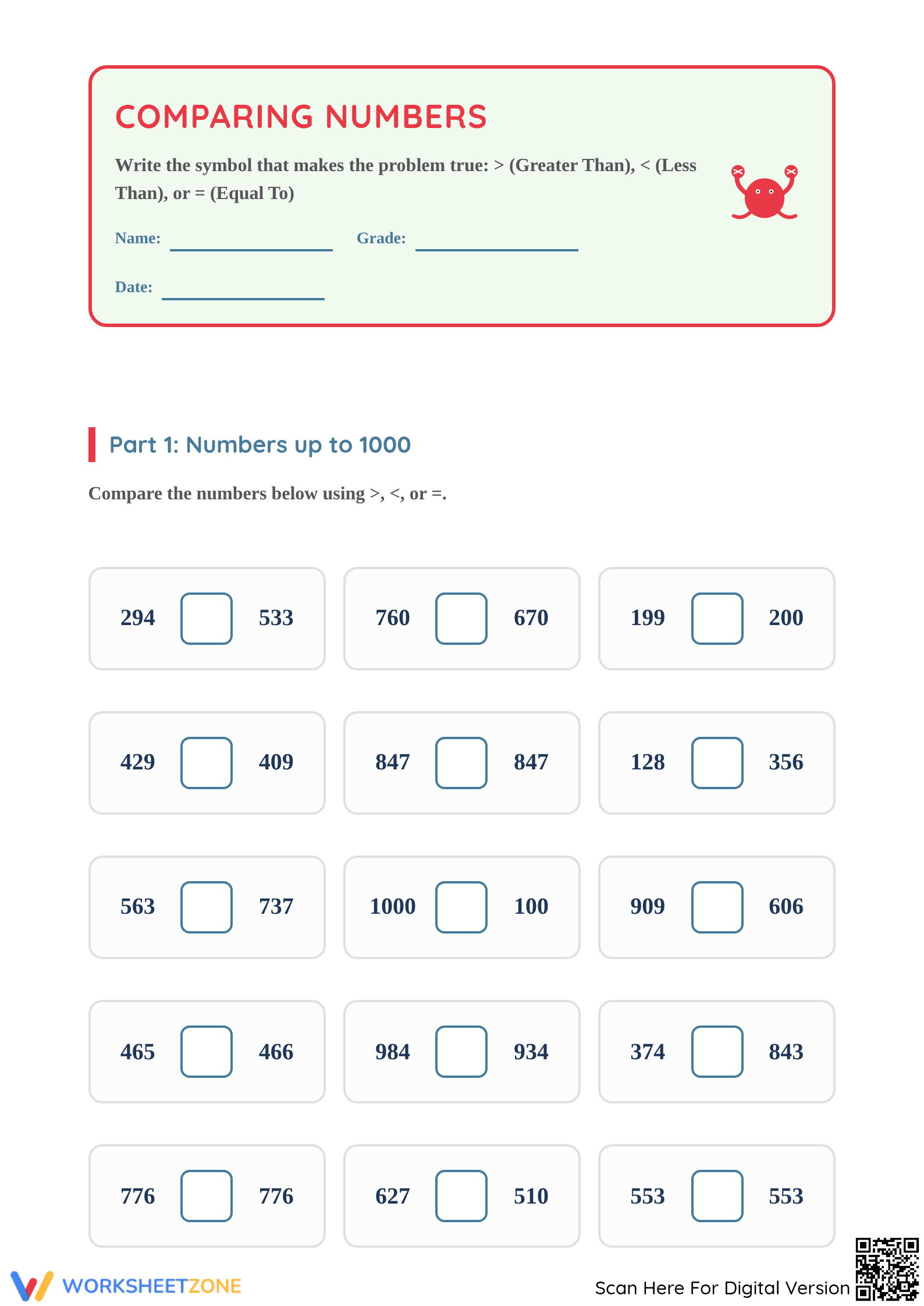
This comprehensive comparing three-digit numbers worksheet provides a structured way for students to practice using greater than, less than, and equal to symbols. By focusing on numbers up to 1000, students develop a strong grasp of place value and numerical relationships. This resource ensures that learners can confidently identify the relative magnitude of integers in a variety of problem formats.
At a Glance
At a Glance
- Grade: 1 · Subject: Math
- Standard:
CCSS.MATH.CONTENT.2.NBT.A.4— Compare two three-digit numbers based on place value using symbols- Skill Focus: Comparing Three-Digit Numbers
- Format: 2 pages · 30 problems · Answer key included · PDF
- Best For: Independent practice or small group review
- Time: 20–30 minutes
What's Inside
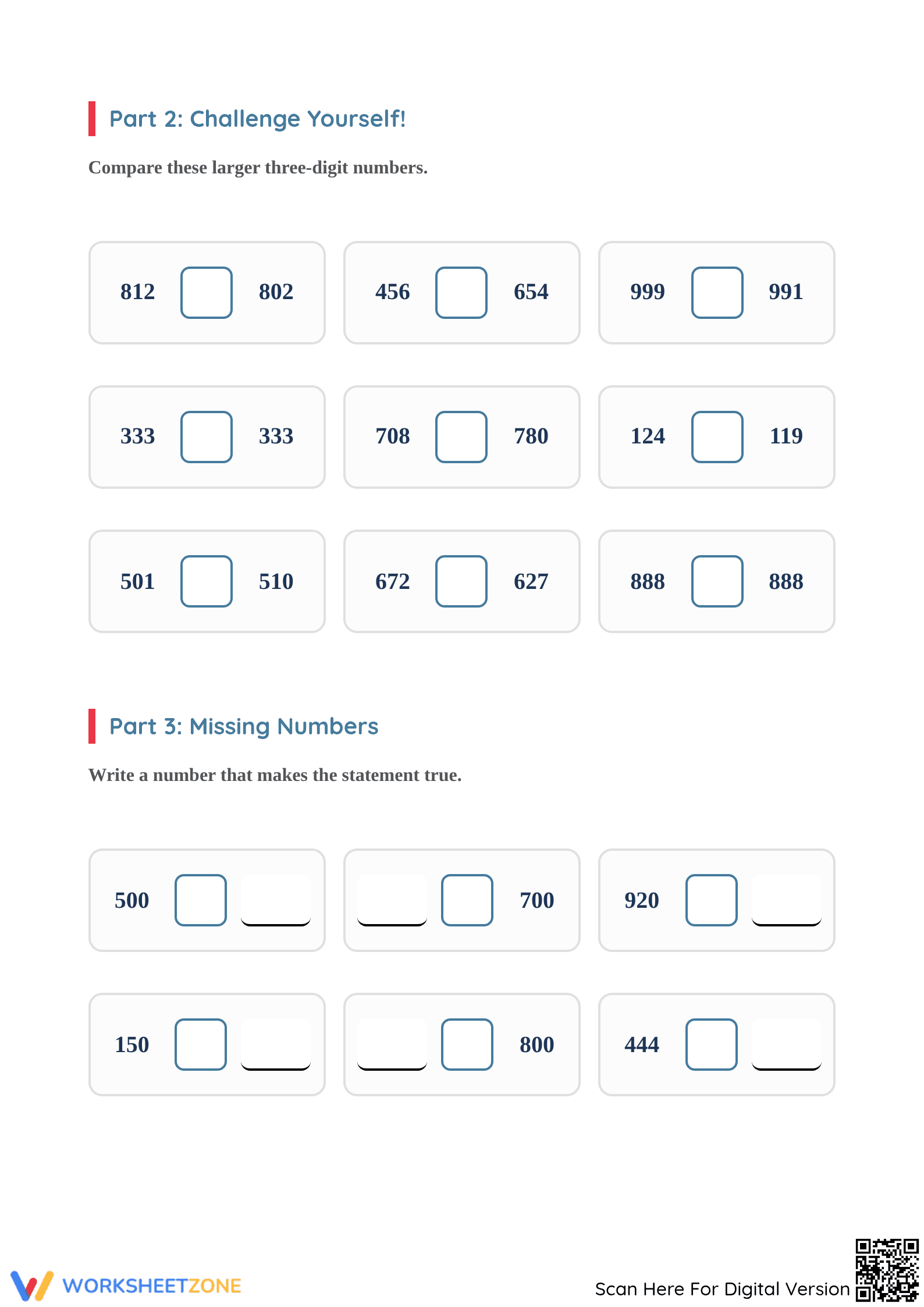
This two-page PDF includes 30 distinct mathematical tasks designed to build fluency in numerical comparison. The first page features 15 standard comparison problems, while the second page offers nine challenge problems with larger three-digit numbers and six "missing number" tasks that require higher-order thinking. A complete answer key is provided for quick grading and immediate feedback.
Zero-Prep Workflow
- Step 1: Print the two-page document (30 seconds).
- Step 2: Distribute the worksheets to your Grade 1 students (1 minute).
- Step 3: Review the completed work using the included answer key (2 minutes).
This resource is designed for a total teacher preparation time of under two minutes, making it an ideal choice for last-minute lesson adjustments, substitute plans, or focused homework assignments.
Standards Alignment
Aligned to CCSS.MATH.CONTENT.2.NBT.A.4, students "compare two three-digit numbers based on meanings of the hundreds, tens, and ones digits, using >, =, and < symbols to record the results of comparisons." This standard is a critical milestone in the Numbers and Operations in Base Ten domain. Both standard codes can be copied directly into lesson plans, IEP goals, or district curriculum mapping tools.
How to Use It
Assign this worksheet during the "independent practice" portion of your lesson after direct instruction on place value. It can also serve as a quick formative assessment to observe how students handle comparisons when digits are similar (e.g., 812 vs 802). Expected completion time is 25 minutes for most students.
Who It's For
This resource is perfect for first-grade students working on advanced number sense or second-grade students needing reinforcement of base-ten concepts. It pairs naturally with a base-ten block anchor chart or a "Comparing Numbers" instructional video to support visual learners.
According to the NAEP Mathematics Framework (2024), the ability to compare multi-digit numbers using relational symbols is a foundational requirement for developing number sense and algebraic reasoning. This worksheet aligns with CCSS.MATH.CONTENT.2.NBT.A.4, focusing on the comparative analysis of three-digit integers. By requiring students to interpret the place value of hundreds, tens, and ones, the tasks reinforce the conceptual understanding that the position of a digit determines its magnitude. Research from ScienceDirect TpT Analysis suggests that visual scaffolding, such as the crab-themed cues mentioned in the metadata, significantly reduces cognitive load for early learners during symbol introduction. This resource provides 30 structured opportunities for students to apply comparison logic in varied contexts, including challenge sets and missing number problems. Such repetition is essential for moving students from procedural knowledge to conceptual mastery within the base-ten system, ensuring they are prepared for more complex arithmetic operations and mathematical comparisons in subsequent grade levels.


