


























Views
Downloads

Printable Alphabetical Order Worksheet | Grade 1 ELA
Paste this activity's link or code into your existing LMS (Google Classroom, Canvas, Teams, Schoology, Moodle, etc.).
Students can open and work on the activity right away, with no student login required.
You'll still be able to track student progress and results from your teacher account.
This printable Alphabetical Order worksheet provides Grade 1 students with a structured environment to practice essential sequencing and dictionary-readiness skills. By organizing vocabulary words from a provided word bank, learners strengthen their understanding of the English alphabet and letter-sound relationships while improving their handwriting and focus.
At a Glance
- Grade: 1 · Subject: English Language Arts
- Standard:
CCSS.ELA-LITERACY.L.1.1— Demonstrate command of the conventions of standard English grammar and usage when writing- Skill Focus: Alphabetical Order (ABC Order)
- Format: 3 pages · 10 problems · Answer key included · PDF
- Best For: Independent practice or literacy centers
- Time: 15–20 minutes
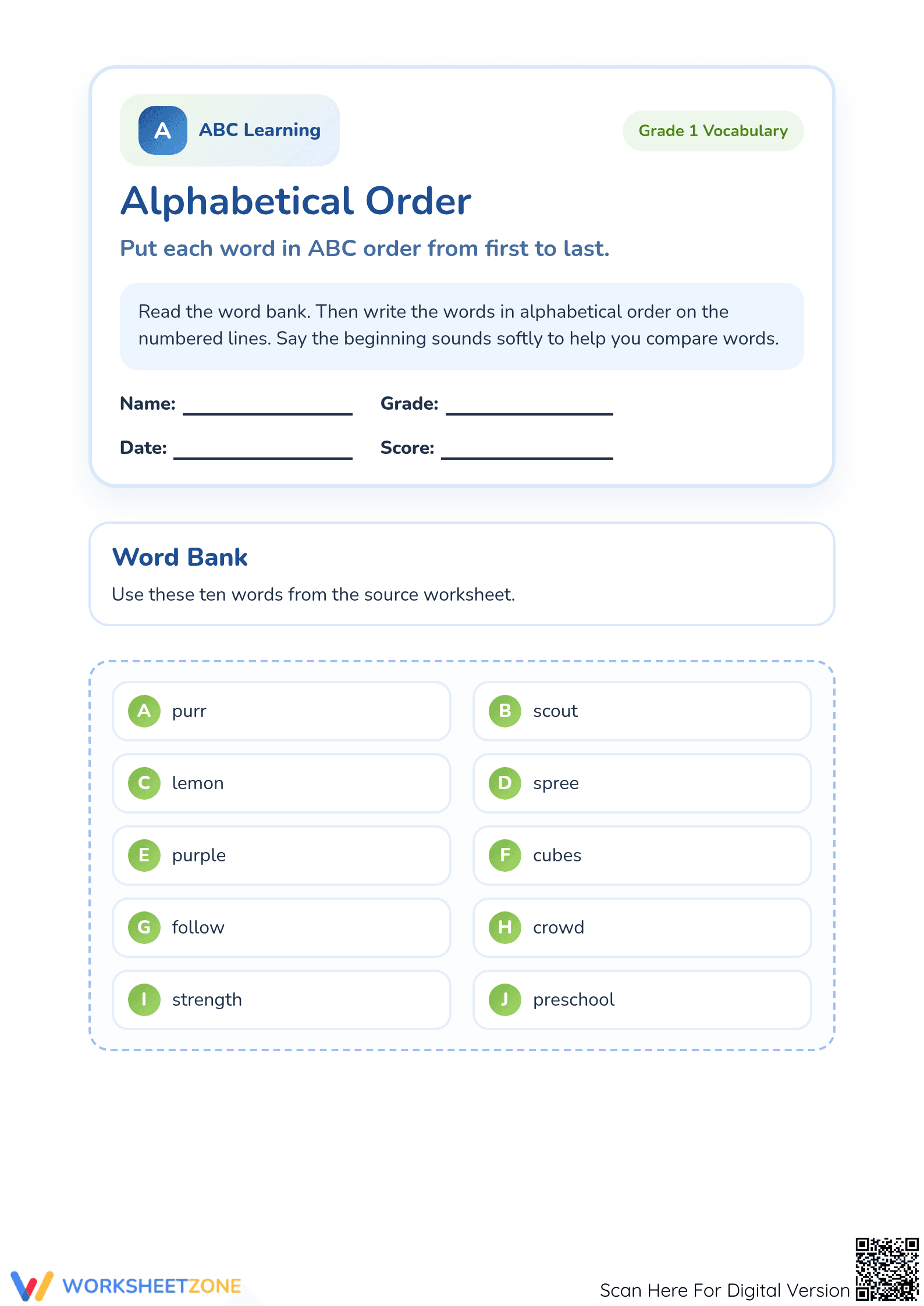
This resource includes a clear word bank featuring ten Grade 1 appropriate vocabulary words like "cubes," "lemon," and "scout." The worksheet is spread across three pages, providing ample writing space for young learners to transcribe their answers clearly. It features a dedicated "Answer Check" section with a compact key, making it easy for teachers to review or for students to self-correct their work independently.
- Guided practice: The word bank introduces the set of words, allowing students to identify beginning sounds and compare them visually.
- Supported practice: Numbered lines 1 through 10 provide a clear visual structure for recording the alphabetical sequence and organizing thoughts.
- Independent practice: Students complete the full sequence without additional cues, demonstrating mastery of alphabetical order through self-directed work.
This worksheet follows a gradual-release model, moving from word identification to independent sequencing, ensuring students build confidence at every step.
Standards Alignment
The primary standard CCSS.ELA-LITERACY.L.1.1 focuses on the command of standard English conventions. This activity specifically supports foundational literacy by requiring students to recognize and apply the conventional order of letters, which is essential for future research and organizational tasks. Both standard codes can be copied directly into lesson plans, IEP goals, or district curriculum mapping tools.
How to Use It
Use this worksheet during a literacy center rotation to reinforce alphabet skills. Before distribution, model alphabetizing three unrelated words on the board. During the activity, observe if students use the "saying beginning sounds softly" tip mentioned in the instructions. This serves as a quick formative assessment of their phonetic awareness and sequencing logic. Completion typically takes 15-20 minutes.
Who It's For
This resource is designed for Grade 1 students, but it also serves as an excellent review for Grade 2 learners or an intervention for Kindergarteners showing advanced readiness. It pairs naturally with an alphabet anchor chart or a short reading passage to extend vocabulary practice. The clean layout is helpful for students requiring minimal visual distractions.
The CCSS.ELA-LITERACY.L.1.1 standard requires students to master foundational conventions of the English language. This Alphabetical Order worksheet provides the specific repetition needed to internalize letter sequencing, a prerequisite for efficient dictionary usage and information retrieval. According to Fisher & Frey (2014), the gradual release of responsibility—moving from word bank identification to independent writing—is critical for ensuring students transition from guided support to autonomous skill application. By engaging with these 10 targeted tasks, learners build the cognitive pathways necessary for more complex linguistic organization. This focused practice ensures that Grade 1 students meet district-level literacy benchmarks while preparing for higher-order vocabulary demands in subsequent years. This resource is a reliable tool for classroom teachers and literacy specialists seeking evidence-based materials for foundational skill development.


