


























Views
Downloads

Printable Alphabetical Order Worksheet | Grade 1 ELA
Paste this activity's link or code into your existing LMS (Google Classroom, Canvas, Teams, Schoology, Moodle, etc.).
Students can open and work on the activity right away, with no student login required.
You'll still be able to track student progress and results from your teacher account.
Mastering alphabetical order is a foundational literacy skill that paves the way for efficient dictionary use and organizational thinking. This comprehensive Grade 1 worksheet provides structured practice in identifying the sequence of words based on their initial letters, ensuring students build the confidence needed to navigate text-based resources independently and accurately.
At a Glance
- Grade: 1 · Subject: English Language Arts
- Standard:
CCSS.ELA-LITERACY.L.1.2— Demonstrate command of English conventions, including spelling and foundational dictionary skills- Skill Focus: Alphabetical order and first-letter recognition
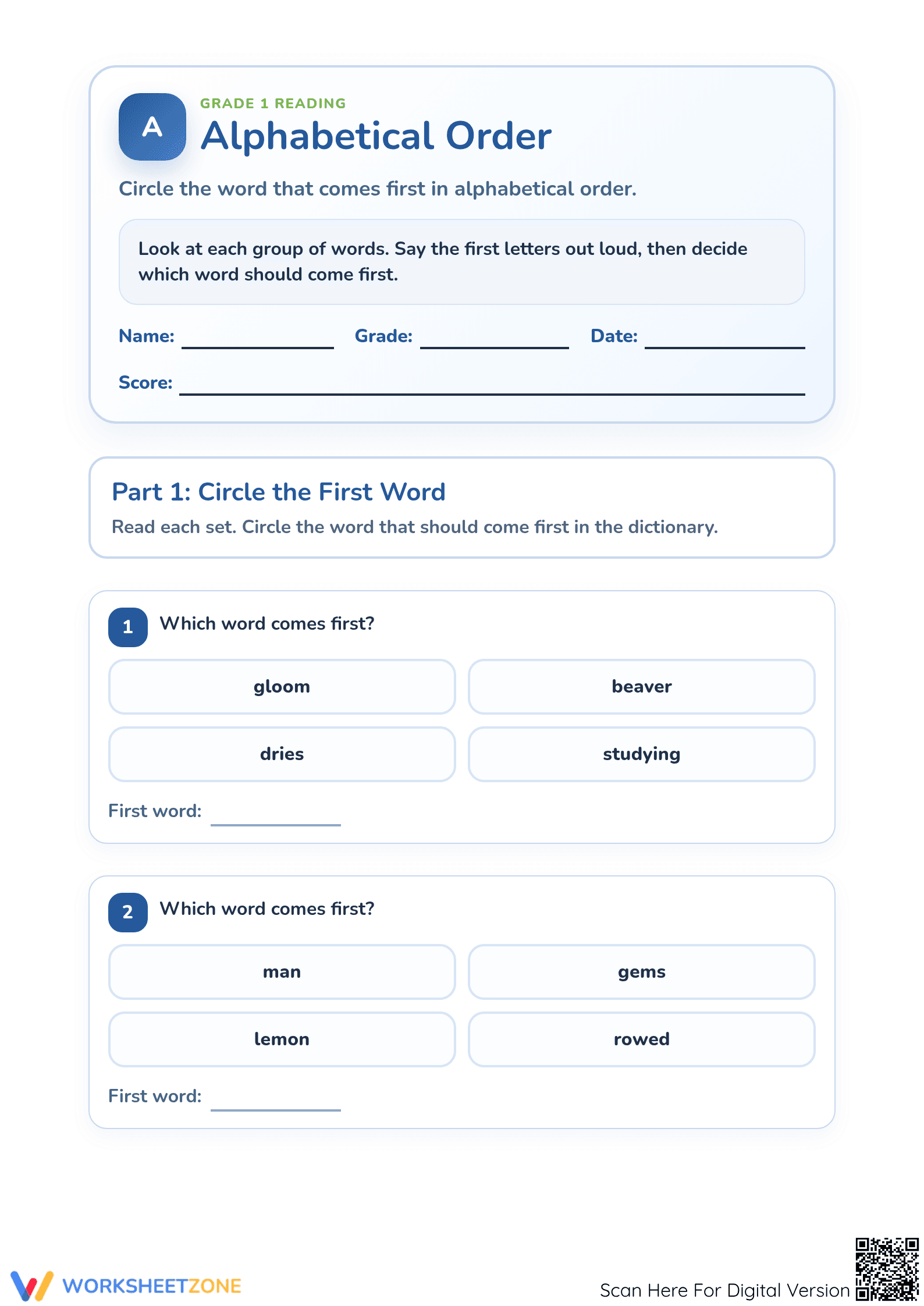
- Format: 4 pages · 12 problems · Answer key included · PDF
- Best For: Literacy centers and independent morning work
- Time: 15–20 minutes
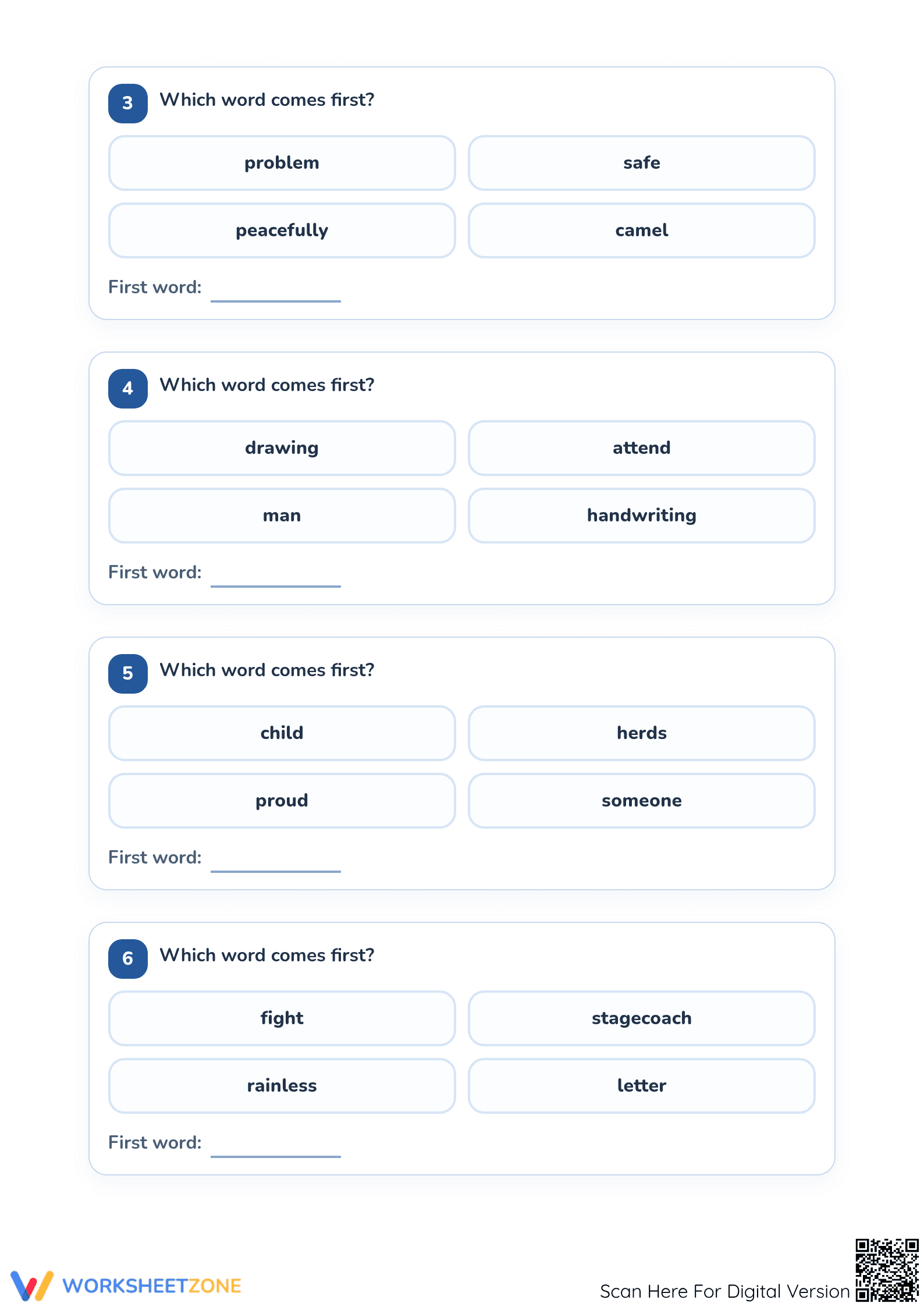
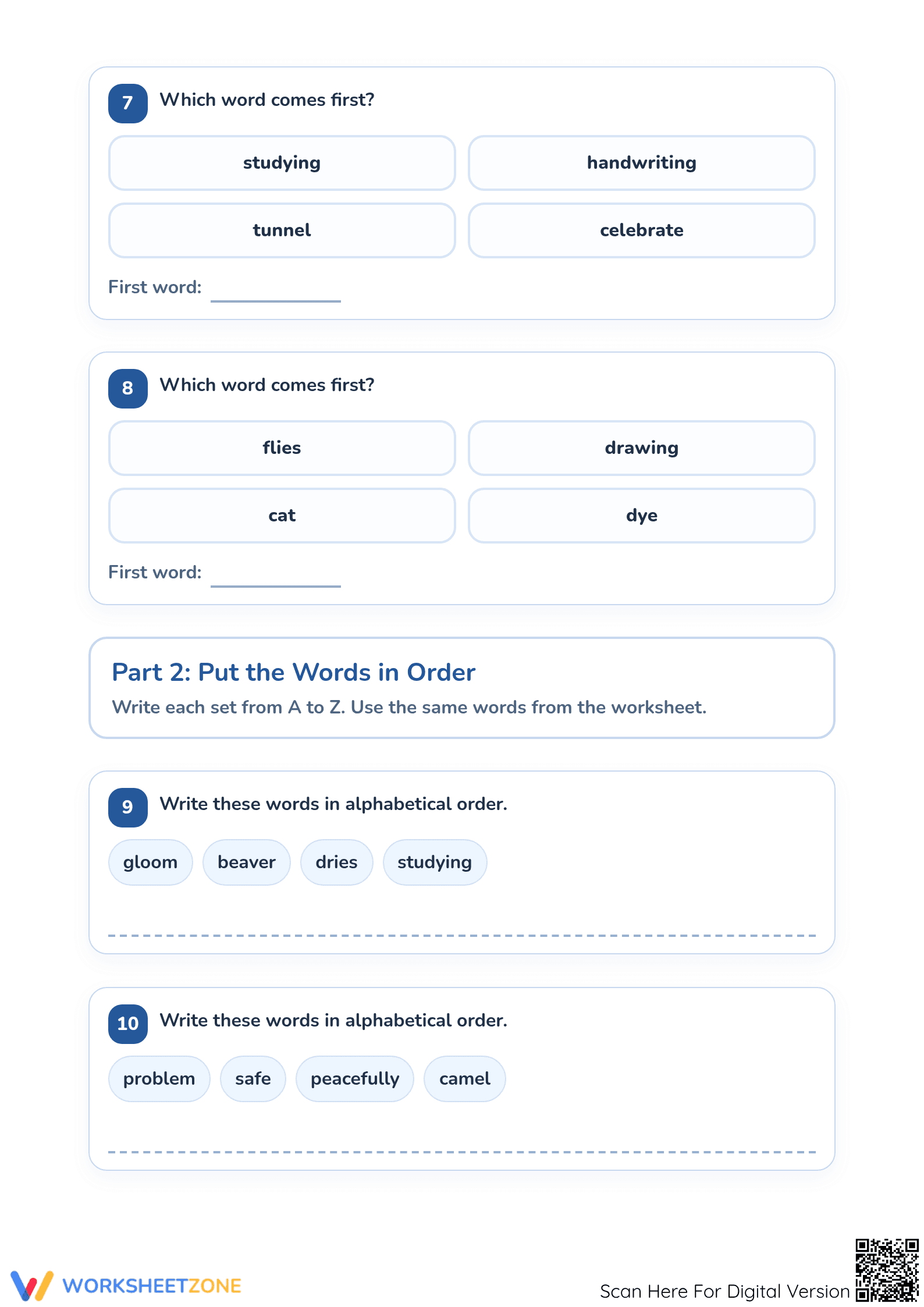
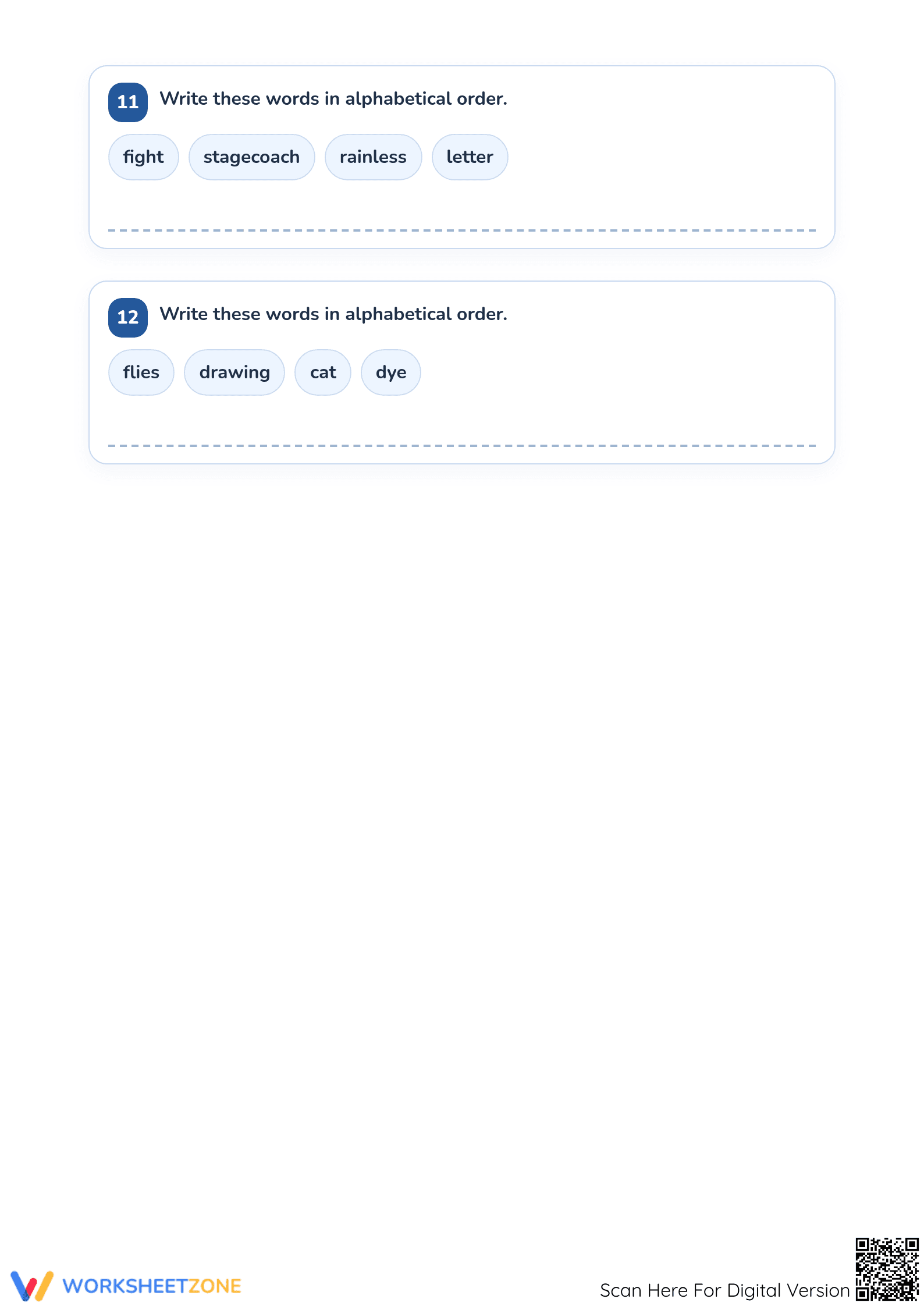
What's Inside: This four-page PDF resource is divided into two logical sections to reinforce learning. Part One features eight multiple-choice tasks where students circle the word that comes first in the dictionary from a set of four options. Part Two challenges students with four writing tasks, requiring them to rearrange provided word banks into a complete A-to-Z list. The layout is clean, with ample space for young writers and a clear answer key for rapid grading.
This resource is designed for a seamless, zero-prep workflow in busy classrooms. Teachers can simply print the four-page PDF in under thirty seconds. Distribution takes less than a minute during transition periods, and the included answer key allows for a five-minute rapid review or self-checking session. Total instructional preparation time is minimized to under two minutes, making it an ideal candidate for emergency sub plans or last-minute literacy center rotations.
Standards Alignment: This worksheet aligns with `CCSS.ELA-LITERACY.L.1.2`, which focuses on the command of the conventions of standard English. By practicing alphabetical sorting, students demonstrate their understanding of letter sequence and spelling patterns. It also provides secondary support for `CCSS.ELA-LITERACY.RF.1.1` by reinforcing print concepts and letter-order awareness. Both standard codes can be copied directly into lesson plans, IEP goals, or district curriculum mapping tools.
How to Use It: Deploy this worksheet as a formative assessment after an introductory lesson on the alphabet to gauge which students require additional scaffolding. It also functions effectively as a literacy center activity where students can work in pairs to "race" through the dictionary-style circling tasks. Teachers should observe whether students are subvocalizing the alphabet while working, as this indicates they are still internalizing the sequence of the 26 letters.
Who It's For: While primarily designed for Grade 1 students, this worksheet is an excellent intervention tool for Grade 2 learners who need to strengthen their organizational skills. It is highly effective for ESL/ELL populations who are learning the Latin alphabet for the first time. Pair this resource with a classroom alphabet anchor chart or a large-print beginner's dictionary to provide a visual reference during the independent practice phase.
Effective alphabetization instruction is critical because it bridges the gap between simple letter recognition and complex information retrieval. According to Fisher & Frey (2014), the gradual release of responsibility in literacy tasks—moving from circling a correct answer to generating an ordered list—ensures that the cognitive load remains manageable while still demanding high-order processing. This worksheet utilizes this exact scaffolded approach, starting with identification in Part One before moving to application in Part Two. Research from EdReports 2024 suggests that foundational skills practice is most effective when it is isolated, repetitive, and directly linked to standard conventions like `CCSS.ELA-LITERACY.L.1.2`. By engaging with twelve distinct word sets, students receive the high-frequency exposure necessary to move letter-sequence knowledge into long-term memory, ultimately reducing the time spent on basic organization and increasing the time available for deep reading comprehension and vocabulary development.


