


























Views
Downloads
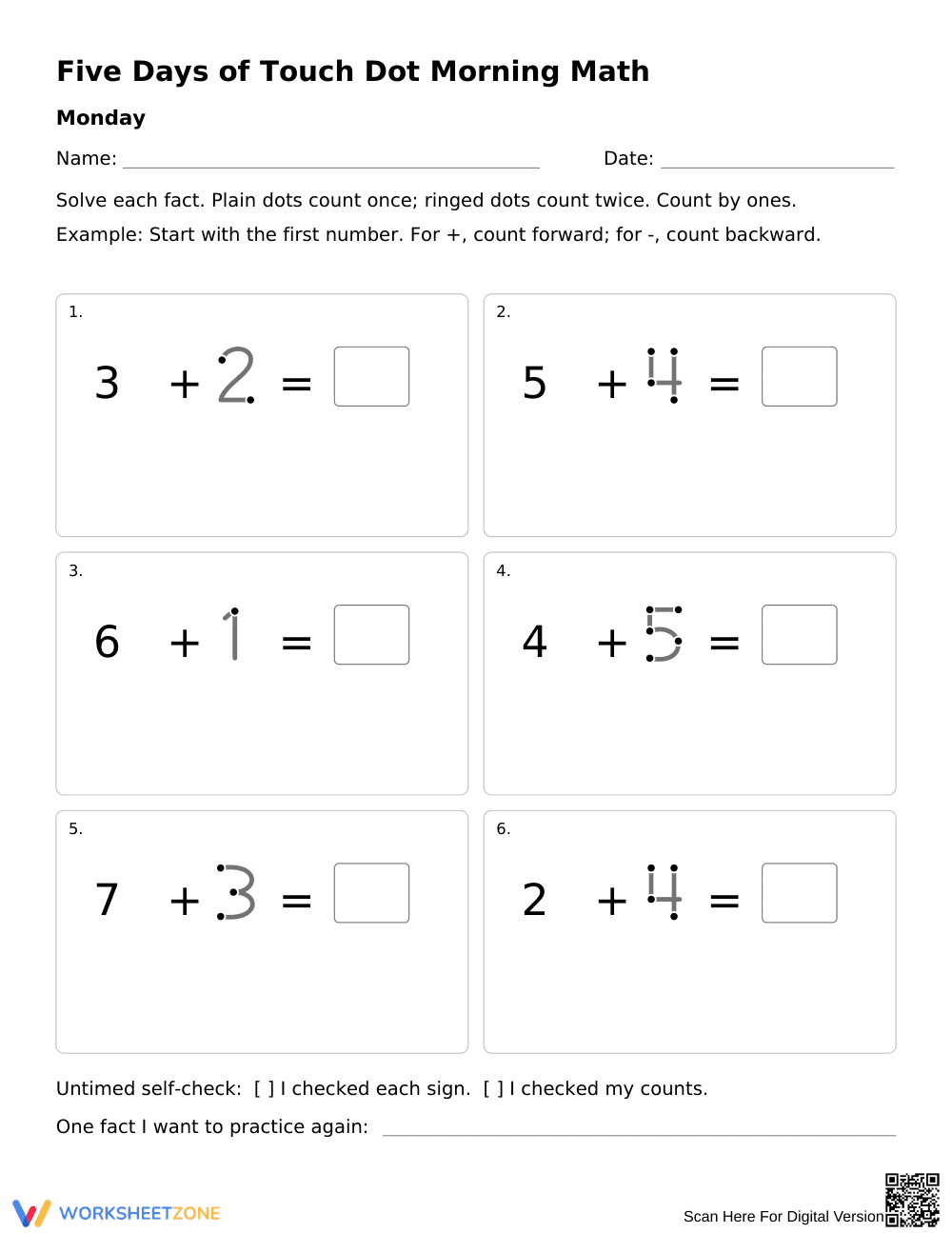
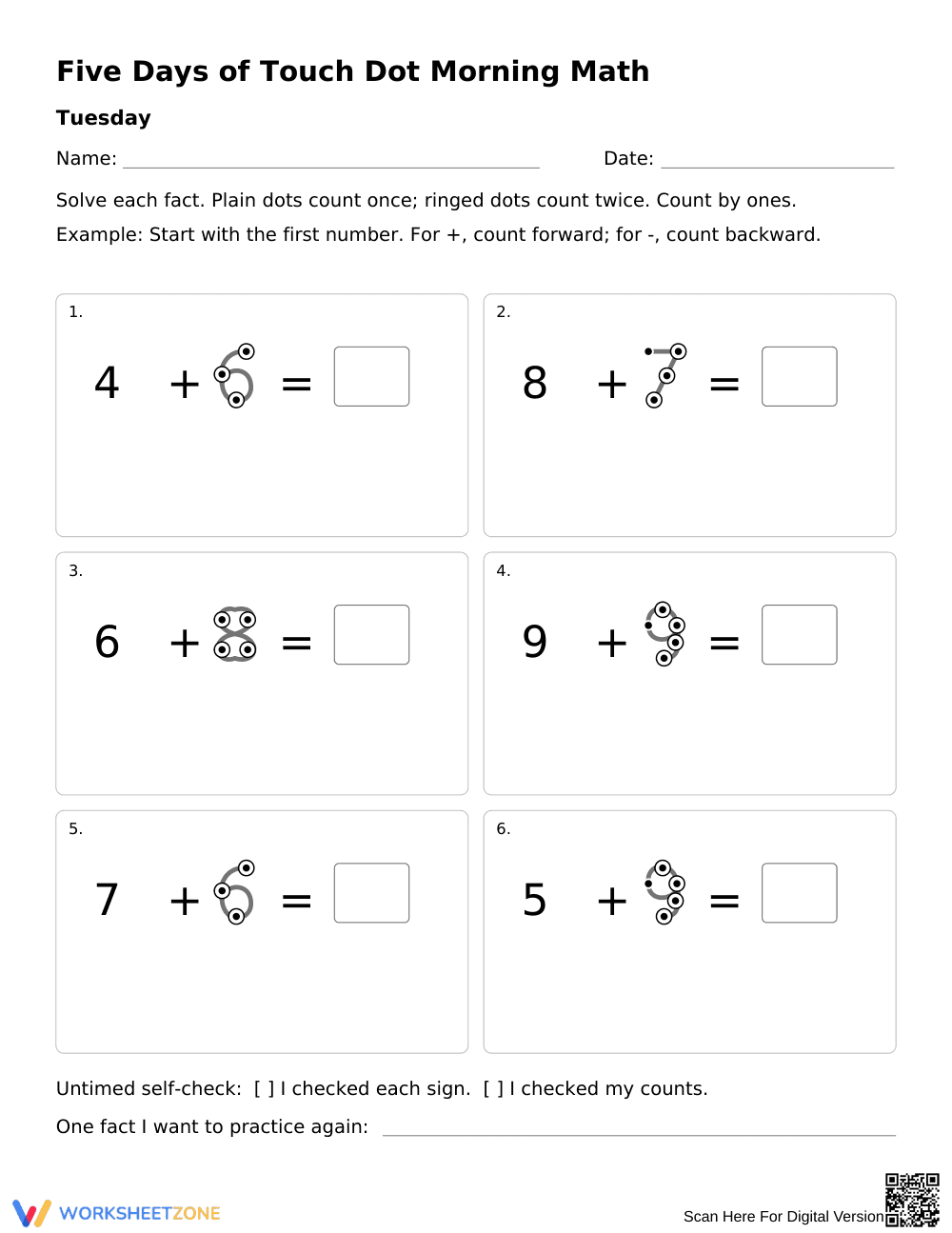
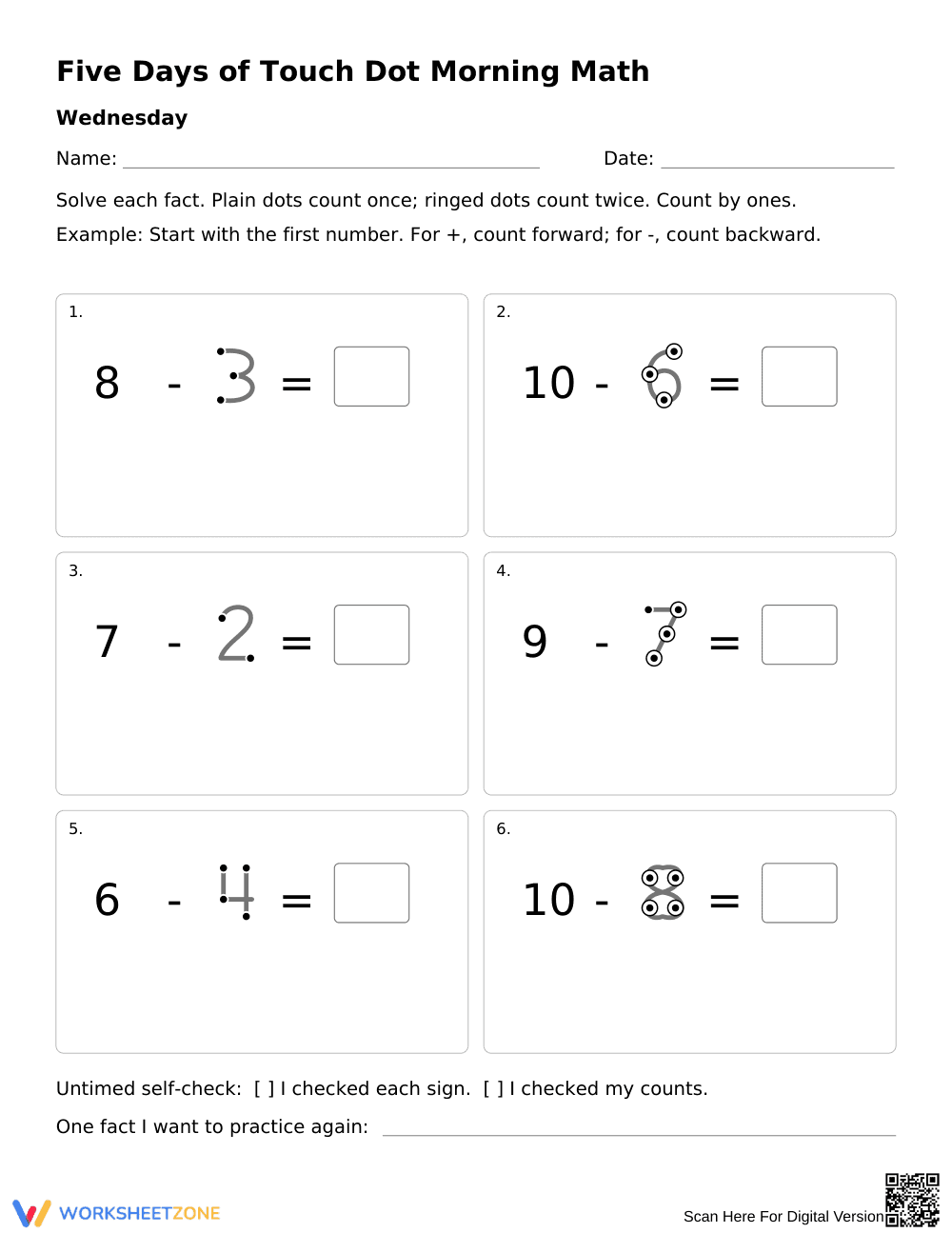
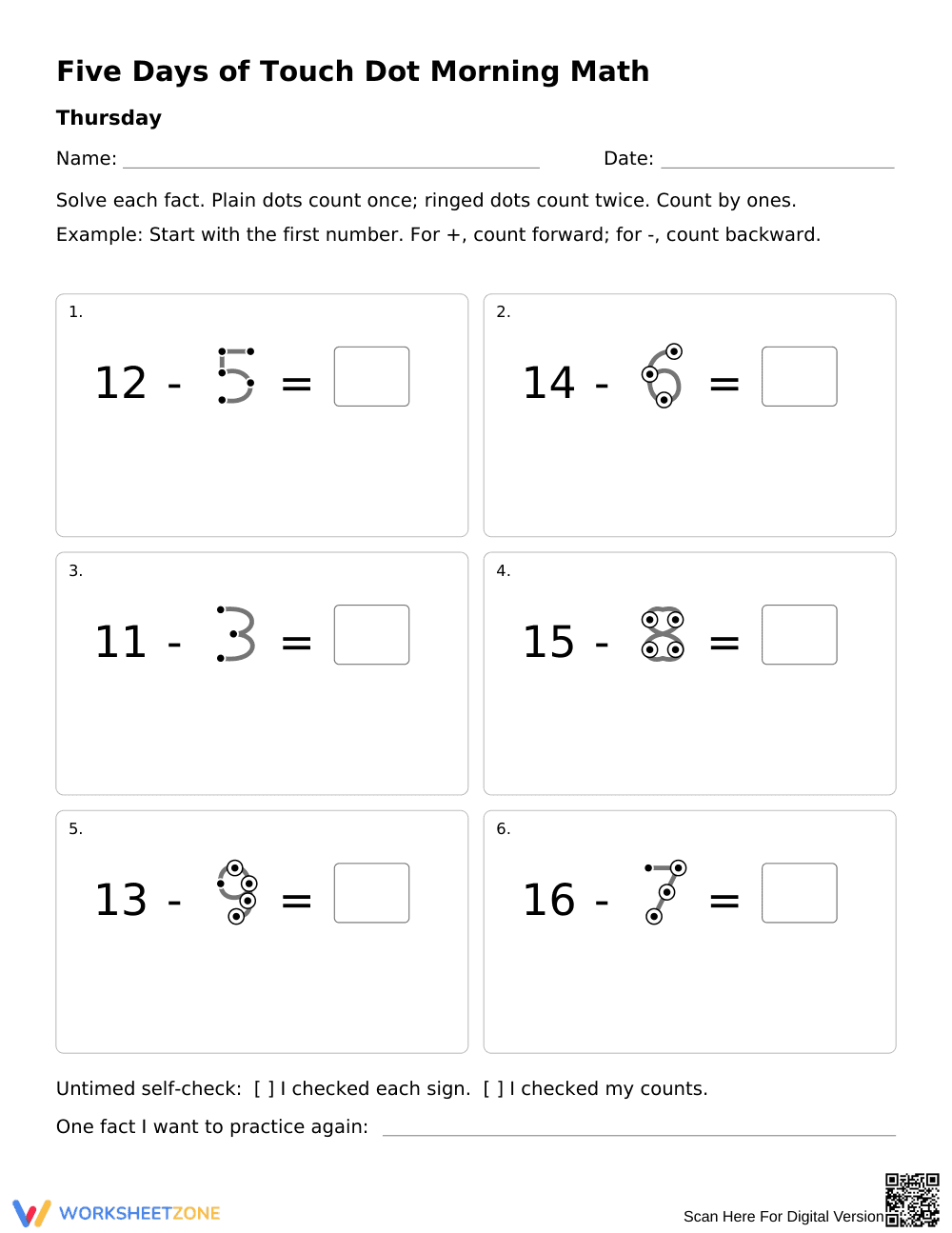
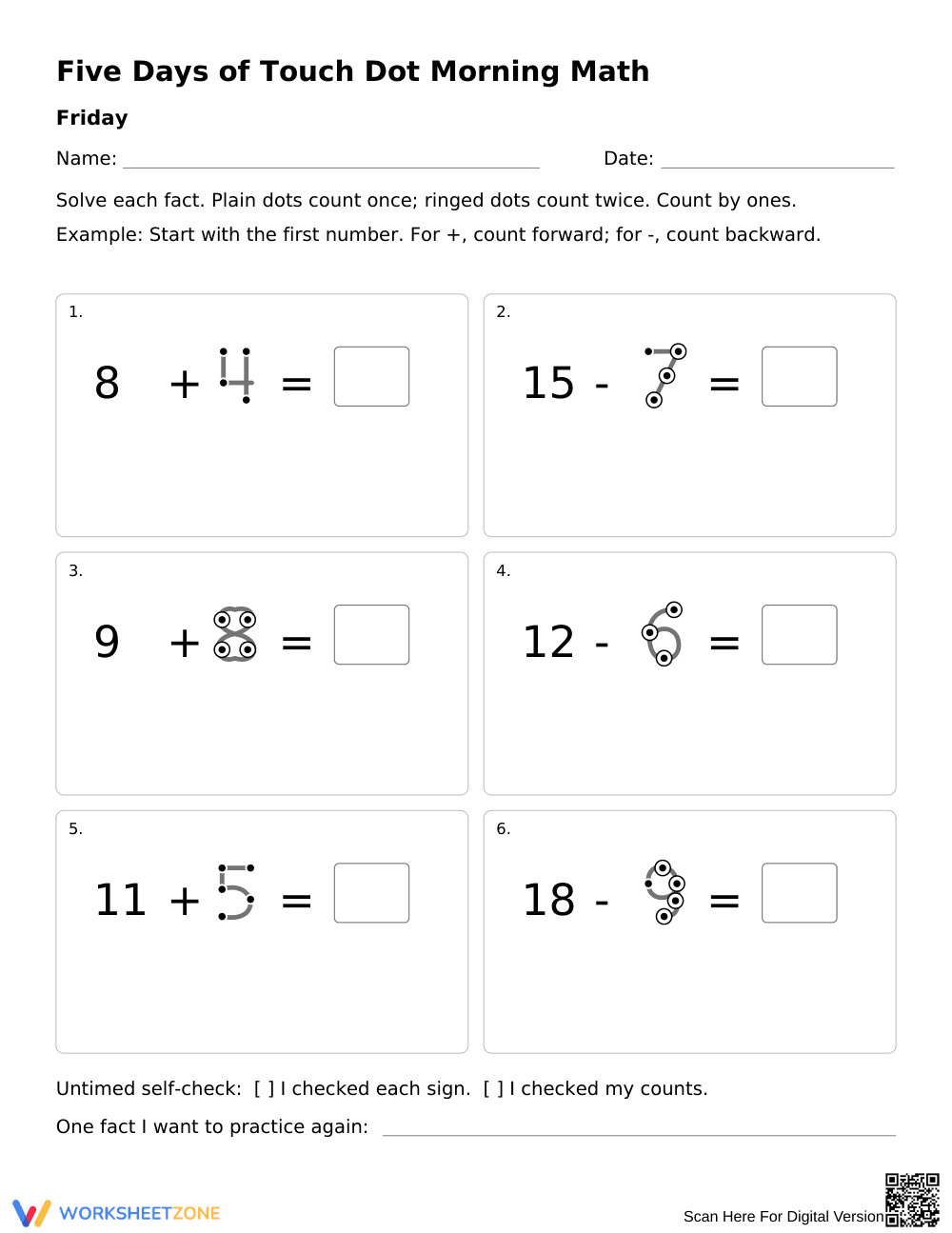

Grade 1 Touch Dot Math — Printable Morning Work
Paste this activity's link or code into your existing LMS (Google Classroom, Canvas, Teams, Schoology, Moodle, etc.).
Students can open and work on the activity right away, with no student login required.
You'll still be able to track student progress and results from your teacher account.
This Grade 1 morning math worksheet provides daily practice with touch dot addition and subtraction facts through 20. Students use visual touch points to count on for addition and count backward for subtraction, building fact fluency. Each page includes 6 problems and self-monitoring checkboxes for student reflection.
At a Glance
- Grade: 1 · Subject: Math
- Standard:
CCSS.MATH.CONTENT.1.OA.C.6— Add and subtract within 20 using concrete counting strategies and touch points- Skill Focus: Touch dot addition and subtraction fluency
- Format: 5 pages · 30 problems · Answer key included · PDF
- Best For: Daily morning work routines
- Time: 5–10 minutes daily
The download features 5 student pages for Monday through Friday, plus a 1-page answer key. Each sheet presents 6 clear equation boxes with single-ringed and double-ringed touch points. Monday and Tuesday cover addition, Wednesday and Thursday focus on subtraction, and Friday provides mixed review. Every page contains untimed self-check reflection checkboxes.
Zero-Prep Classroom Workflow
Integrating this resource takes under 2 minutes of teacher preparation:
- Print (1 minute): Print all 5 student pages at the start of the week.
- Distribute (30 seconds): Place daily sheets on desks before arrival for a quiet morning warm-up.
- Review (30 seconds): Use the included answer key for quick grading or document camera review.
This predictable layout is also ideal for emergency substitute plans or independent seatwork.
Standards Alignment
This resource aligns with CCSS.MATH.CONTENT.1.OA.C.6: Add and subtract within 20, demonstrating fluency for addition and subtraction within 10 using counting strategies. It also supports CCSS.MATH.CONTENT.1.OA.C.5 by linking counting directly to basic operations. Both standard codes can be copied directly into lesson plans, IEP goals, or district mapping tools.
How to Use It
Use this worksheet set as a daily morning work routine. Students spend 5 to 10 minutes solving the 6 daily equations independently. Alternatively, assign pages during math rotations while leading guided groups. During work time, observe if students touch single dots once and double-ringed dots twice to verify correct touch counting technique.
Who It's For
Designed for general education first-grade classrooms, special education settings, and tier-2 intervention groups needing multisensory math support. Differentiate by encouraging advanced students to count on mentally while struggling learners tap each dot. Pair this worksheet with desk touch-point reference strips during early instruction.
This five-day morning math resource aligns directly with Common Core standard CCSS.MATH.CONTENT.1.OA.C.6 to systematically build addition and subtraction fluency within 20 using structured touch-point visual counting cues. Research findings from EdReports 2024 demonstrate that short-duration daily retrieval practice paired with concrete visual-tactile anchors significantly accelerates early arithmetic fact acquisition and computation retention among primary grade learners. By combining explicit visual touch dots with student self-monitoring reflection checkboxes, children transition smoothly from initial perceptual counting to fluent operational fact retrieval. The consistent six-problem daily structure minimizes working memory overhead while actively promoting student self-regulation and error-checking habits. Primary educators and special education teachers can incorporate these predictable practice sheets into morning arrival routines, tier-2 intervention blocks, or individualized IEP goal tracking systems to collect clean baseline data and document measurable computational growth across every instructional week.


