




























Views
Downloads

Complete Day and Night Science Worksheet — Kindergarten

Paste this activity's link or code into your existing LMS (Google Classroom, Canvas, Teams, Schoology, Moodle, etc.).
Students can open and work on the activity right away, with no student login required.
You'll still be able to track student progress and results from your teacher account.
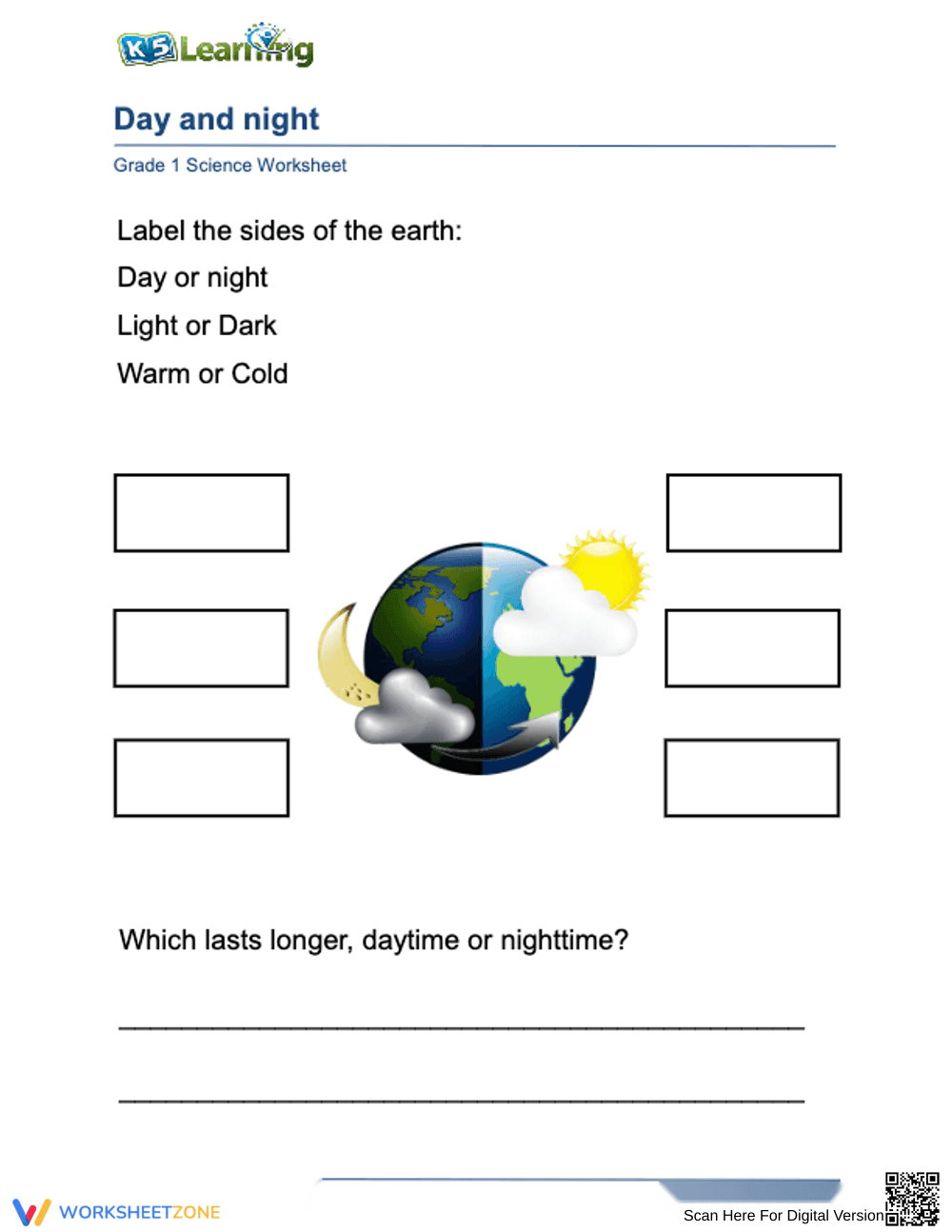
Identify the observable patterns of the sun and moon with this focused science worksheet. Students label the Earth's sides to distinguish between day and night based on light and temperature. This activity helps young learners visualize the relationship between the sun's position and Earth's rotation, leading to a deeper understanding of predictable celestial patterns.
At a Glance
- Grade: Kindergarten · Subject: Science
- Standard:
1-ESS1-1— Use observations of the sun and moon to describe predictable patterns- Skill Focus: Day vs. Night Characteristics
- Format: 2 pages · 7 problems · Answer key included · PDF
- Best For: Introduction to Earth's rotation and patterns
- Time: 15–20 minutes
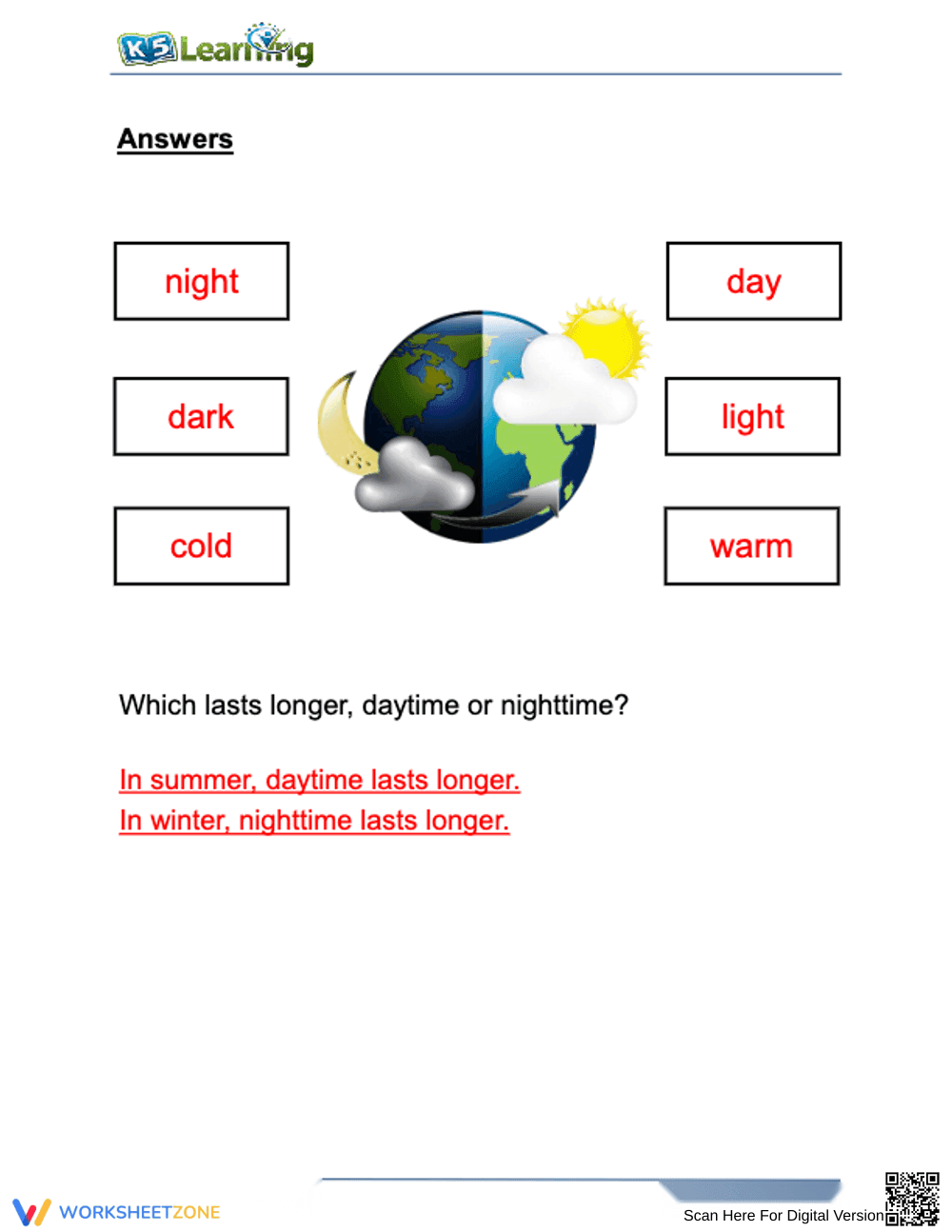
This two-page PDF includes a focused worksheet and a matching answer key for immediate feedback. The primary task features a central illustration of Earth flanked by six labeling boxes where students categorize sides as day/night, light/dark, and warm/cold. A concluding critical thinking question asks students to consider seasonal variations in daytime and nighttime duration, encouraging high-level observational science.
This resource is designed for a seamless three-step classroom workflow. First, print the single-sided worksheet in less than one minute. Second, distribute the pages for a quick 15-minute independent activity or morning work session. Finally, review student responses using the provided answer key during a whole-group discussion. The total teacher preparation time is estimated at under two minutes, making it an ideal choice for emergency sub plans.
Aligned to 1-ESS1-1, this worksheet requires students to use observations of the sun and moon to describe patterns that can be predicted. It specifically addresses the concept that the sun's light creates day and night cycles based on Earth's orientation. This primary standard code can be copied directly into lesson plans, IEP goals, or district curriculum mapping tools.
Use this worksheet during the "Explain" phase of a 5E lesson cycle to solidify the difference between light and dark sides of the Earth. As a formative assessment, observe if students correctly associate "warm" with the sunlit side and "cold" with the nighttime side. It works best after a direct instruction session involving a globe and a flashlight to simulate rotation.
This resource is tailored for Kindergarten and Grade 1 students beginning their study of the solar system. It provides necessary scaffolding for early readers while offering a challenge for advanced learners through the seasonal duration question. Pair this worksheet with a short non-fiction passage about the sun or an anchor chart showing the Earth's rotation.
According to Fisher & Frey (2014), the use of visual scaffolds and labeling tasks is critical for early science literacy, as it allows students to organize complex abstract concepts like planetary rotation into manageable categories. This Kindergarten science worksheet directly supports standard 1-ESS1-1 by guiding students through the observation of predictable solar patterns. By distinguishing between light, dark, warmth, and cold, learners build the foundational cognitive frameworks necessary for later astronomical studies. Research indicates that connecting physical sensations with visual phenomena increases retention of core scientific facts in primary grades. This resource provides a structured environment for this conceptual development, ensuring students can accurately describe why day and night occur. The inclusion of an answer key facilitates the immediate feedback loop necessary for mastering these early standards. This material is designed to integrate easily into any NGSS-aligned science curriculum.


