




























Views
Downloads

Grade 1 Pumpkin Math — Printable Addition Game

Paste this activity's link or code into your existing LMS (Google Classroom, Canvas, Teams, Schoology, Moodle, etc.).
Students can open and work on the activity right away, with no student login required.
You'll still be able to track student progress and results from your teacher account.
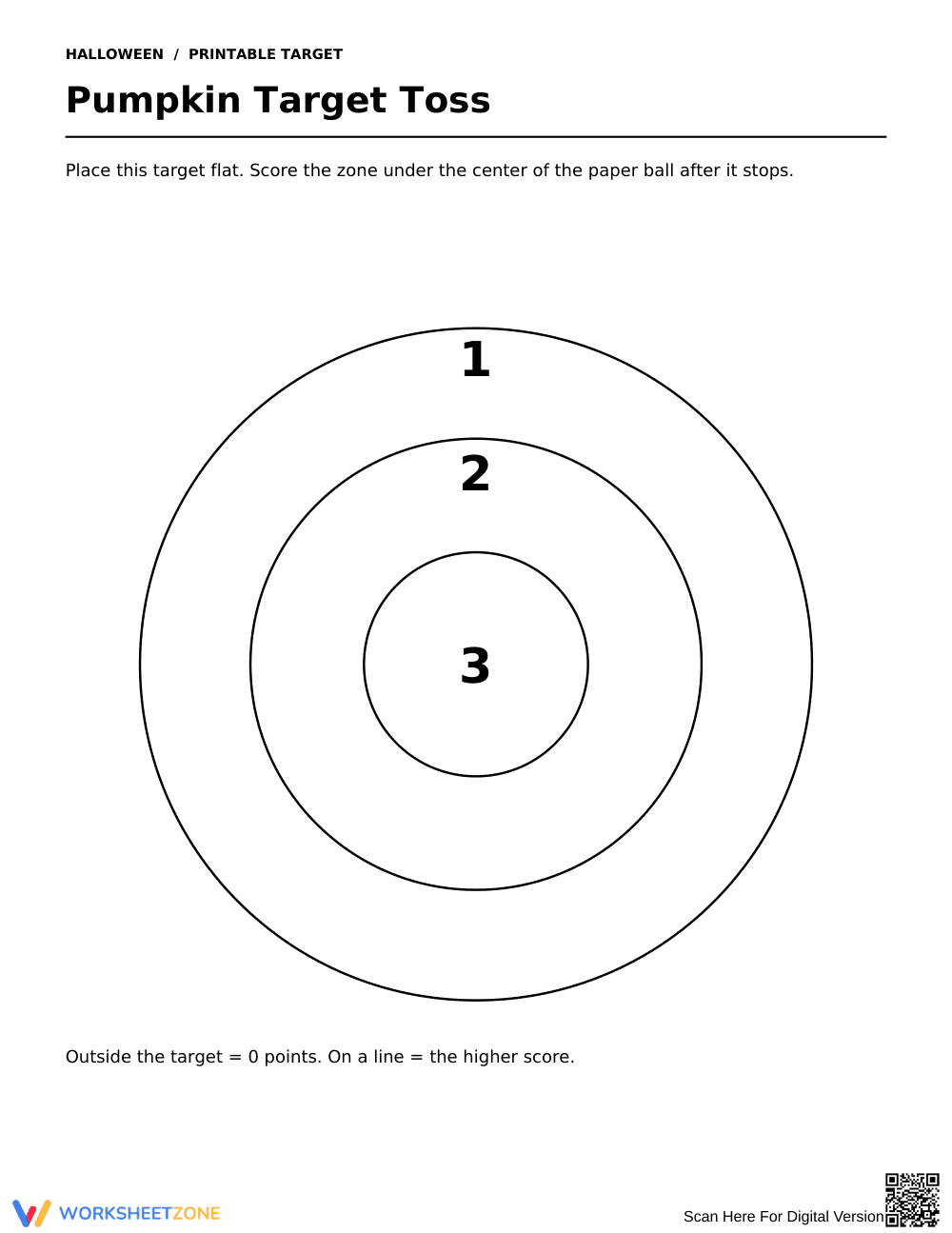
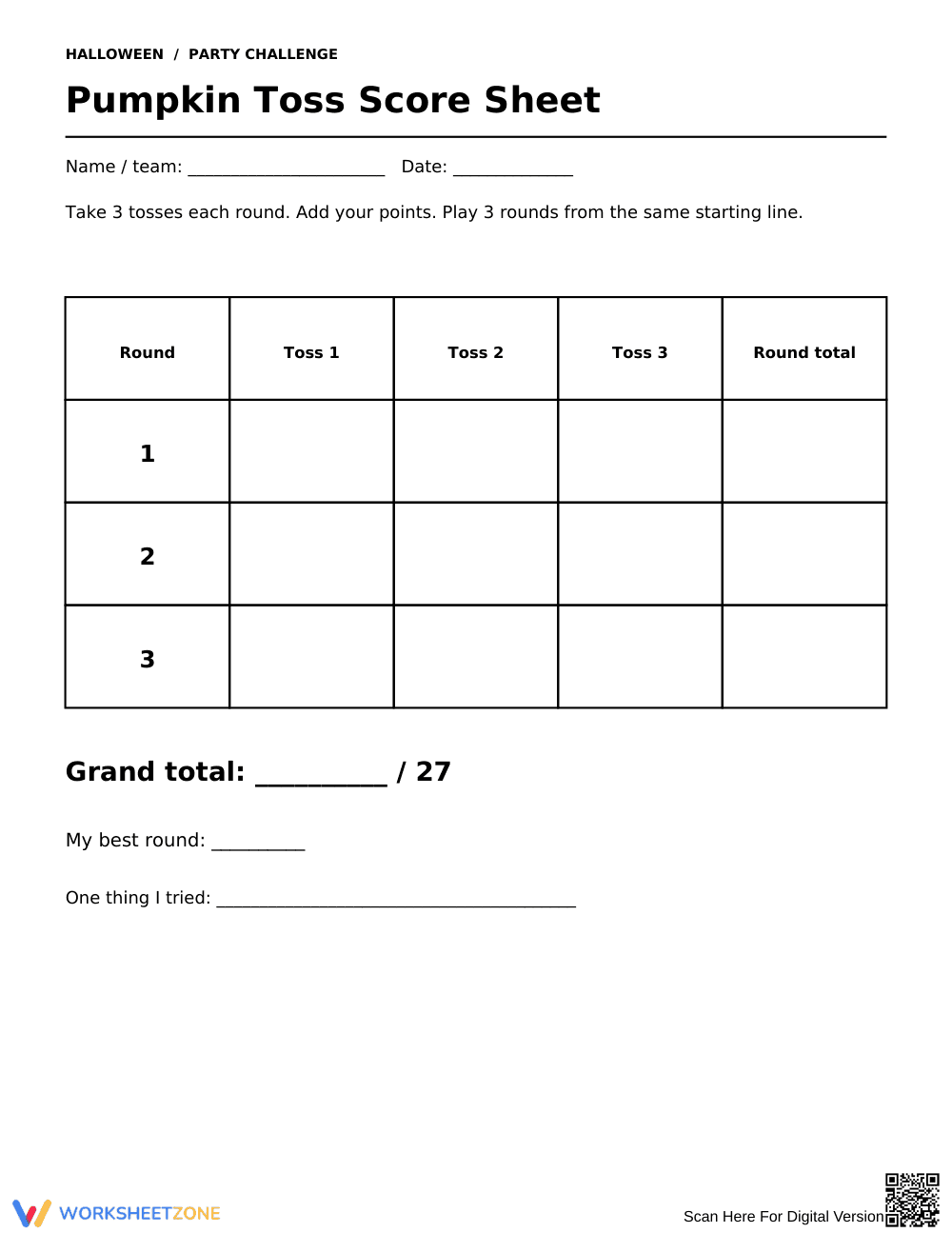
This Grade 1 Halloween math activity combines gross motor coordination with three-addend addition practice. Students toss paper markers onto a concentric pumpkin target, record three individual toss scores per round, and calculate round subtotals plus a grand total. It reinforces mental addition, data recording, and number combinations through interactive game play.
At a Glance
- Grade: 1 · Subject: Math
- Standard:
CCSS.MATH.CONTENT.1.OA.A.2— Add three whole numbers whose sum is less than or equal to twenty- Skill Focus: Adding three single-digit numbers and finding cumulative sums
- Format: 2 pages · 4 scoring tasks · Answer key included · PDF
- Best For: Halloween math stations and small groups
- Time: 10–15 minutes
This printable package contains a bullseye target featuring concentric scoring zones from one to three, a dedicated player score sheet structured for three rounds, and an educator host guide. The score sheet provides clear input boxes for recording separate tosses, calculating round totals, compiling a final score out of 27, and completing metacognitive reflection prompts.
Zero-Prep Workflow
Designed for immediate classroom deployment, setup requires under two minutes:
- Print (1 minute): Print one target sheet per station and one score sheet per learner on standard letter paper.
- Distribute (30 seconds): Provide scrap paper for students to crumple into markers and mark floor lines three feet back.
- Review (30 seconds): Explain scoring rules using the host guide before launching independent rotations or sub plans.
Standards Alignment
This activity aligns with primary standard `CCSS.MATH.CONTENT.1.OA.A.2`, which requires students to solve addition situations involving three whole numbers whose sum is less than twenty. It also supports `CCSS.MATH.CONTENT.1.OA.C.6` by reinforcing fluency with basic addition combinations within ten. Both standard codes can be copied directly into lesson plans, IEP goals, or district curriculum mapping tools.
How to Use It
Deploy this game during math center rotations after direct instruction on multiple-addend addition strategies, or during seasonal classroom celebrations. During gameplay, circulate to observe how students combine their three scores; note whether they count on, find doubles, or use mental ten-frames. Expect each group round to take 10 to 15 minutes, allowing ample time for peer collaboration, score recording, and reflection.
Who It's For
This resource serves first-grade students developing fact fluency, kindergarten learners needing visual counting practice, and second graders reviewing basic operations. Differentiate by moving toss distances closer or allowing seated tosses. Pair this printable with a ten-frame visual anchor chart or physical counters to scaffold addition for striving mathematicians.
Active learning modalities significantly strengthen early foundational numeracy, as confirmed by educational research. Aligned with CCSS.MATH.CONTENT.1.OA.A.2, this game targets adding three whole numbers whose sum is within twenty by uniting physical movement with authentic data recording. According to the RAND AIRS 2024 report, contextualized game-based math tasks increase student engagement and produce measurable gains in arithmetic automaticity compared to passive worksheet drill methods alone. When students log individual tosses, sum multi-addend scores, and evaluate cumulative performance across three rounds, they actively contextualize abstract numerals through kinesthetic play. The structural integration of immediate calculation and brief metacognitive reflection reinforces numerical relationships and promotes flexible mental computation strategies. By delivering structured computational repetitions in an approachable, low-anxiety format, this standard-aligned math activity equips early elementary educators with an actionable tool that supports both conceptual understanding and computational fluency.


