


























Views
Downloads

Alphabetical Order Worksheet | Printable Grade 1 ELA
Paste this activity's link or code into your existing LMS (Google Classroom, Canvas, Teams, Schoology, Moodle, etc.).
Students can open and work on the activity right away, with no student login required.
You'll still be able to track student progress and results from your teacher account.
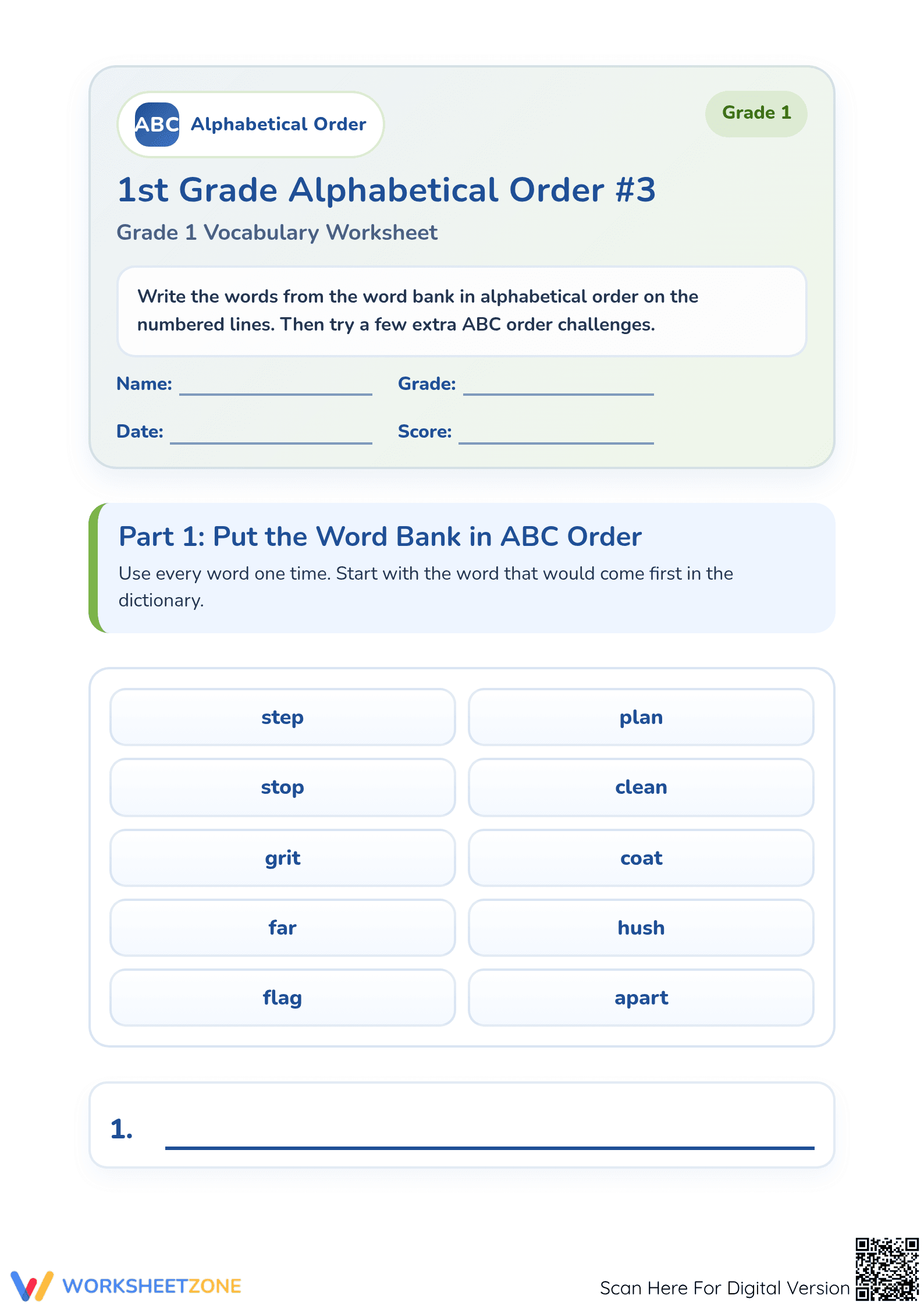
Students master the foundational skill of organization with this 1st Grade Alphabetical Order worksheet. By arranging vocabulary words in correct sequence, learners strengthen their letter recognition and preparation for future dictionary use. This resource provides clear structure and immediate application for early elementary language arts students.
At a Glance
- Grade: 1 · Subject: English Language Arts
- Standard:
CCSS.ELA-LITERACY.L.1.1— Use common language conventions to organize and sequence words accurately- Skill Focus: Alphabetical Order (ABC Order)
- Format: 4 pages · 15 problems · Answer key included · PDF
- Best For: Independent practice and foundational vocabulary organization
- Time: 15–20 minutes
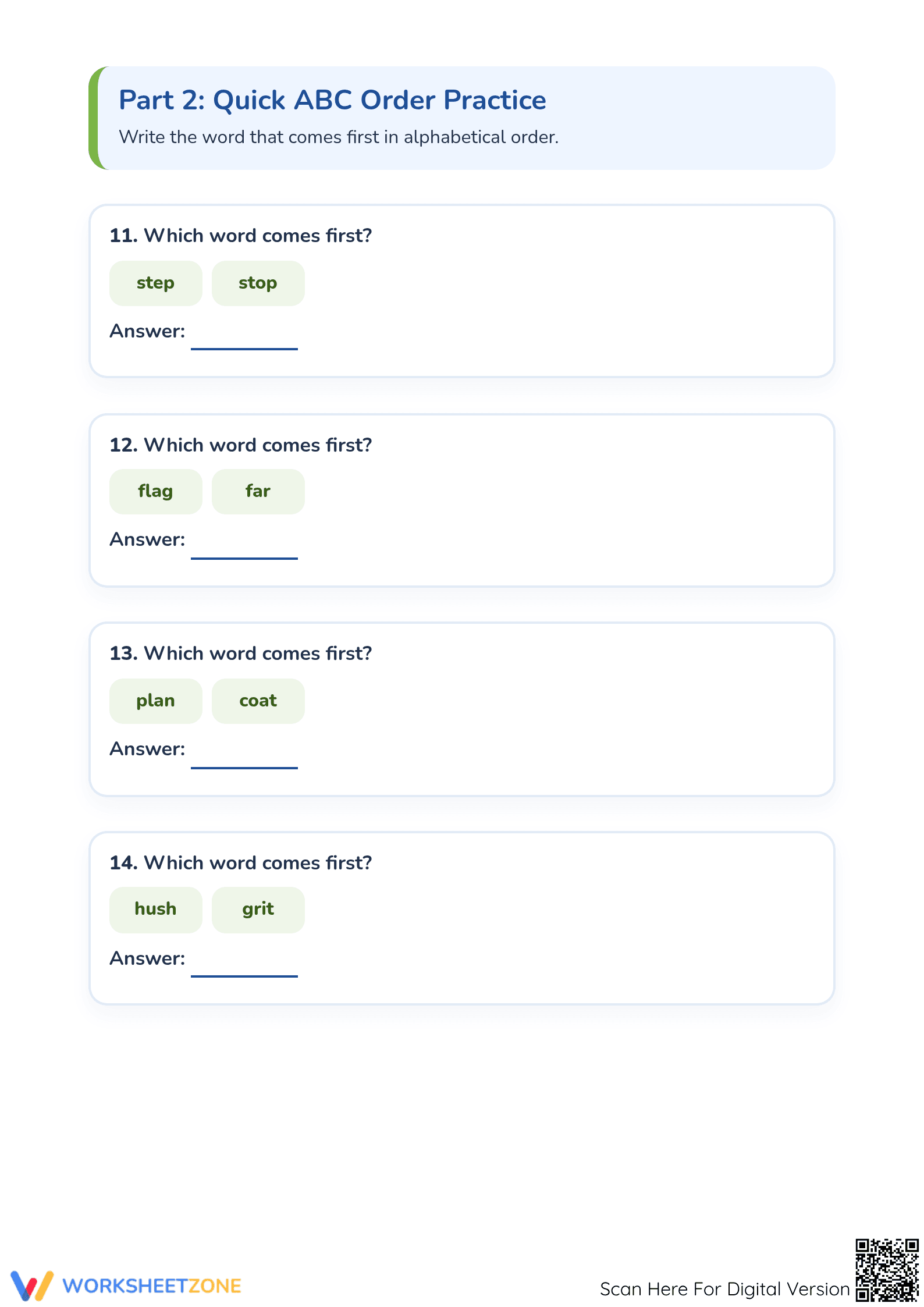
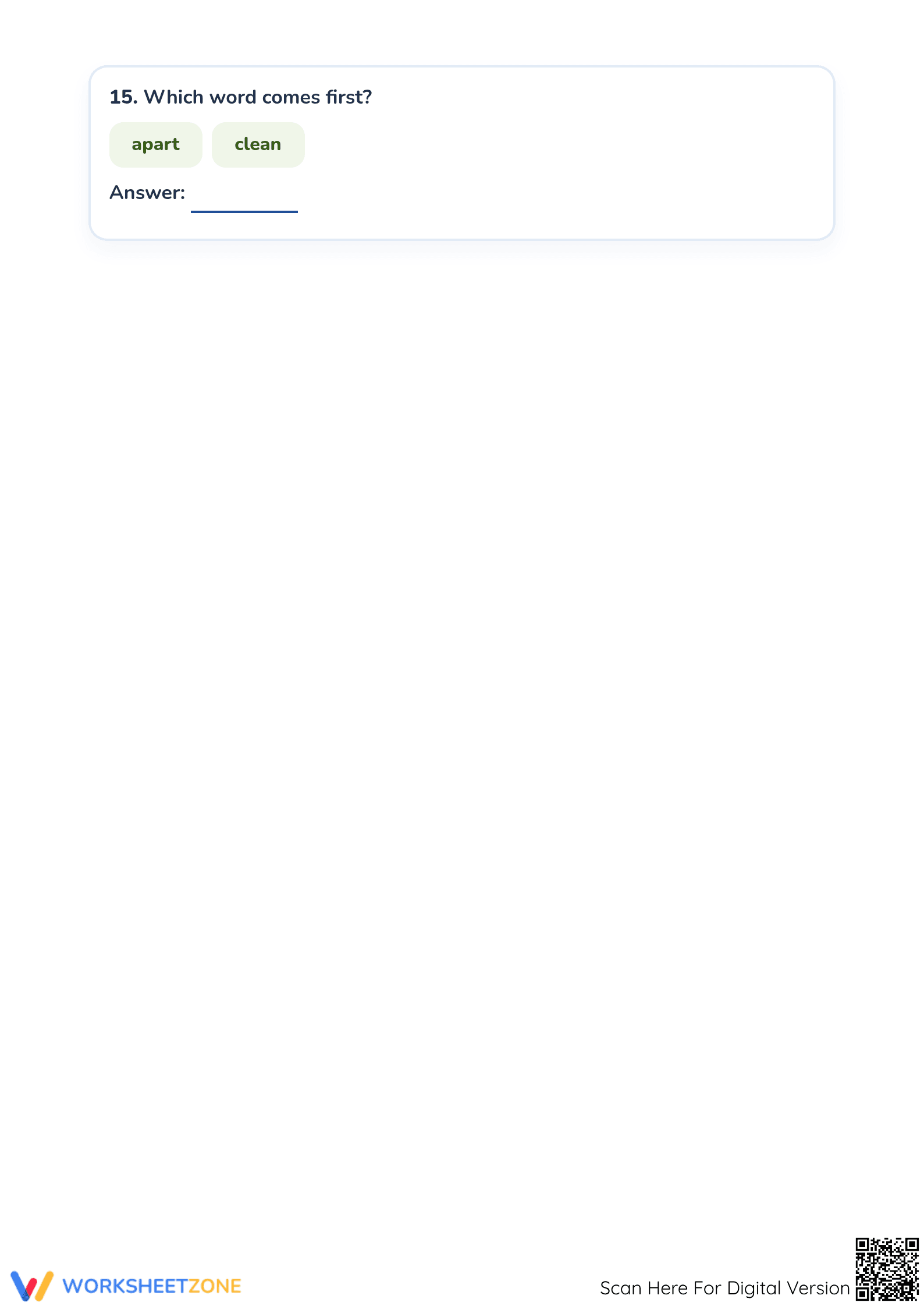
This comprehensive four-page PDF includes a two-part practice suite designed for first-grade learners. Part one features a ten-word bank where students must sort terms onto numbered lines. Part two introduces five specific comparison challenges, asking students to identify which of two words appears first in the alphabet. A complete answer key is included for rapid grading.
Skill Progression
- Guided Practice: Students engage in initial sorting by arranging a full list of ten words with the support of a high-contrast visual word bank.
- Supported Practice: In Part 2, the cognitive load shifts as students evaluate specific word pairs to choose the correct alphabetical leader.
- Independent Practice: Learners finalize the full 15-task sequence without external scaffolds, reinforcing the "I Do, We Do, You Do" instructional model.
This gradual release approach ensures that students build confidence before tackling independent sequencing tasks.
Standards Alignment
This resource is primarily aligned with CCSS.ELA-LITERACY.L.1.1, which requires students to demonstrate command of the conventions of standard English. Sequencing words alphabetically is a critical prerequisite for mastering organizational skills and navigating reference materials. Both standard codes can be copied directly into lesson plans, IEP goals, or district curriculum mapping tools.
How to Use It
Use this worksheet during the independent practice phase of a lesson on alphabetization to assess individual student progress. It serves as an excellent formative-assessment tool; teachers should observe if students physically recite the alphabet while working to gauge their reliance on verbal scaffolding. Expected completion time is approximately 20 minutes depending on prior letter fluency.
Who It's For
This resource is built for first-grade students but is also suitable for kindergarteners ready for enrichment or second graders requiring remedial support. It pairs naturally with an alphabet anchor chart or a classroom word wall to provide visual cues during the sorting process for students who struggle with mental recall of the letter sequence.
Research by Fisher & Frey (2014) emphasizes that organizational skills like alphabetical ordering are not merely rote tasks but cognitive building blocks for complex information retrieval. According to the RAND AIRS 2024 report, early exposure to systematic word sequencing significantly correlates with improved vocabulary acquisition and dictionary proficiency in later elementary years. This worksheet targets CCSS.ELA-LITERACY.L.1.1, helping Grade 1 students internalize the linear structure of language. By practicing with 15 distinct tasks, learners move from simple recognition to the functional application of ABC order. Providing structured word banks allows students to focus on the sequencing logic rather than spelling, which EdReports 2024 identifies as a best practice for foundational literacy materials. This printable PDF ensures that educators have a high-quality, research-backed tool ready for immediate classroom implementation, bridging the gap between basic letter knowledge and advanced organizational competency.


