


























Views
Downloads

Grade 1 Alphabetical Order — Printable No-Prep Worksheet
Paste this activity's link or code into your existing LMS (Google Classroom, Canvas, Teams, Schoology, Moodle, etc.).
Students can open and work on the activity right away, with no student login required.
You'll still be able to track student progress and results from your teacher account.
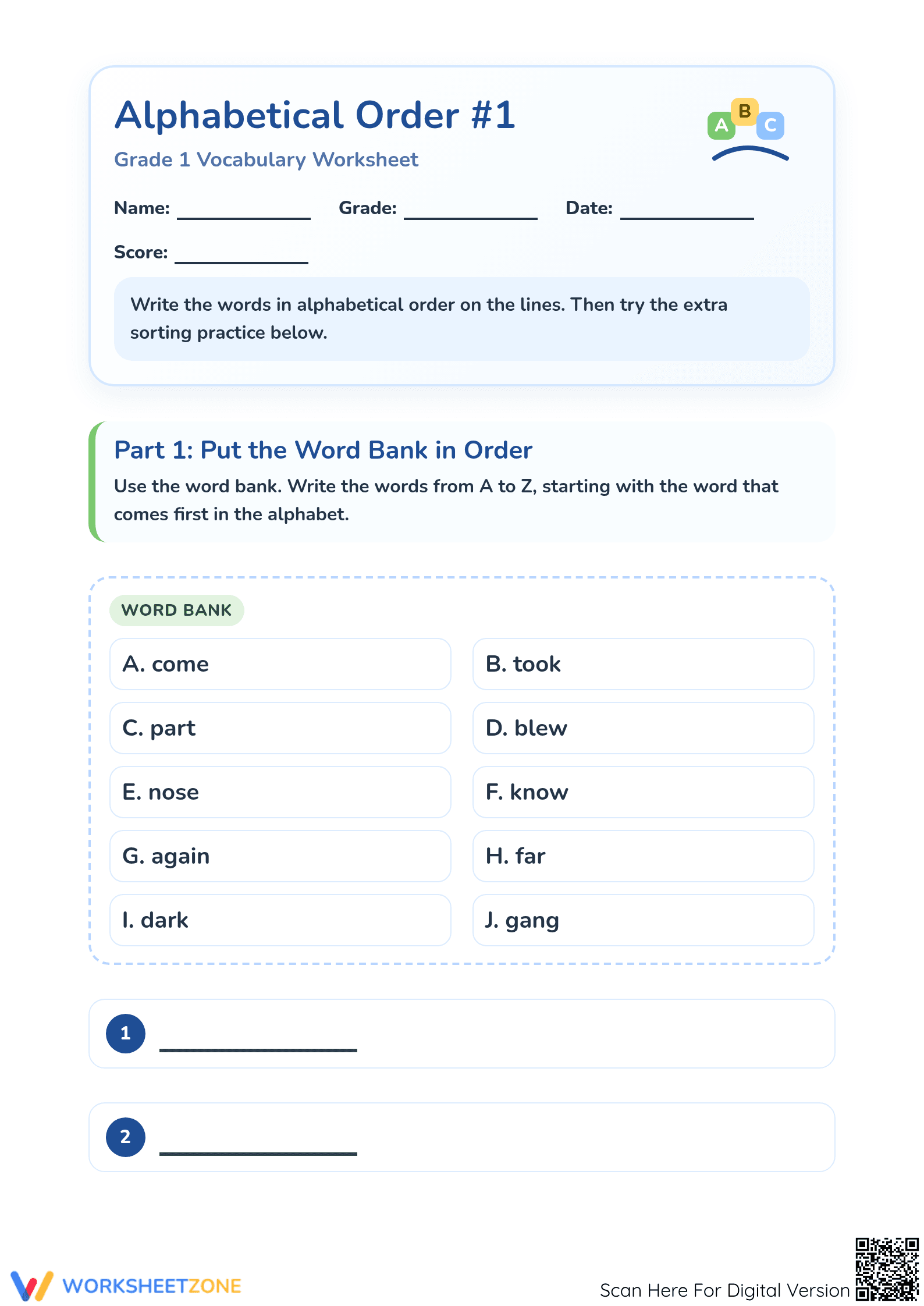
This Grade 1 alphabetical order worksheet helps students master the foundational skill of sorting words by their first letter. By completing 18 structured exercises across three pages, learners build the dictionary-readiness skills needed for independent vocabulary growth. Students will gain confidence in recognizing letter sequences and organizing word lists with increasing accuracy.
At a Glance
- Grade: 1 · Subject: English Language Arts (ELA)
- Standard:
CCSS.ELA-LITERACY.L.1.4— Use beginning dictionaries to determine or clarify the meaning of words and phrases- Skill Focus: Alphabetical order sorting
- Format: 3 pages · 18 problems · Answer key included · PDF
- Best For: Independent practice or emergency sub plans
- Time: 20–30 minutes
What's Inside
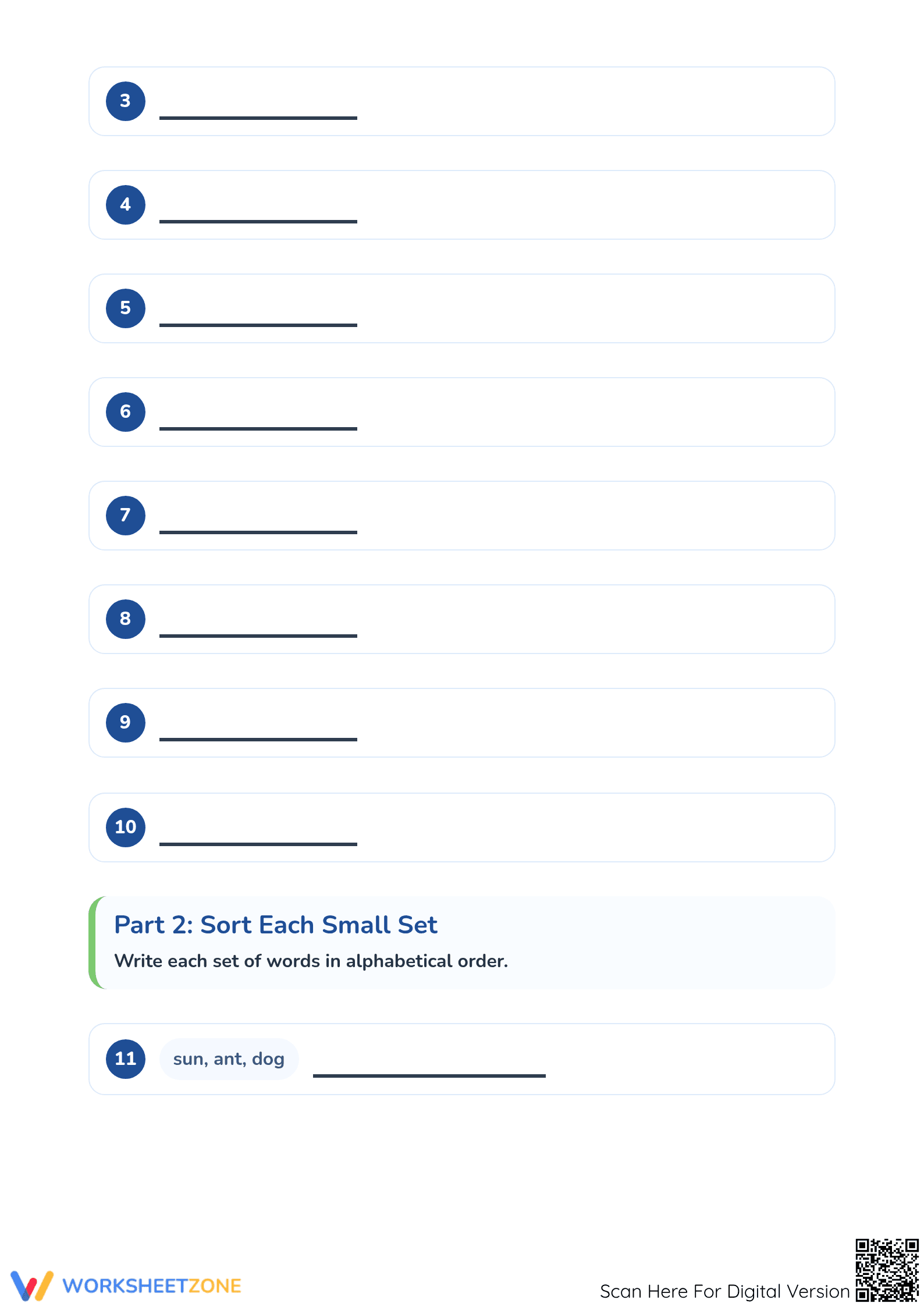
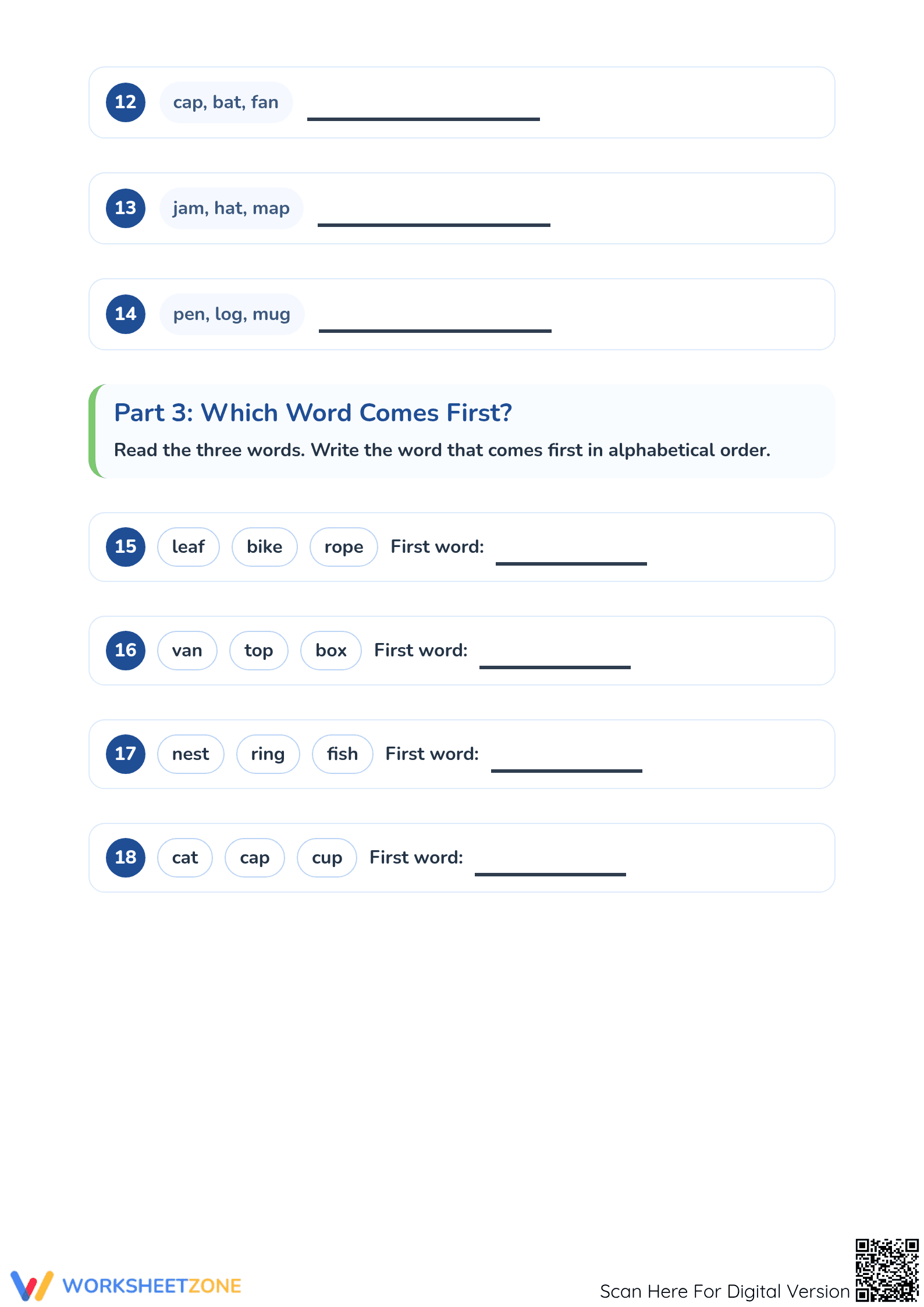
The resource features 18 tasks organized into three sections for comprehensive coverage. Students begin by sorting a 10-word bank, followed by smaller three-word sorting sets to refine discrimination. The final section involves identifying the word that comes first among three options. A full answer key is included for immediate feedback or self-grading.
Zero-Prep Workflow
Designed for a streamlined experience, this set requires under two minutes of preparation. Print the three-page PDF, distribute it during your ELA block as independent work, and review answers using the provided key. It is an ideal resource for emergency sub plans because the instructions are completely self-explanatory for students.
Standards Alignment
This activity aligns with `CCSS.ELA-LITERACY.L.1.4`, focusing on using glossaries and beginning dictionaries. Alphabetical order is a prerequisite for these higher-order skills. By practicing sorting now, students establish the framework required for future research. This standard code can be copied directly into lesson plans or district curriculum mapping tools.
How to Use It
Use this worksheet during the "You Do" phase of a gradual-release lesson after introducing the alphabet sequence. It also serves as an excellent formative assessment tool; observe students during the second section to see if they can sort three-word sets without a visual alphabet anchor. Expect most first-graders to complete the full packet in 20 to 30 minutes.
Who It's For
This resource is tailored for Grade 1 but works for Kindergarteners with letter mastery or Grade 2 review. It pairs naturally with an alphabet anchor chart or vocabulary passage. Differentiation is easy: provide a visual alphabet strip for students who struggle with mental recall of letter positions during the sorting process.
Foundational literacy research by Fisher & Frey (2014) emphasizes that the acquisition of organizational skills like alphabetical order is critical for developing efficient information-seeking behaviors in early learners. This Grade 1 worksheet directly supports CCSS.ELA-LITERACY.L.1.4 by providing 18 targeted tasks that build the necessary fluency for future dictionary and glossary usage. Systematic practice with sorting word sets allows students to internalize the sequential logic of the English language, a prerequisite for advanced literacy and independent vocabulary expansion. By focusing on alphabetical sorting, the resource ensures that students transition from simple letter recognition to the functional application of the alphabet in academic contexts. This approach aligns with evidence-based instructional strategies that prioritize scaffolding the development of executive functioning skills within the domain of English Language Arts, ultimately preparing students for the rigorous demands of upper-elementary research and composition.


