




























Views
Downloads
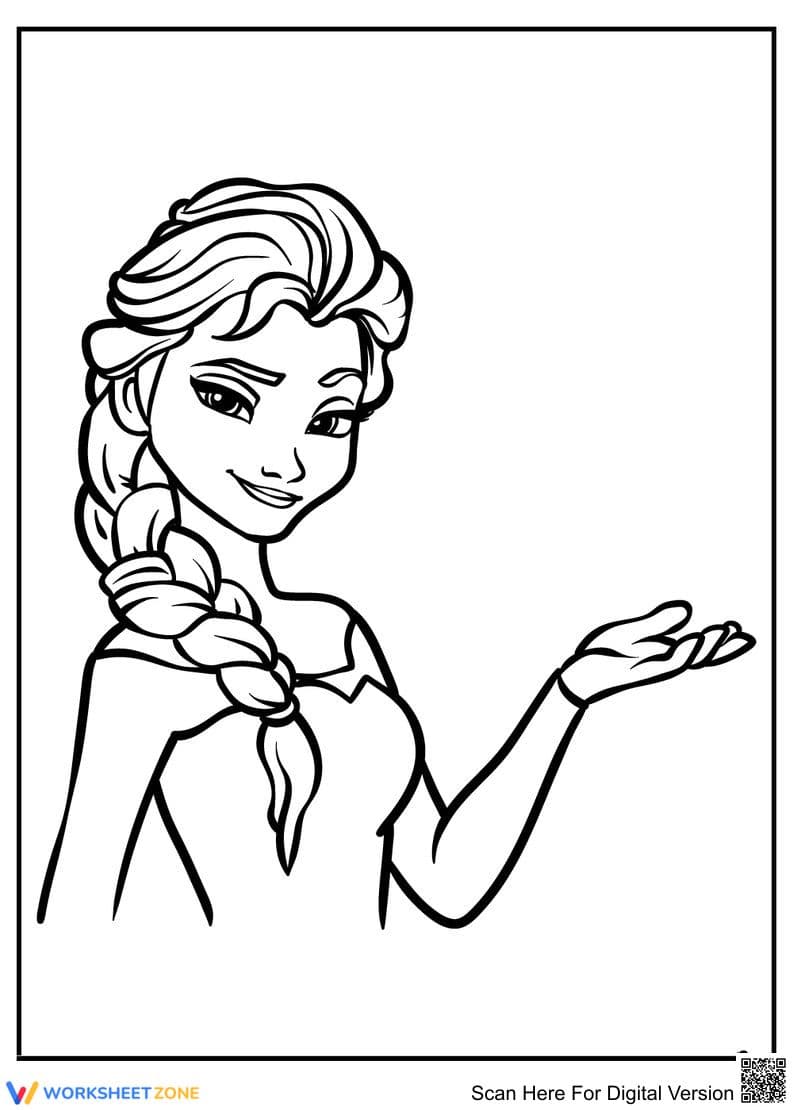

Elsa Coloring Page | Essential Kindergarten Printable

Paste this activity's link or code into your existing LMS (Google Classroom, Canvas, Teams, Schoology, Moodle, etc.).
Students can open and work on the activity right away, with no student login required.
You'll still be able to track student progress and results from your teacher account.
This printable Elsa coloring worksheet provides a high-interest creative outlet for young learners to develop essential fine motor control and hand-eye coordination. By engaging with a familiar character, students practice precision and color selection, which are foundational precursors to formal writing and artistic expression in early childhood education settings.
At a Glance
- Grade: Kindergarten · Subject: Arts & English
- Standard:
CCSS.ELA-LITERACY.SL.K.5— Add drawings or visual displays to descriptions to provide additional detail- Skill Focus: Fine motor control and creative expression
- Format: 1 page · 1 task · Answer key N/A · PDF
- Best For: Morning work or early finishers
- Time: 15–20 minutes
The worksheet features a high-resolution, single-page line art illustration of Queen Elsa. The design includes varying line weights to help students distinguish between primary outlines and finer details like hair texture and facial features. This no-prep PDF is ready for immediate distribution, requiring only standard crayons, colored pencils, or markers for completion.
The zero-prep workflow for this resource is designed for maximum efficiency in a busy classroom. First, print the single-page PDF (30 seconds). Second, distribute the sheets to students during transition periods or as part of a literacy center (1 minute). Finally, review the completed work to assess grip strength and spatial awareness (30 seconds). Total teacher preparation time is under two minutes, making it an ideal emergency sub plan component.
This resource aligns with `CCSS.ELA-LITERACY.SL.K.5`, which encourages students to "add drawings or other visual displays to descriptions as desired to provide additional detail." While primarily an artistic task, it supports the standard by allowing students to visually represent a character they may be describing in a companion writing or speaking activity. Both standard codes can be copied directly into lesson plans, IEP goals, or district curriculum mapping tools.
Use this worksheet as a formative assessment tool for fine motor development during the first weeks of school. Observe how students hold their coloring tools and their ability to stay within the lines. Alternatively, use it as a "cool-down" activity following a high-energy lesson to help students refocus. Completion typically takes 15 to 20 minutes depending on the student's attention to detail.
This activity is designed for Kindergarten and Grade 1 students, though it remains popular through Grade 5 for recreational use. It is particularly effective for English Language Learners (ELLs) as a non-verbal way to participate in classroom themes. Pair this worksheet with a character description anchor chart or a read-aloud of a winter-themed story to provide context.
Research by Fisher & Frey (2014) emphasizes the importance of visual representation in the gradual release of responsibility model, noting that creative tasks like coloring can lower the affective filter for young learners. By integrating familiar cultural icons like Elsa, educators can bridge the gap between home interests and school-based fine motor requirements. The use of CCSS.ELA-LITERACY.SL.K.5 ensures that even artistic endeavors remain grounded in recognized developmental milestones. This worksheet serves as a bridge for students who are still developing the manual dexterity required for complex letter formation, providing a low-stakes environment to practice pressure control and stroke precision. According to the RAND AIRS 2024 report on early childhood engagement, high-interest visual materials significantly increase task persistence among students in the K-2 range, leading to better long-term outcomes in foundational literacy and motor skills.


