


























Views
Downloads
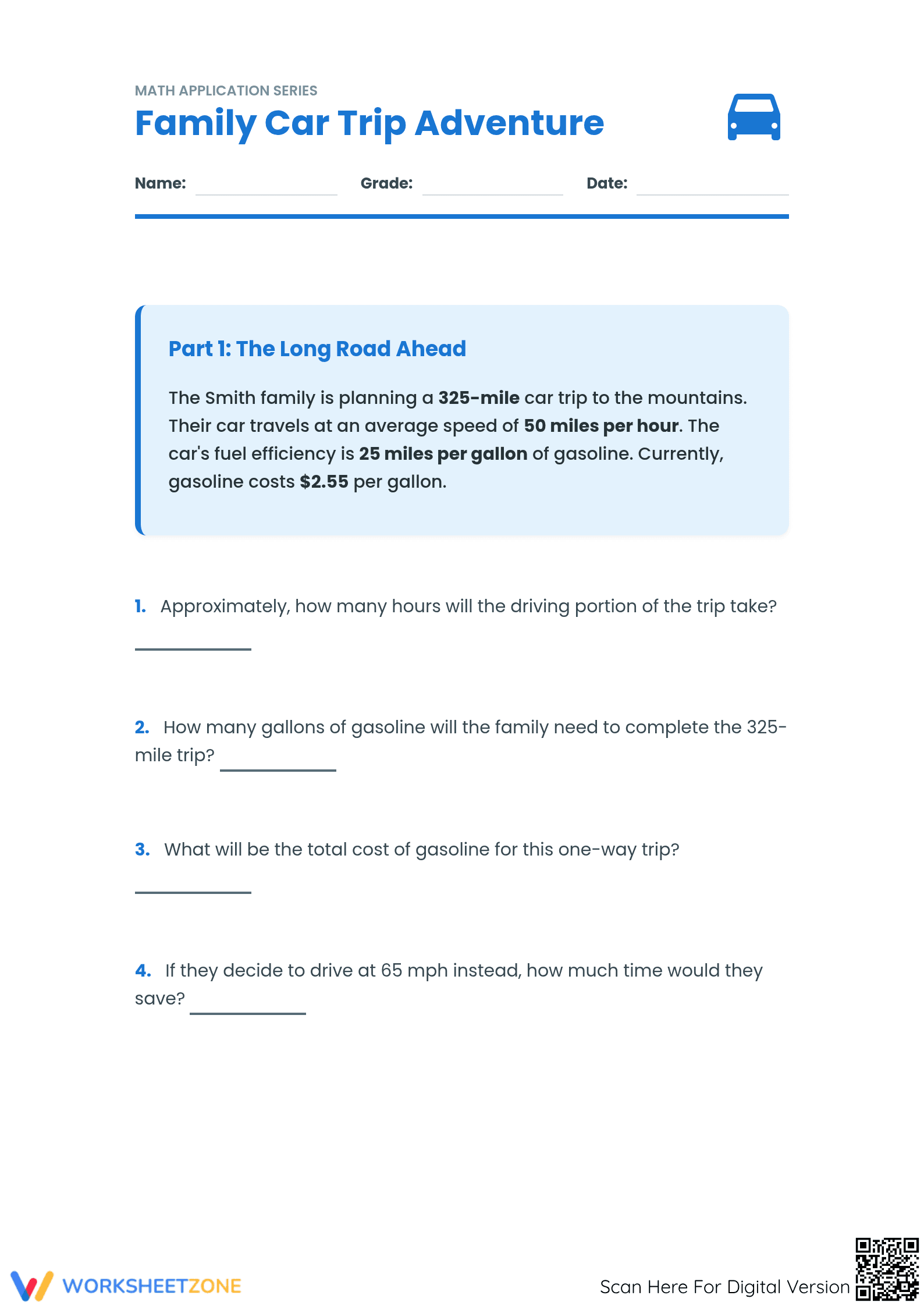

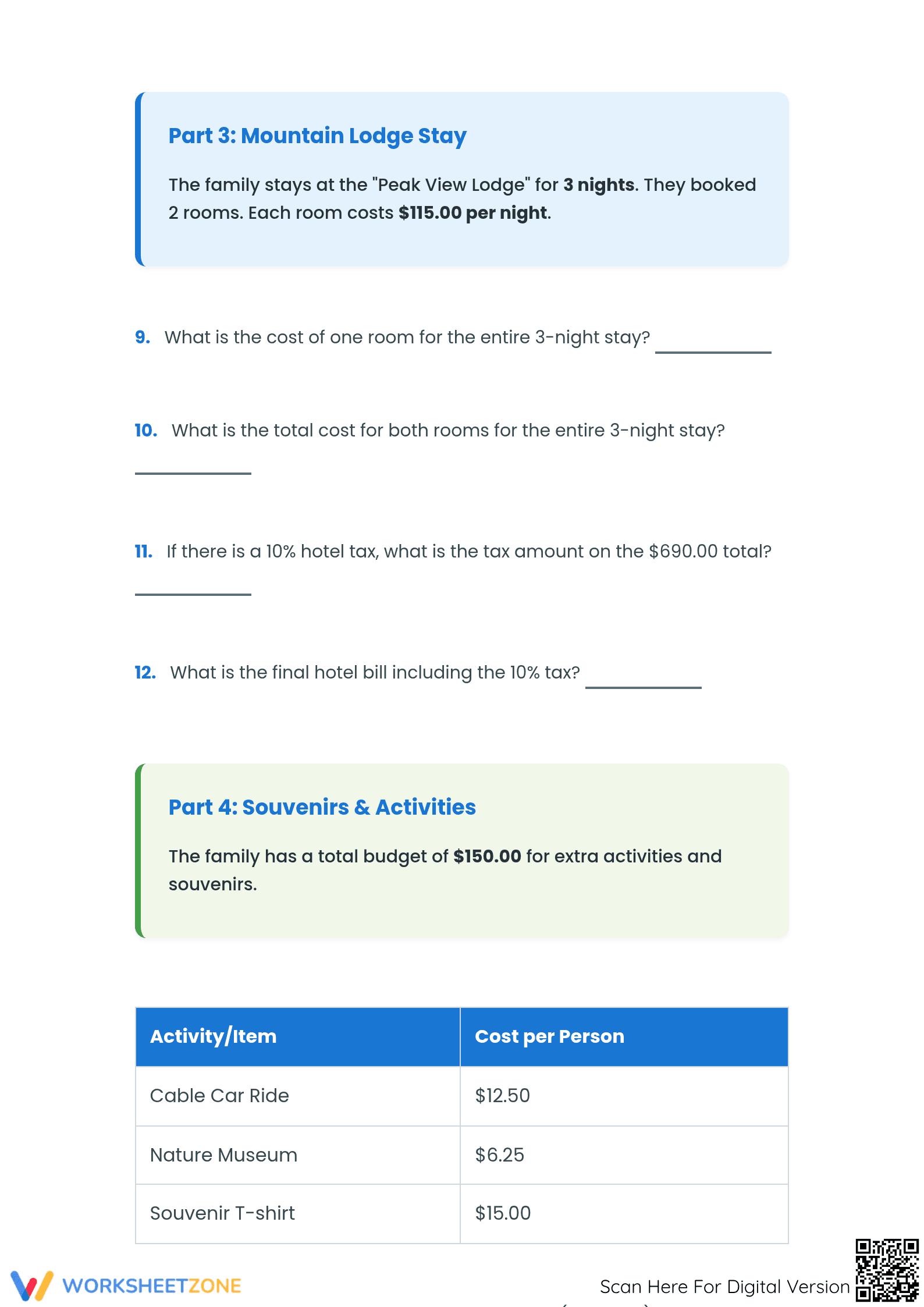
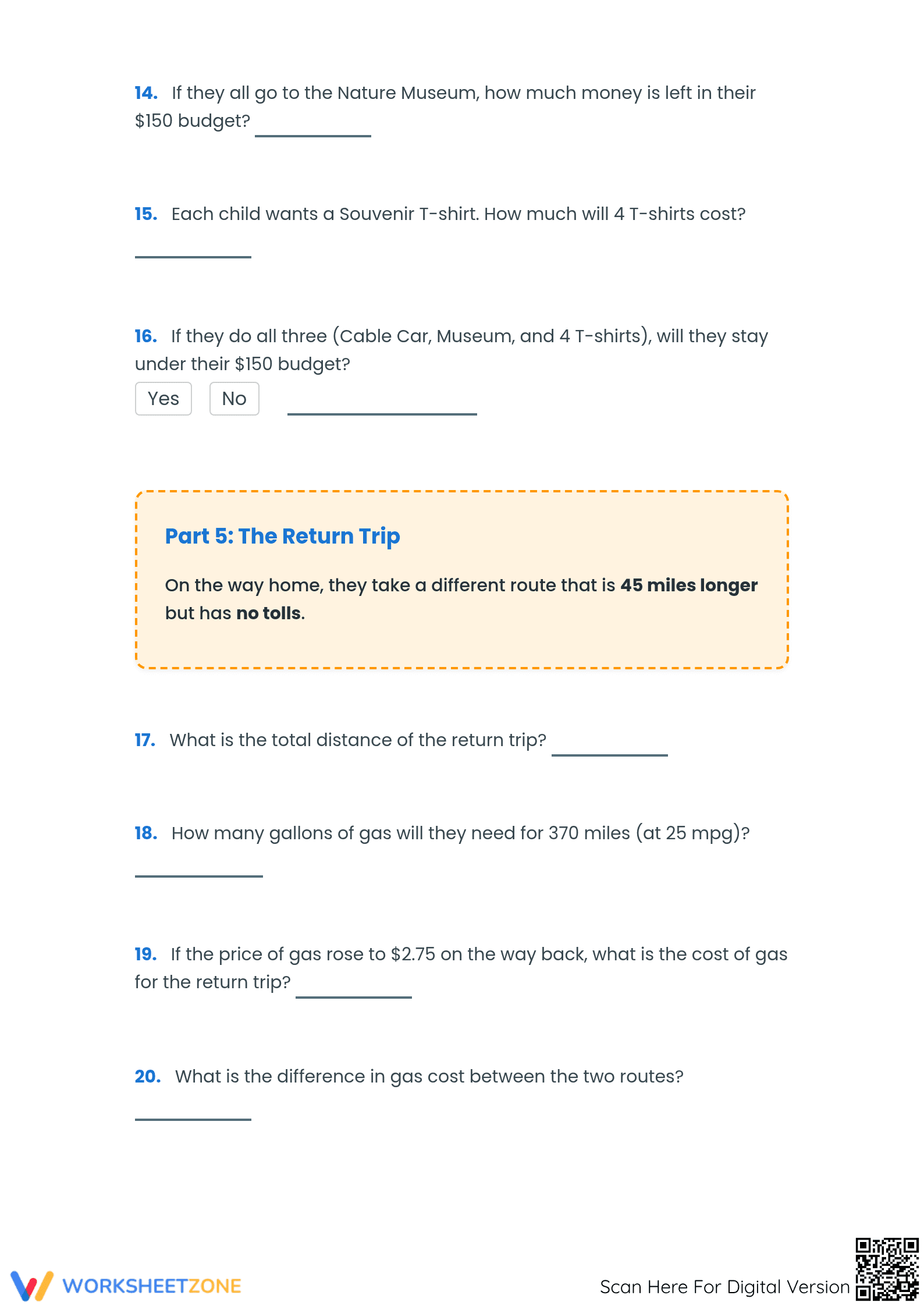
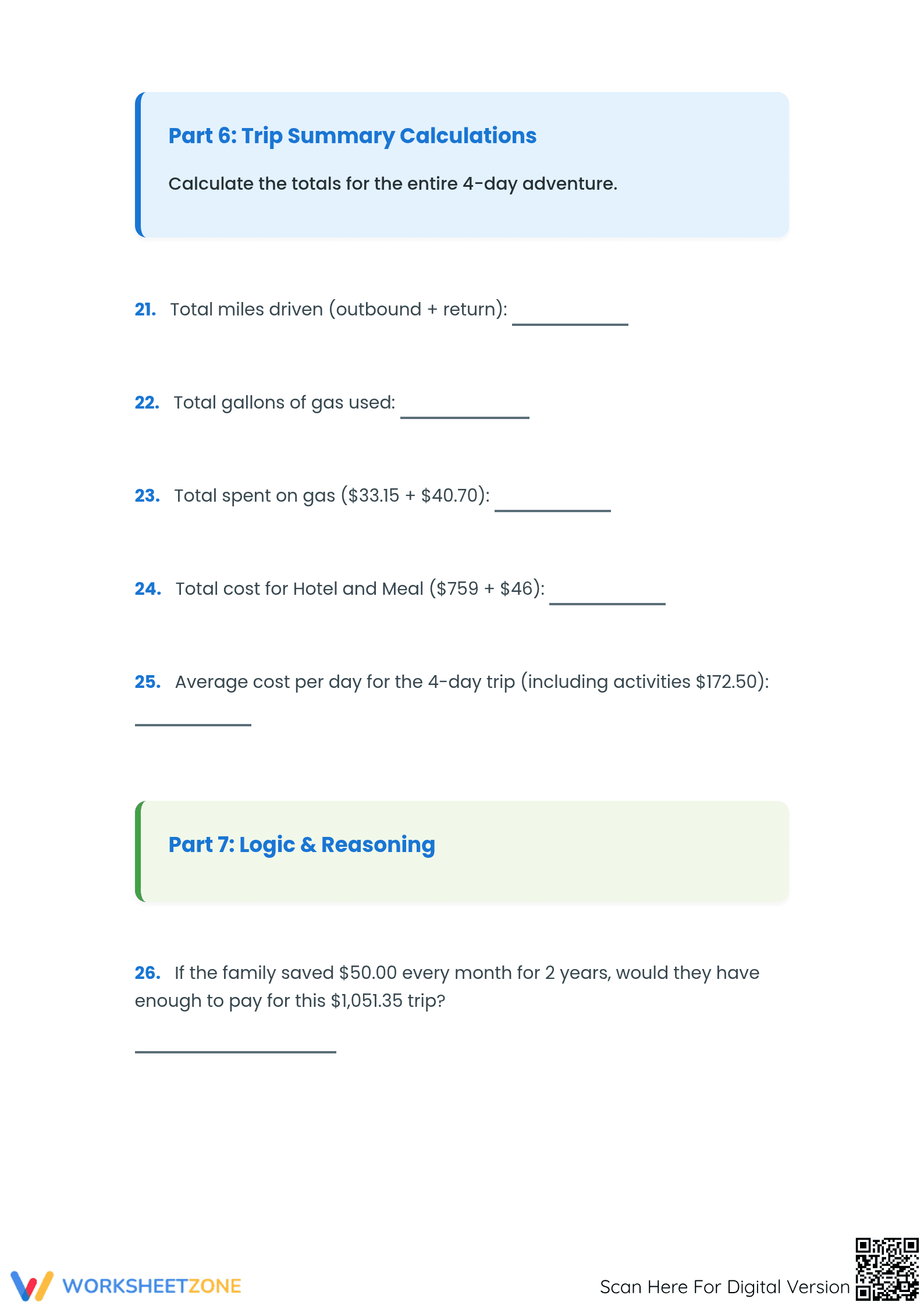

Family Car Trip Adventure Math Worksheet | Printable
Paste this activity's link or code into your existing LMS (Google Classroom, Canvas, Teams, Schoology, Moodle, etc.).
Students can open and work on the activity right away, with no student login required.
You'll still be able to track student progress and results from your teacher account.
Master real-world mathematics through a comprehensive travel narrative. This multi-page resource challenges students to apply arithmetic operations, decimal logic, and critical reasoning to a 4-day family road trip. Students calculate everything from fuel costs to hotel taxes, ensuring they see the immediate utility of their classroom skills in a tangible, engaging context.
At a Glance
- Grade: 4–5 · Subject: Math
- Standard:
CCSS.MATH.CONTENT.4.OA.A.3— Solve multi-step word problems using the four operations and represent with equations- Skill Focus: Multi-Step Problem Solving
- Format: 5 pages · 26 problems · Answer key included · PDF
- Best For: Independent practice or emergency sub plans
- Time: 45–60 minutes
What's Inside
This collection features seven distinct parts following the Smith family's journey. Across 5 printable pages, students encounter 26 problems covering speed/distance/time, fuel efficiency, restaurant budgeting with tips, hotel stay calculations with tax, and souvenir spending. The structured layout includes clear data tables for pricing and a chronological flow that keeps learners motivated as they "travel" through the packet.
Zero-Prep Workflow
This worksheet is designed for an immediate classroom experience. Teachers can print the 5-page packet in under 1 minute and distribute it as a self-contained unit. Because the narrative flow guides students through the trip chronologically, learners can work through the 26 problems independently with minimal teacher intervention. The provided answer key allows for a rapid 5-minute review session at the end of the period, making this an ideal solution for sub plans.
Standards Alignment
The primary focus is `CCSS.MATH.CONTENT.4.OA.A.3`, which requires students to solve multistep word problems posed with whole numbers and assess the reasonableness of answers. The worksheet also supports decimal operations found in Grade 5 standards. Both standard codes can be copied directly into lesson plans, IEP goals, or district curriculum mapping tools to ensure documented instructional alignment.
How to Use It
Use this resource as a culminating activity after teaching decimal operations or as a formative assessment mid-unit. During instruction, observe how students handle the transition from Part 2 (restaurant totals) to Part 3 (hotel stays) to identify gaps in percentage calculations. Expected completion time is approximately one standard class period, though it can be split over two days for younger learners.
Who It's For
This adventure is perfect for Grade 4 and 5 students who need to move beyond simple algorithms into logical application. It provides natural differentiation through context; while the math remains rigorous, the familiar trip scenario helps bridge the gap for students who struggle with abstract word problems. Pair this with a direct instruction lesson on "hidden questions" in multi-step problems.
The Family Car Trip Adventure aligns with research from Fisher & Frey (2014) regarding the efficacy of scaffolded narrative inquiry in mathematics. By embedding 26 computational tasks within a continuous story, the worksheet reduces the cognitive friction often associated with isolated word problems. Students engage with CCSS.MATH.CONTENT.4.OA.A.3 by solving multi-step scenarios that require them to hold multiple variables—such as speed, distance, and fuel efficiency—in their working memory simultaneously. This approach mirrors the complex problem-solving environments found in NAEP assessments, where students must synthesize data from tables and text to reach a final solution. The inclusion of real-world constraints like hotel taxes and restaurant tips ensures that learners develop financial literacy alongside traditional arithmetic proficiency. Ultimately, this resource provides the rigorous practice necessary for students to transition from simple algorithmic execution to authentic mathematical modeling and analysis in high-stakes testing environments.


