


























Views
Plays

Wind Velocity Worksheet | Grade 12 Printable Practice
Paste this activity's link or code into your existing LMS (Google Classroom, Canvas, Teams, Schoology, Moodle, etc.).
Students can open and work on the activity right away, with no student login required.
You'll still be able to track student progress and results from your teacher account.
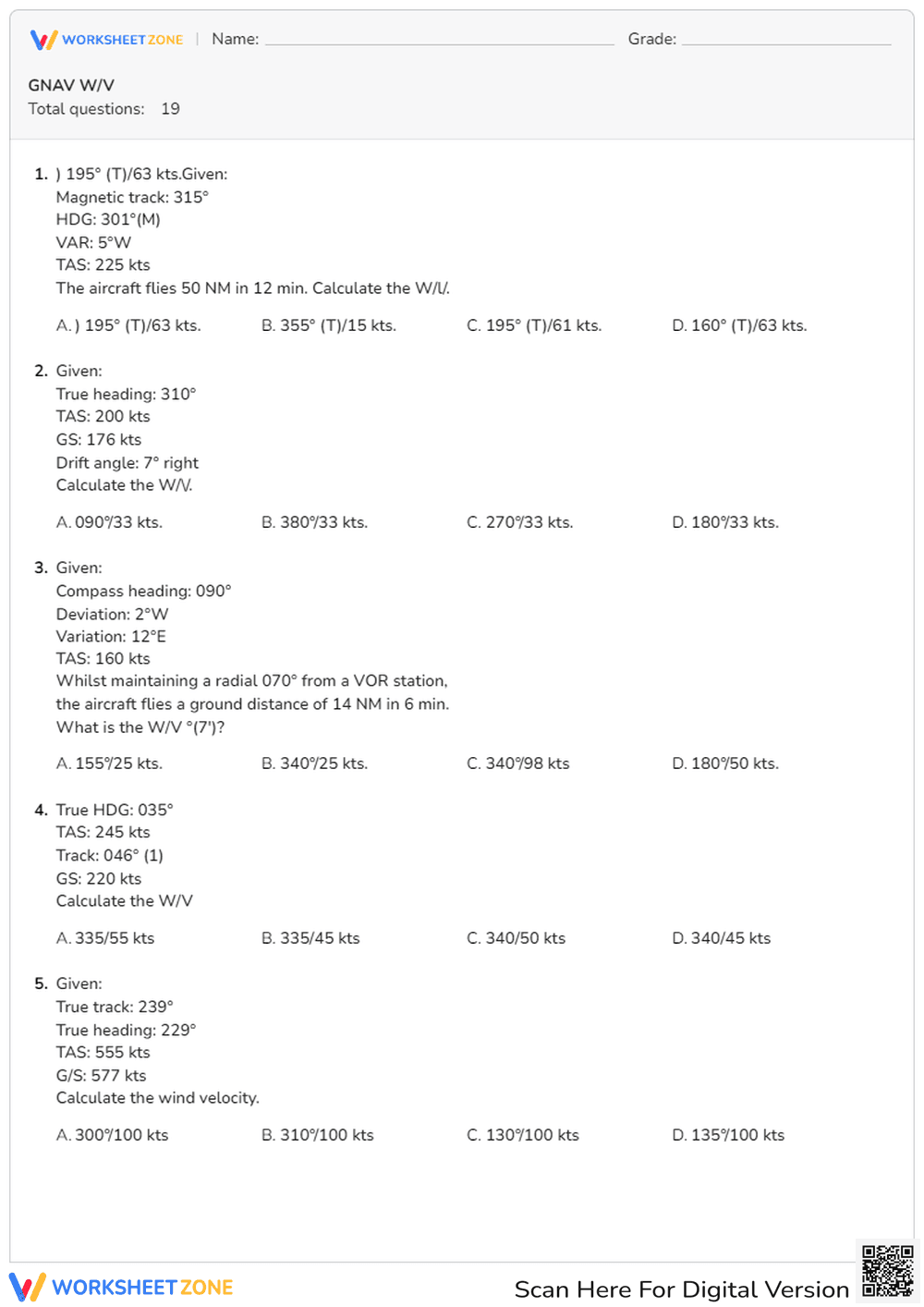
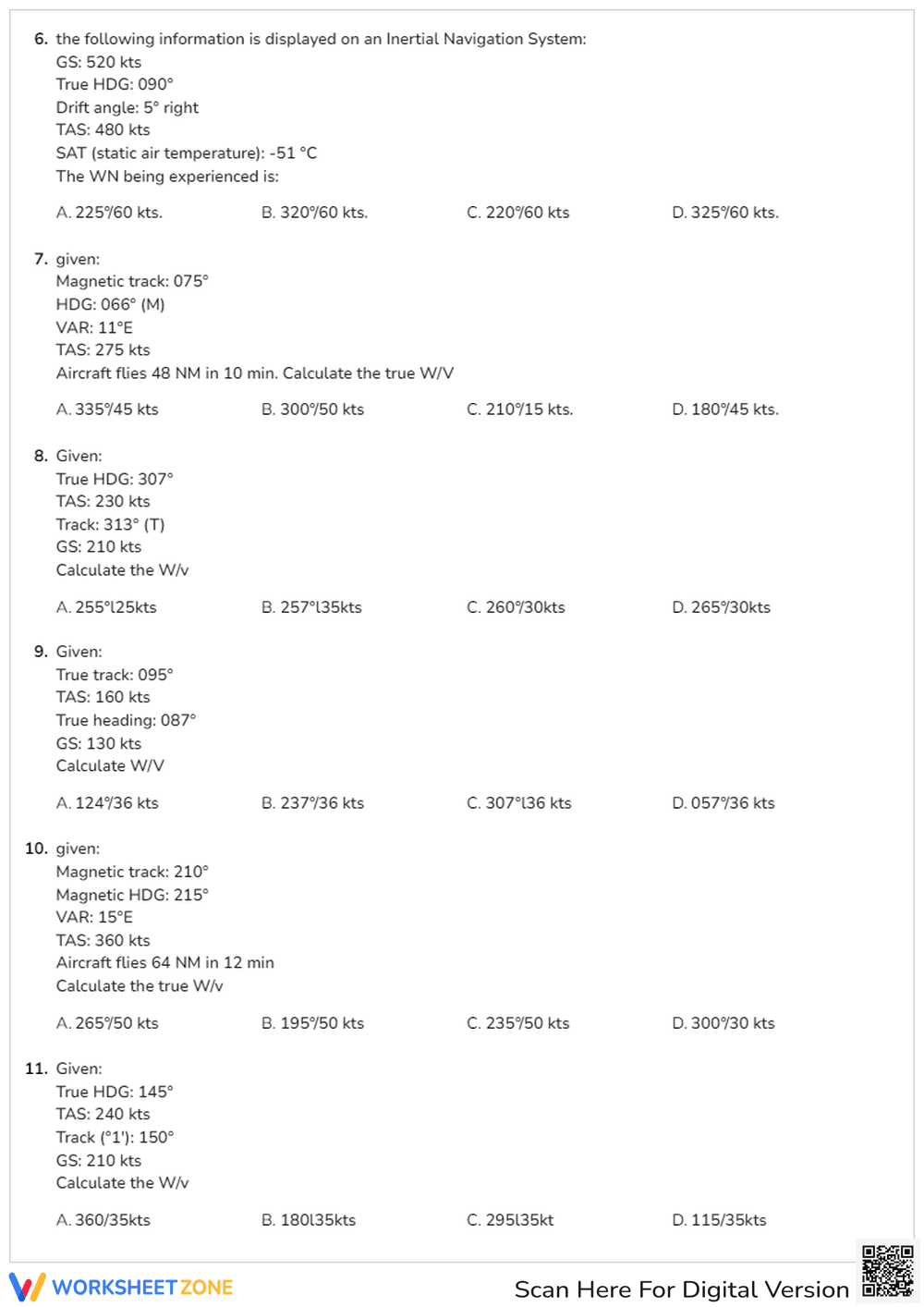
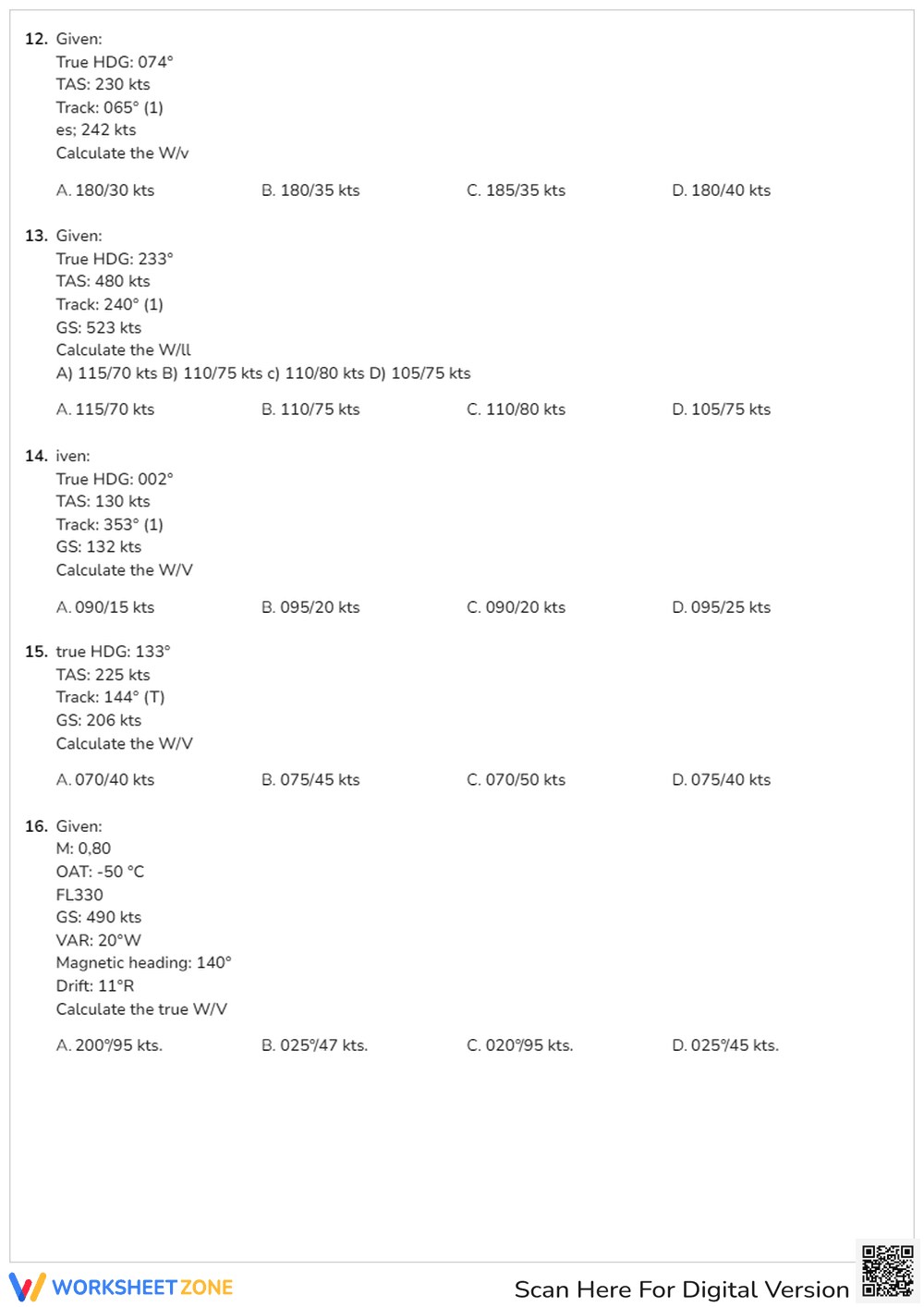
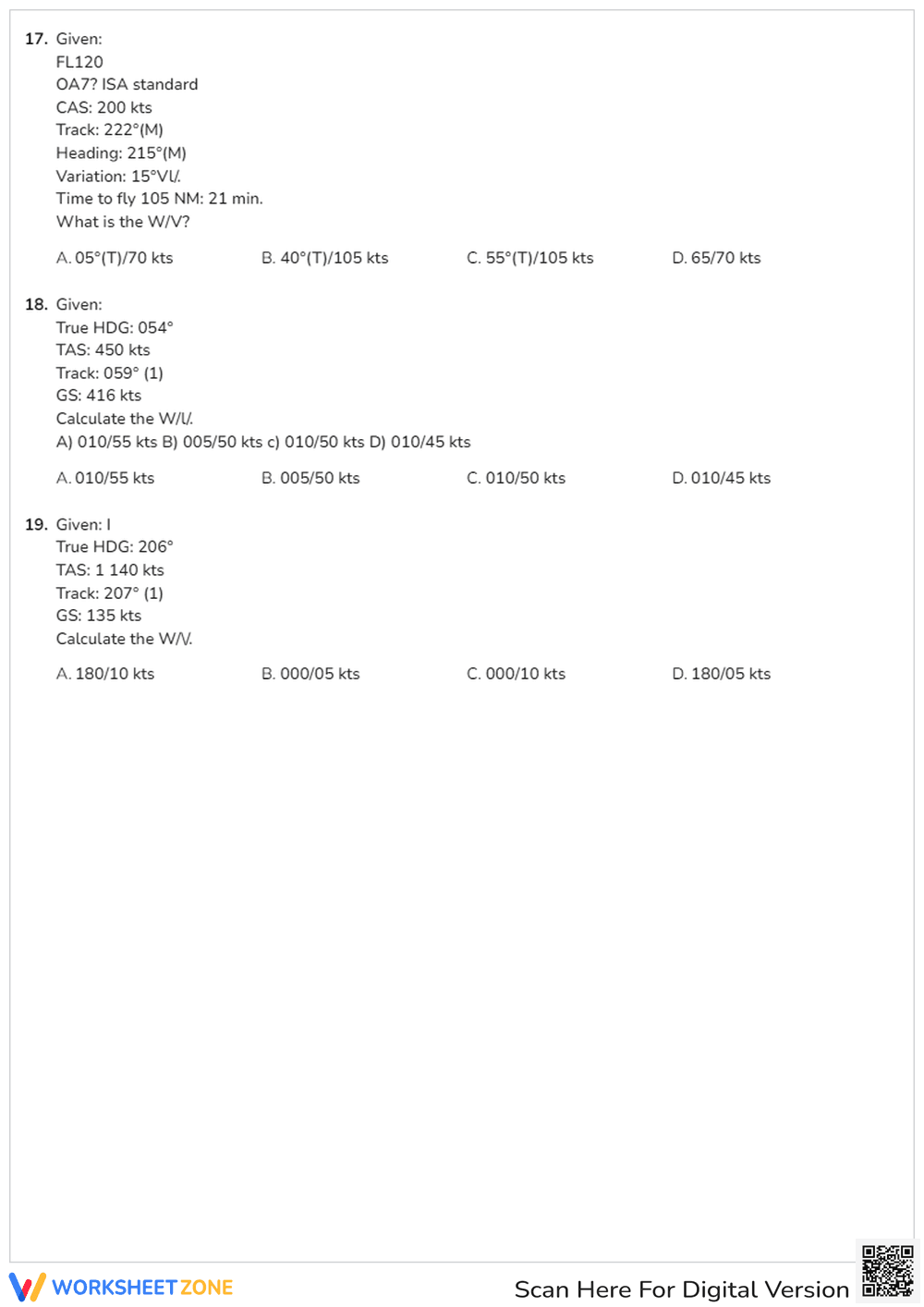
This Grade 12 aviation physics worksheet provides students with rigorous practice in calculating wind velocity using vector mathematics. By synthesizing flight data such as True Airspeed, Ground Speed, and drift angles, learners develop the high-level precision required for professional flight planning and advanced kinematics applications.
At a Glance
- Grade: 12 · Subject: Physics
- Standard:
CCSS.MATH.CONTENT.HSN.VM.A.3— Solve problems involving velocity represented by vectors- Skill Focus: Wind Velocity Vector Analysis
- Format: 4 pages · 19 problems · Answer key included · PDF
- Best For: Independent practice and sub plans
- Time: 45–60 minutes
This comprehensive 4-page PDF contains 19 complex multiple-choice questions designed to simulate professional aviation examinations. Each problem provides a unique set of flight data, including Magnetic Track, Heading, Variation, and True Airspeed. Students must synthesize these data points to determine the resultant wind velocity. The layout is clean and professional, mirroring the format of standard pilot certification tests and providing a self-contained data block for every question.
Zero-Prep Workflow
- Print: Generate the 4-page packet in under 30 seconds for your entire class or flight cohort.
- Distribute: Hand out the materials immediately; the self-contained data blocks require no additional textbooks or external charts to solve.
- Review: Use the included answer key to facilitate a 15-minute technical debrief, focusing on common vector calculation errors.
Total teacher preparation time is less than 2 minutes, making this an ideal resource for both primary instruction and emergency sub plans in technical STEM environments.
This resource is aligned to CCSS.MATH.CONTENT.HSN.VM.A.3, which requires students to solve problems involving velocity and other quantities that can be represented by vectors. The worksheet specifically targets the application of vector addition and subtraction in a physical context. Both standard codes can be copied directly into lesson plans, IEP goals, or district curriculum mapping tools.
This worksheet is best utilized during the application phase of a unit on kinematics or navigation. Instructors should assign it after students have been introduced to manual vector plotting or flight computers. It serves as an excellent formative assessment to observe how accurately students can differentiate between magnetic and true headings before moving on to cross-country flight planning. Expected completion time ranges from 45 to 60 minutes depending on calculator proficiency.
This material is designed for Grade 12 students, college-level aviation candidates, and high school physics students in advanced tracks. It is particularly effective for learners pursuing private pilot licensure or those in specialized STEM programs. Pair this resource with a standard flight computer or a vector-based anchor chart for maximum instructional impact.
The integration of vector mathematics into vocational contexts like aviation navigation is supported by research from Fisher & Frey (2014), which emphasizes the importance of purposeful, domain-specific practice in developing disciplinary literacy. This worksheet addresses the standard CCSS.MATH.CONTENT.HSN.VM.A.3 by requiring students to solve problems involving velocity represented by vectors. By engaging with 19 distinct scenarios involving True Airspeed, Ground Speed, and drift, students move beyond rote memorization toward a functional understanding of how environmental variables impact mechanical systems. Such rigorous application of mathematical principles ensures that learners are prepared for the high-stakes environments of aeronautical engineering and professional piloting. The structured multiple-choice format provides immediate feedback loops, allowing for the rapid identification of misconceptions in vector orientation or unit conversion. This resource serves as a vital bridge between abstract geometry and the practical demands of modern navigation science.


