


























Views
Downloads

Multiply by Multiples of 10 | Printable Grade 3 Math
Paste this activity's link or code into your existing LMS (Google Classroom, Canvas, Teams, Schoology, Moodle, etc.).
Students can open and work on the activity right away, with no student login required.
You'll still be able to track student progress and results from your teacher account.
This Grade 3 math resource helps students master the concept of multiplying one-digit numbers by multiples of 10 through a combination of vocabulary building, visual modeling, and direct computation. By connecting place value understanding to basic facts, learners develop the fluency needed for multi-digit arithmetic and future algebraic reasoning.
At a Glance
- Grade: 3 · Subject: Math
- Standard:
3.NBT.A.3— Multiply one-digit whole numbers by multiples of 10 like 10 through 90- Skill Focus: Multiples of 10 Multiplication
- Format: 3 pages · 11 problems · Answer key included · PDF
- Best For: Small group math centers or homework
- Time: 20–30 minutes
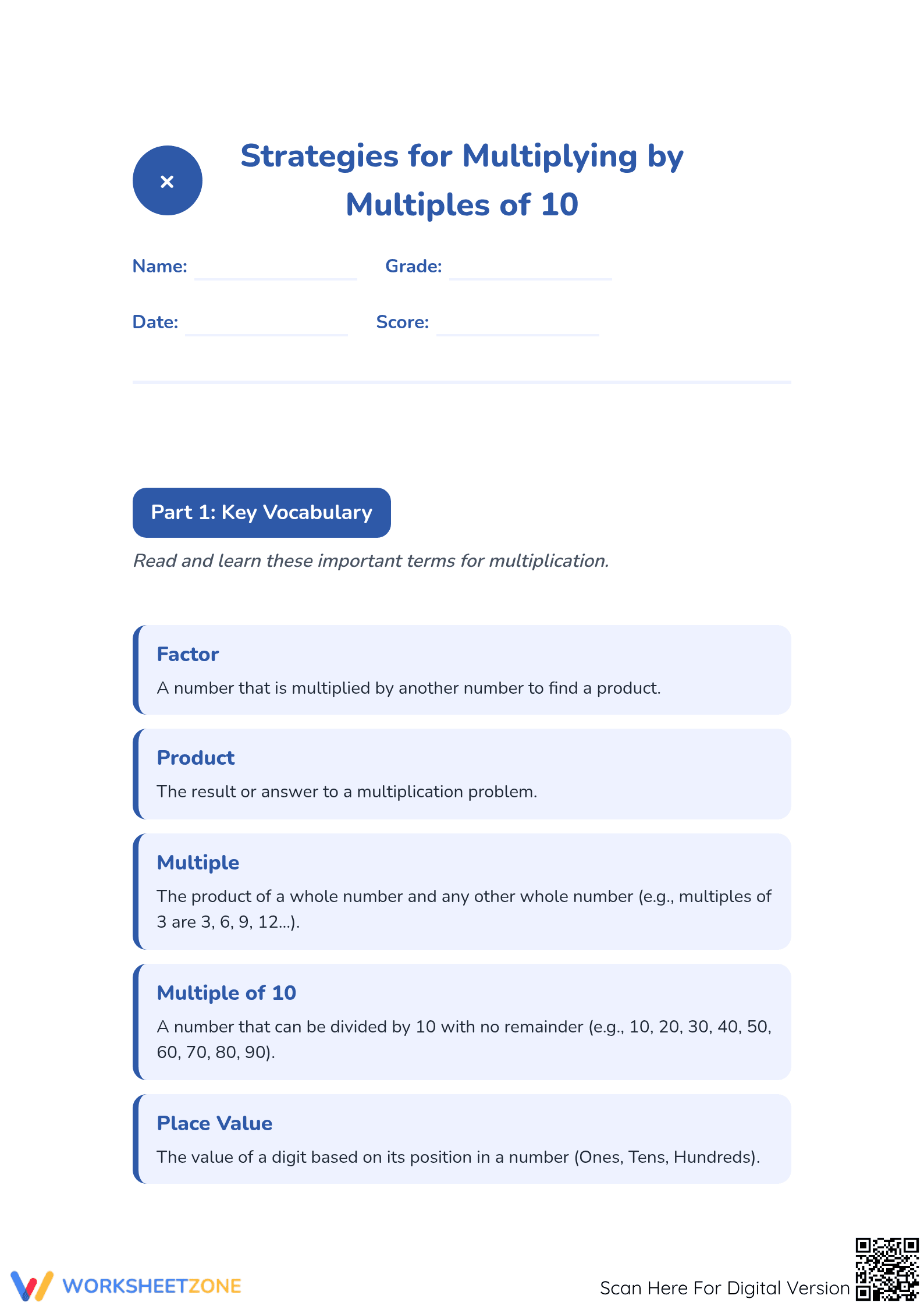
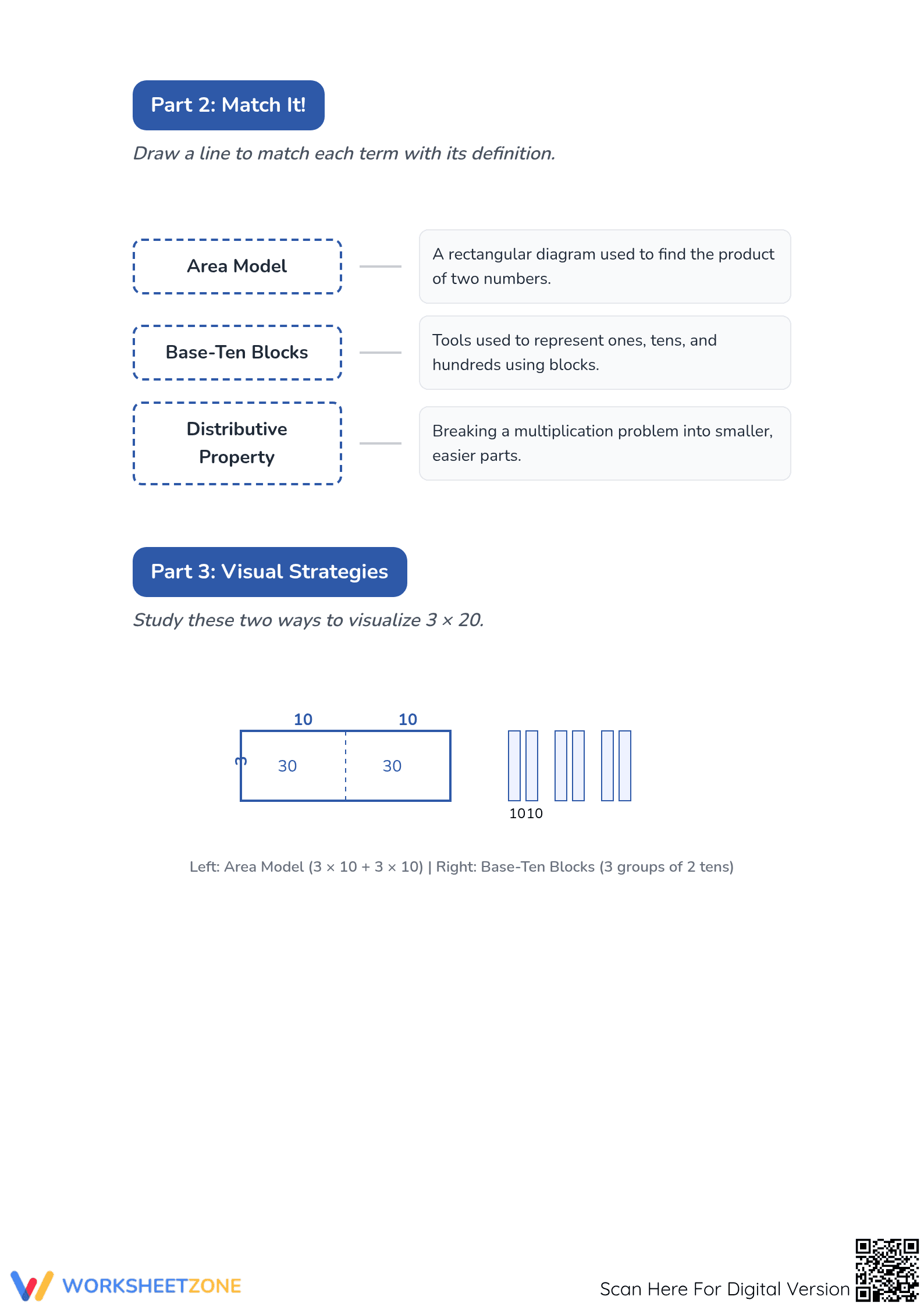
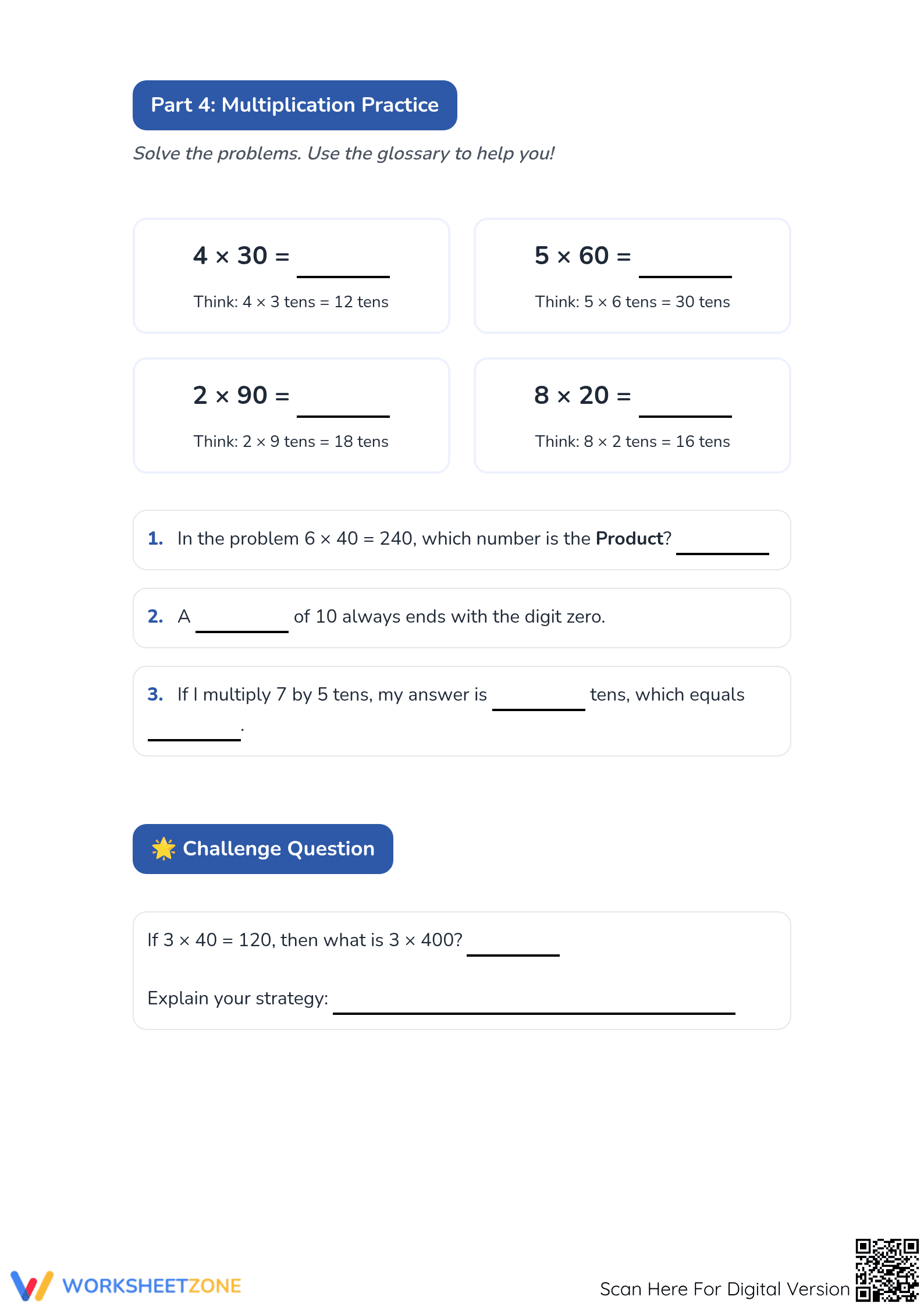
This three-page PDF offers a comprehensive instructional path. It starts with a glossary of essential terms like factor and product, followed by a matching activity to reinforce definitions. The second page introduces visual strategies including area models and base-ten blocks. Finally, students apply their knowledge through calculation practice and a multi-step challenge question.
Skill Progression
- Guided Practice: Students begin with vocabulary acquisition and matching definitions to ensure they understand the mathematical language before attempting calculations.
- Supported Practice: The worksheet utilizes "Think" prompts that encourage students to decompose problems into tens (e.g., 4 x 3 tens = 12 tens) to bridge the gap between simple facts and larger products.
- Independent Practice: Learners are challenged to apply strategies to abstract equations and explain their reasoning in a higher-order thinking challenge question.
The worksheet follows a gradual release model, moving from conceptual definitions to visual models and finally to independent application.
Standards Alignment
This worksheet is strictly aligned to 3.NBT.A.3: Multiply one-digit whole numbers by multiples of 10 in the range 10-90 (e.g., 9 x 80, 5 x 60) using strategies based on place value and properties of operations. Both standard codes can be copied directly into lesson plans, IEP goals, or district curriculum mapping tools.
How to Use It
Use this glossary and practice set during the "We Do" phase of a lesson. After introducing the area model on the whiteboard, have students complete the matching and "Think" sections in pairs to verbalize their reasoning. Alternatively, assign the practice page as a formative assessment. Observe if students are successfully converting "tens" back into standard form to identify those needing additional base-ten block support.
Who It's For
This resource is ideal for third-grade students working on base-ten operations. It provides excellent scaffolding for English Learners (ELs) through the explicit vocabulary glossary and visual models, making it a strong pairing for a direct instruction lesson on multi-digit multiplication properties.
Research from RAND AIRS 2024 emphasizes that integrating explicit vocabulary instruction within mathematical tasks significantly improves conceptual retention for diverse learners. This Grade 3 multiplication worksheet implements these findings by front-loading terms like factor, multiple, and place value before introducing computation. By standardizing the "Think" strategy of converting 4 x 30 into 4 x 3 tens, the resource reduces the cognitive load associated with larger numbers, allowing students to focus on the underlying place value logic. This approach aligns with evidence-based practices that recommend visual representations, such as the area models and base-ten blocks included here, to bridge the gap between concrete and abstract mathematical thinking. Using the standard code 3.NBT.A.3, educators can ensure that student practice remains focused on high-utility skills required for future multi-digit arithmetic success. The inclusion of a challenge question further promotes the higher-order thinking necessary for exceeding standard benchmarks.


