


























Views
Downloads
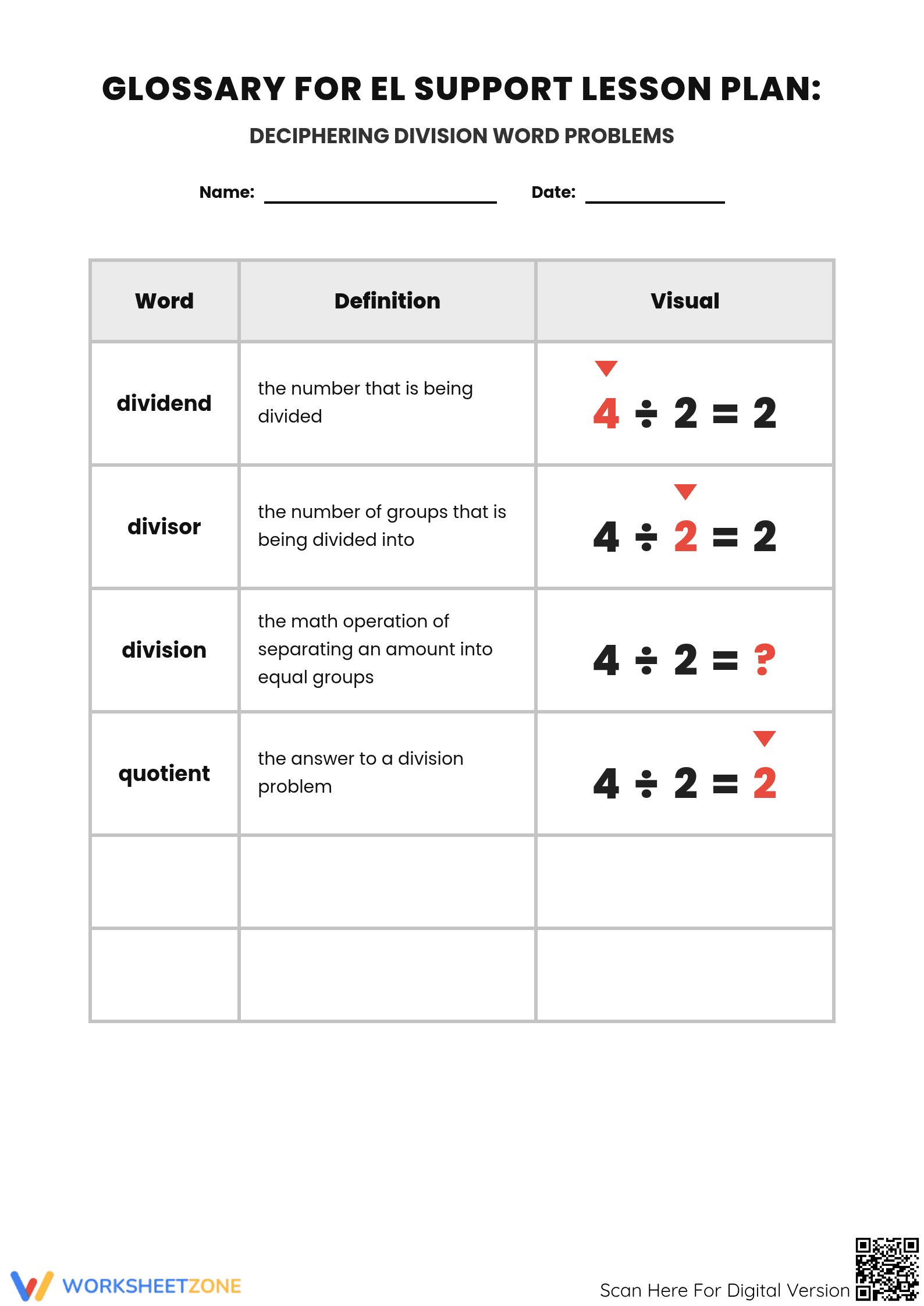

Division Vocabulary Glossary | Grade 4 Printable
Paste this activity's link or code into your existing LMS (Google Classroom, Canvas, Teams, Schoology, Moodle, etc.).
Students can open and work on the activity right away, with no student login required.
You'll still be able to track student progress and results from your teacher account.
This Grade 4 division vocabulary glossary provides students with a clear, visual reference for essential mathematical terms used in division word problems. By defining critical components like the dividend, divisor, and quotient with accompanying illustrations, it removes linguistic barriers and helps learners transition from basic calculation to conceptual word problem mastery effectively.
At a Glance
- Grade: 4 · Subject: Math
- Standard:
4.OA.A.2— Use multiplication and division to solve word problems involving multiplicative comparison- Skill Focus: Division Vocabulary Mastery
- Format: 1 page · 4 terms · Reference Tool included · PDF
- Best For: EL support and math vocabulary building
- Time: 5–10 minutes
What's Inside
This one-page reference sheet features a structured glossary table containing four essential division terms: dividend, divisor, division, and quotient. Each entry provides a student-friendly definition and a corresponding visual equation that highlights the specific part of the problem. Additionally, two blank rows are provided, allowing students to add their own vocabulary words or translated terms during the lesson.
Zero-Prep Workflow
The zero-prep workflow for this glossary is designed for immediate instructional support. First, print the single-page PDF (30 seconds). Next, distribute the sheet to students during the introduction of the "Deciphering Division Word Problems" lesson (1 minute). Finally, refer to the visual cues as you model the problem-solving process (ongoing). Total teacher preparation time is under two minutes, making it an ideal resource for busy classrooms or unexpected sub plans.
Standards Alignment
This resource is directly aligned to 4.OA.A.2, which requires students to "multiply or divide to solve word problems involving multiplicative comparison." Understanding the precise vocabulary of division is a prerequisite for correctly setting up these comparisons. This standard code can be copied directly into lesson plans, IEP goals, or district curriculum mapping tools to ensure vertical alignment across the mathematics department.
How to Use It
Teachers can utilize this glossary as a desk-side reference during independent practice or as a guided resource during small-group instruction. One effective use case is to have students point to the "divisor" or "quotient" on their glossary whenever they identify those values within a word problem. For formative assessment, observe if students are using the correct terminology during peer discussions to gauge their level of conceptual understanding.
Who It's For
This glossary is specifically crafted for fourth-grade students, particularly English Learners (ELs) who benefit from visual scaffolding in mathematics. It also serves as an excellent modification for students with IEPs requiring vocabulary support. The resource pairs naturally with any division word problem passage or an anchor chart focusing on the four basic operations, providing a bridge between language and logic.
Mastering the specialized language of mathematics is a critical component of academic success, as highlighted in the RAND AIRS 2024 report on elementary mathematics instruction. This Grade 4 glossary focuses on the primary standard 4.OA.A.2, providing students with the linguistic tools necessary to interpret and solve complex division word problems. By pairing formal definitions of terms like dividend and quotient with immediate visual reinforcements, the resource reduces the cognitive load on students who are simultaneously learning new mathematical concepts and academic English. Research from ScienceDirect TpT Analysis emphasizes that visual glossaries improve retention and application of mathematical terms in real-world scenarios. This standalone reference tool ensures that every student, regardless of their linguistic background, has access to the essential vocabulary required for multiplicative comparison. Educators can confidently integrate this worksheet into their curriculum to support differentiated instruction and meet the rigorous demands of state standards.


