


























Views
Downloads

Printable Compare & Contrast Worksheet | Grade 1 ELA
Paste this activity's link or code into your existing LMS (Google Classroom, Canvas, Teams, Schoology, Moodle, etc.).
Students can open and work on the activity right away, with no student login required.
You'll still be able to track student progress and results from your teacher account.
This Grade 1 compare and contrast worksheet helps students master essential vocabulary like "same" and "different." By working through structured matching and drawing activities, early readers build the foundational language skills required for analyzing texts and participating in collaborative classroom discussions.
At a Glance
- Grade: 1 · Subject: ELA
- Standard:
CCSS.ELA-LITERACY.SL.1.1— Participate in collaborative conversations with diverse partners about grade 1 topics and texts- Skill Focus: Compare and Contrast vocabulary acquisition
- Format: 3 printable pages · 12 structured problems · Answer key included · PDF
- Best For: Vocabulary building, independent practice, and early literacy center rotations
- Time: 15–20 minutes
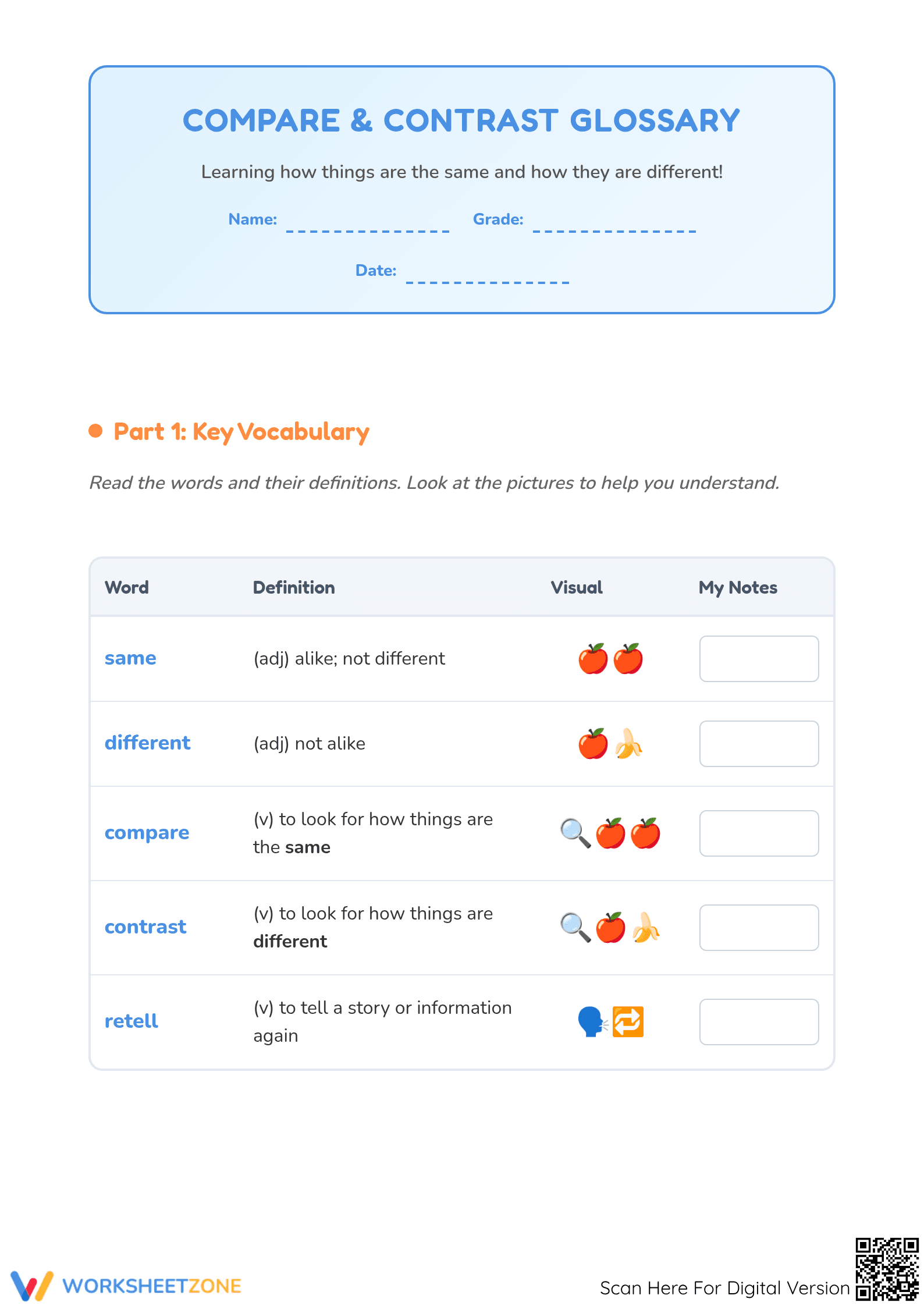
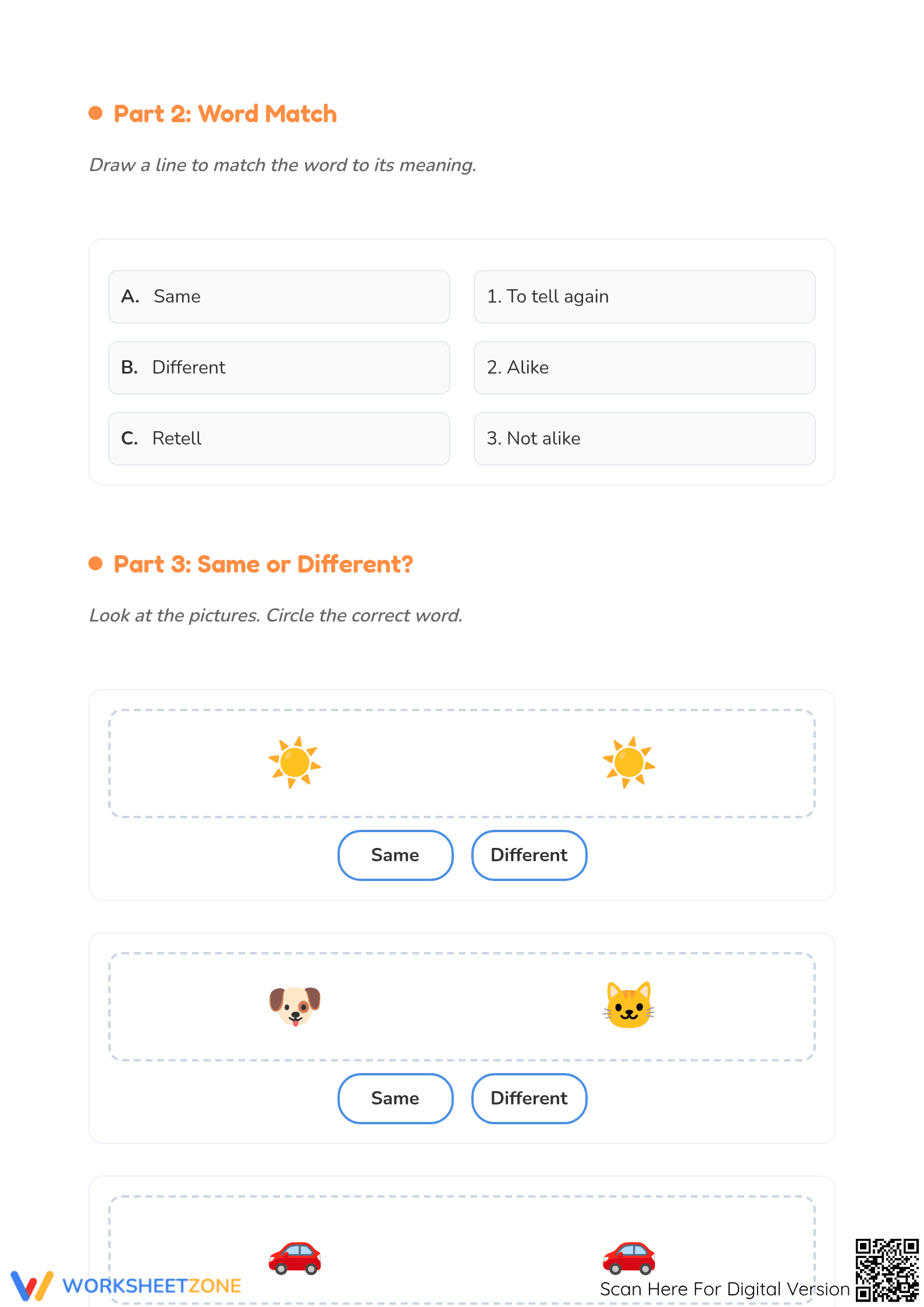
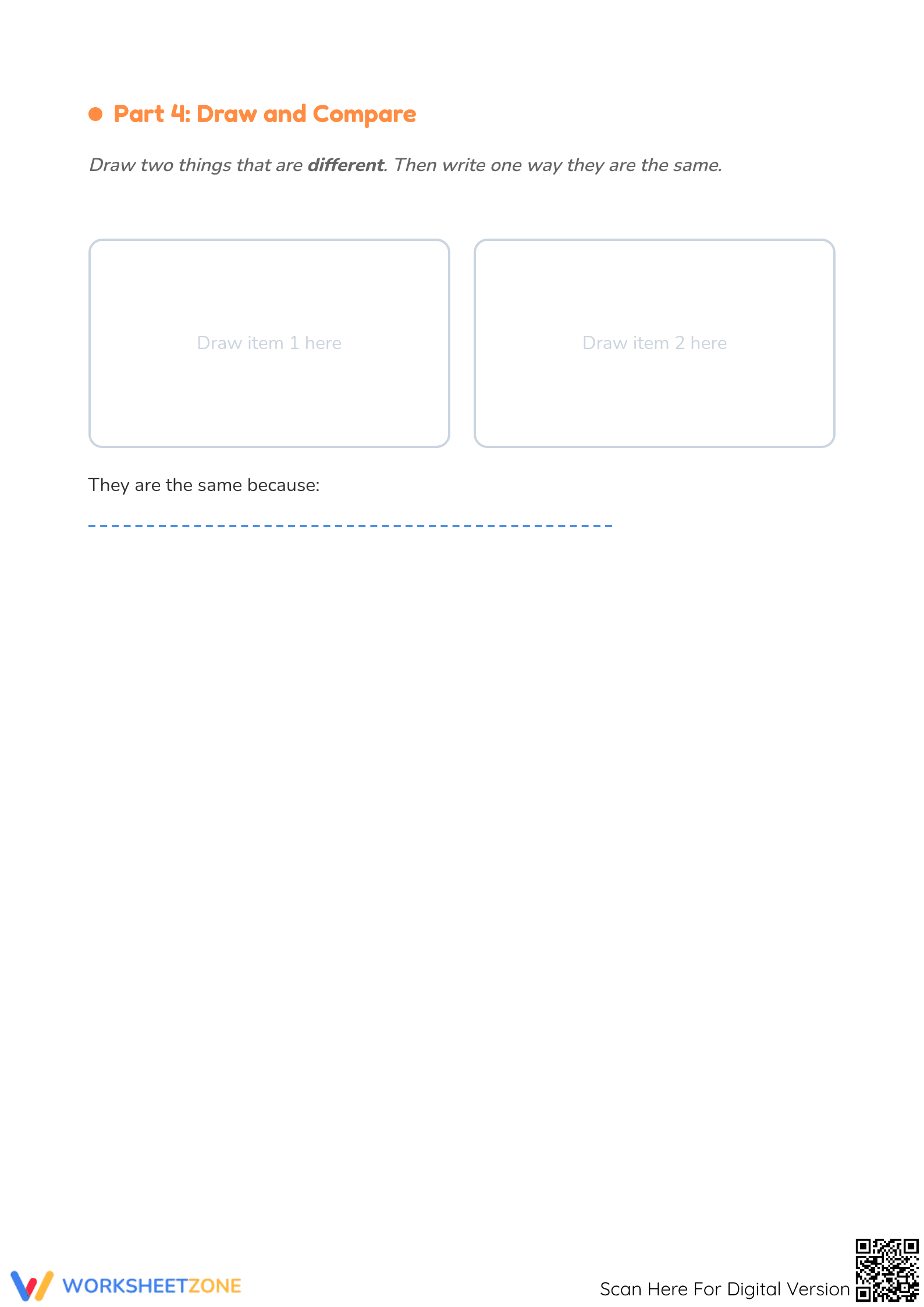
This resource features three pages of targeted activities to reinforce comparative language. Part 1 introduces a visual glossary with five key terms and picture cues. Part 2 challenges students with a word-matching exercise. Part 3 offers visual discrimination tasks where students circle whether paired images are the same or different. Finally, Part 4 includes a drawing prompt requiring students to illustrate two different items and write a sentence explaining one similarity. A three-page answer key is provided.
Skill Progression
- Guided practice: The worksheet begins with a highly supported visual glossary. Students review definitions for key terms alongside helpful picture cues, establishing a strong foundation.
- Supported practice: Next, learners complete a matching activity and a visual identification task. These sections offer moderate scaffolding, allowing students to apply their new vocabulary to concrete examples.
- Independent practice: The final page removes the visual scaffolds, prompting students to draw their own contrasting items and write a complete sentence explaining a shared characteristic.
This gradual-release approach ensures students confidently transition from the "I Do" phase of vocabulary acquisition to the "You Do" phase of independent application.
Standards Alignment
This resource is aligned to primary standard CCSS.ELA-LITERACY.SL.1.1: Participate in collaborative conversations with diverse partners about grade 1 topics. By mastering the vocabulary of comparison, students gain the academic language necessary to engage meaningfully in these discussions. Both standard codes can be copied directly into lesson plans, IEP goals, or district curriculum mapping tools.
How to Use It
Use this worksheet before direct instruction on a new fiction text to front-load essential comparative vocabulary. Alternatively, assign it during independent center time. As a formative assessment tip, observe students during the final drawing task; their ability to articulate a similarity between two different objects will quickly reveal their grasp of the concept. Expect students to complete the full packet in 15 to 20 minutes.
Who It's For
Designed for first-grade students developing academic vocabulary, the strong visual supports make this effective for English Language Learners (ELLs) and students requiring scaffolding. For differentiation, read definitions aloud to struggling readers or challenge advanced students to write multiple sentences. It pairs naturally with any introductory lesson on comparing and contrasting fiction texts.
Mastering academic vocabulary is a critical step in early literacy development. This worksheet targets CCSS.ELA-LITERACY.SL.1.1, helping students participate in collaborative conversations about topics by equipping them with the precise language needed to compare and contrast. According to Fisher & Frey (2014), explicit vocabulary instruction combined with visual scaffolds significantly improves students' ability to engage with complex texts and articulate their understanding. By moving from a structured glossary to independent application, this resource ensures learners internalize terms like "same" and "different" rather than merely memorizing them. Providing early elementary students with these foundational tools fosters deeper reading comprehension and more analytical classroom discussions. This structured practice builds the cognitive framework necessary for evaluating relationships between characters, settings, and events in future reading assignments, setting the stage for long-term academic success across all subject areas.


