


























Views
Downloads

Printable Sight Word "Four" Worksheet | Grade 1 English
Paste this activity's link or code into your existing LMS (Google Classroom, Canvas, Teams, Schoology, Moodle, etc.).
Students can open and work on the activity right away, with no student login required.
You'll still be able to track student progress and results from your teacher account.
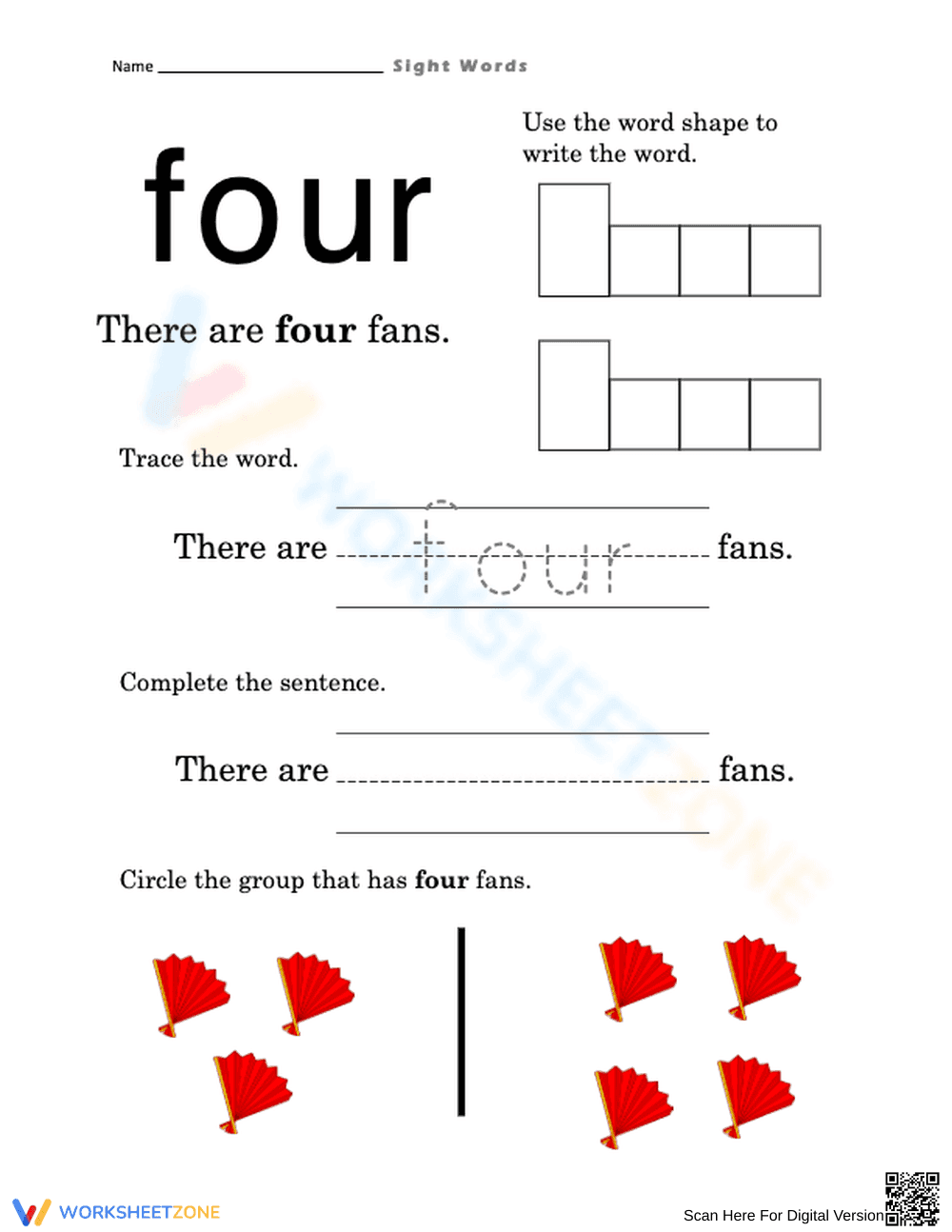
This Grade 1 sight word worksheet provides essential practice for the high-frequency word "four" through a multi-sensory approach. Students master spelling and recognition by engaging with word shapes, tracing, and sentence-level application. By focusing on orthographic patterns, this resource ensures students build the foundational literacy skills required for reading fluency.
At a Glance
- Grade: 1 · Subject: English Language Arts
- Standard:
CCSS.ELA-LITERACY.L.1.2— Use conventional spelling for words with common spelling patterns and for frequently occurring irregular words- Skill Focus: Sight Word Recognition and Spelling
- Format: 1 page · 5 tasks · Answer key included · PDF
- Best For: Literacy centers and morning work
- Time: 10–15 minutes
What's Inside
This single-page PDF contains five distinct instructional tasks designed to solidify word mastery. It begins with orthographic mapping using word-shape boxes to help students visualize the word "four." Following this, students trace the word within a complete sentence, then independently write the word to finish a sentence. The final task involves identifying the correct quantity of objects to reinforce conceptual understanding.
Zero-Prep Workflow
The zero-prep design of this worksheet makes it an ideal resource for busy classrooms or emergency sub plans. The instructional workflow is streamlined into three simple steps: First, print the single-page PDF (approximately 30 seconds). Second, distribute the copies to students during your literacy block (1 minute). Finally, review the work using the included answer key for immediate formative feedback (1 minute).
Standards Alignment
Aligned to CCSS.ELA-LITERACY.L.1.2, this worksheet focuses on the conventions of standard English spelling. It supports students in using conventional spelling for frequently occurring irregular words. Both standard codes can be copied directly into lesson plans, IEP goals, or district curriculum mapping tools.
How to Use It
Use this worksheet as a focused "Skill Spotlight" after introducing the word "four" during direct instruction. It serves as an excellent formative assessment tool; observe students as they complete the word-shape task to identify those who may struggle with letter-height differentiation. This resource is best utilized during the "Independent Practice" phase of a lesson to ensure students can apply their knowledge without teacher scaffolding.
Who It's For
This resource is tailored for Grade 1 students but is also suitable for kindergarten extension or Grade 2 intervention. It provides valuable support for English Language Learners (ELL) by providing sentence-level context and visual aids. For best results, pair this worksheet with a sight word anchor chart or a short reading passage that frequently features the target word to provide additional exposure and reinforcement.
Educational research by Fisher & Frey (2014) emphasizes the importance of multi-modal practice for high-frequency word acquisition in early childhood. This worksheet addresses CCSS.ELA-LITERACY.L.1.2 by integrating orthographic mapping through word-shape boxes, kinesthetic tracing, and contextual application within complete sentences. By requiring students to identify the quantitative value of the word 'four' alongside its spelling, the resource reinforces the semantic link between the symbol and its meaning. Research indicates that students who engage in scaffolded writing tasks that move from isolated tracing to independent sentence completion demonstrate higher retention rates of irregular sight words. This systematic approach ensures that Grade 1 learners develop the foundational literacy skills necessary for reading fluency and writing accuracy. The inclusion of a visual discrimination task further supports phonological awareness and cognitive processing, making this a robust tool for diverse classroom environments and targeted intervention sessions.


