




























Views
Downloads
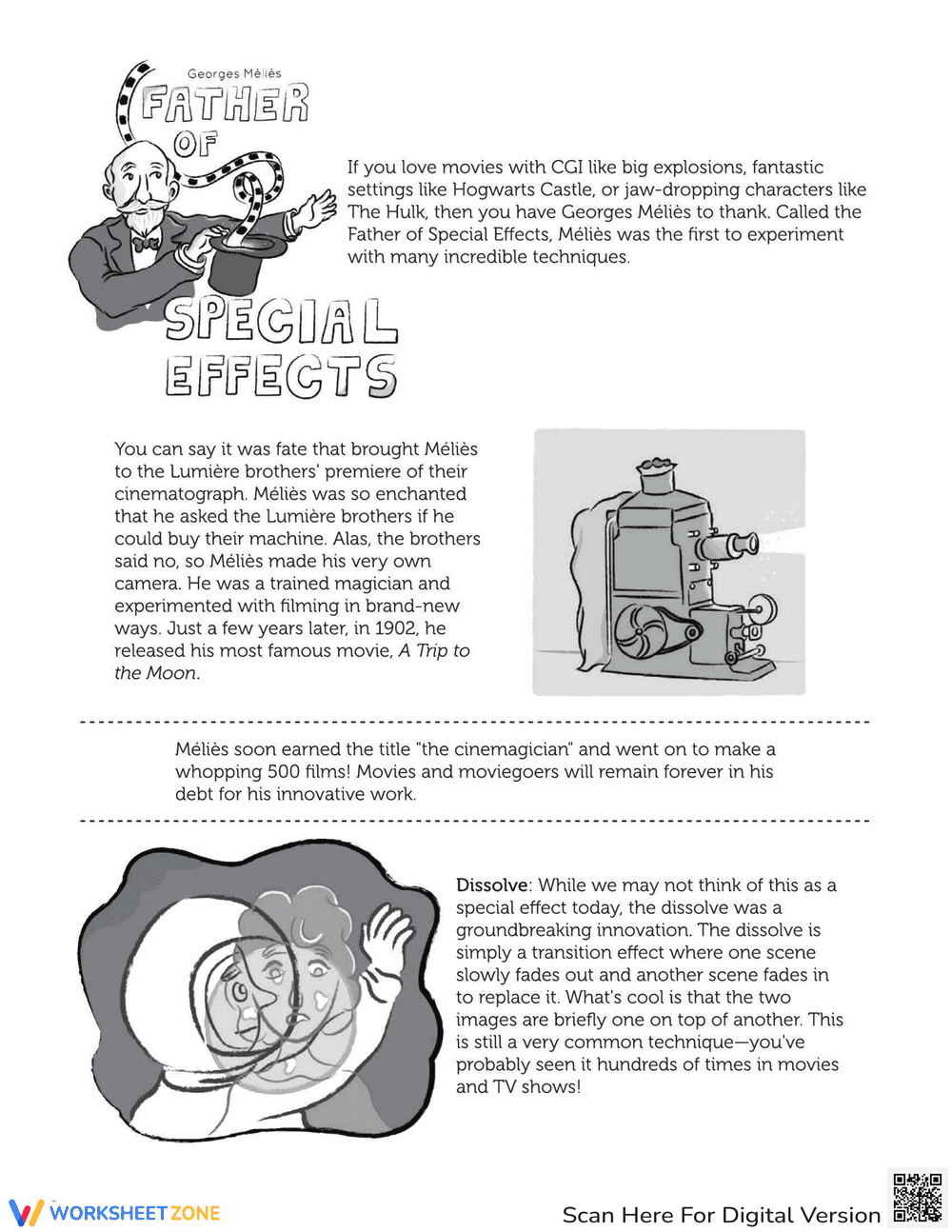

Georges Melies Special Effects: Printable Grade 5 ELA

Paste this activity's link or code into your existing LMS (Google Classroom, Canvas, Teams, Schoology, Moodle, etc.).
Students can open and work on the activity right away, with no student login required.
You'll still be able to track student progress and results from your teacher account.
This Grade 5 reading comprehension worksheet helps students analyze early cinema history and special effects. Students read about Georges Méliès, the pioneer of techniques like double exposure, and answer text-dependent questions. This resource builds critical analysis skills by connecting historical innovations to modern filmmaking.
At a Glance
- Grade: Grade 5 · Subject: Reading Comprehension
- Standard:
CCSS.ELA-LITERACY.RI.5.3— Explain relationships between historical events and ideas in informational texts- Skill Focus: Nonfiction text analysis and historical connections
- Format: 3 pages · 3 tasks · No answer key · PDF
- Best For: Independent reading practice and ELA centers
- Time: 25–35 minutes
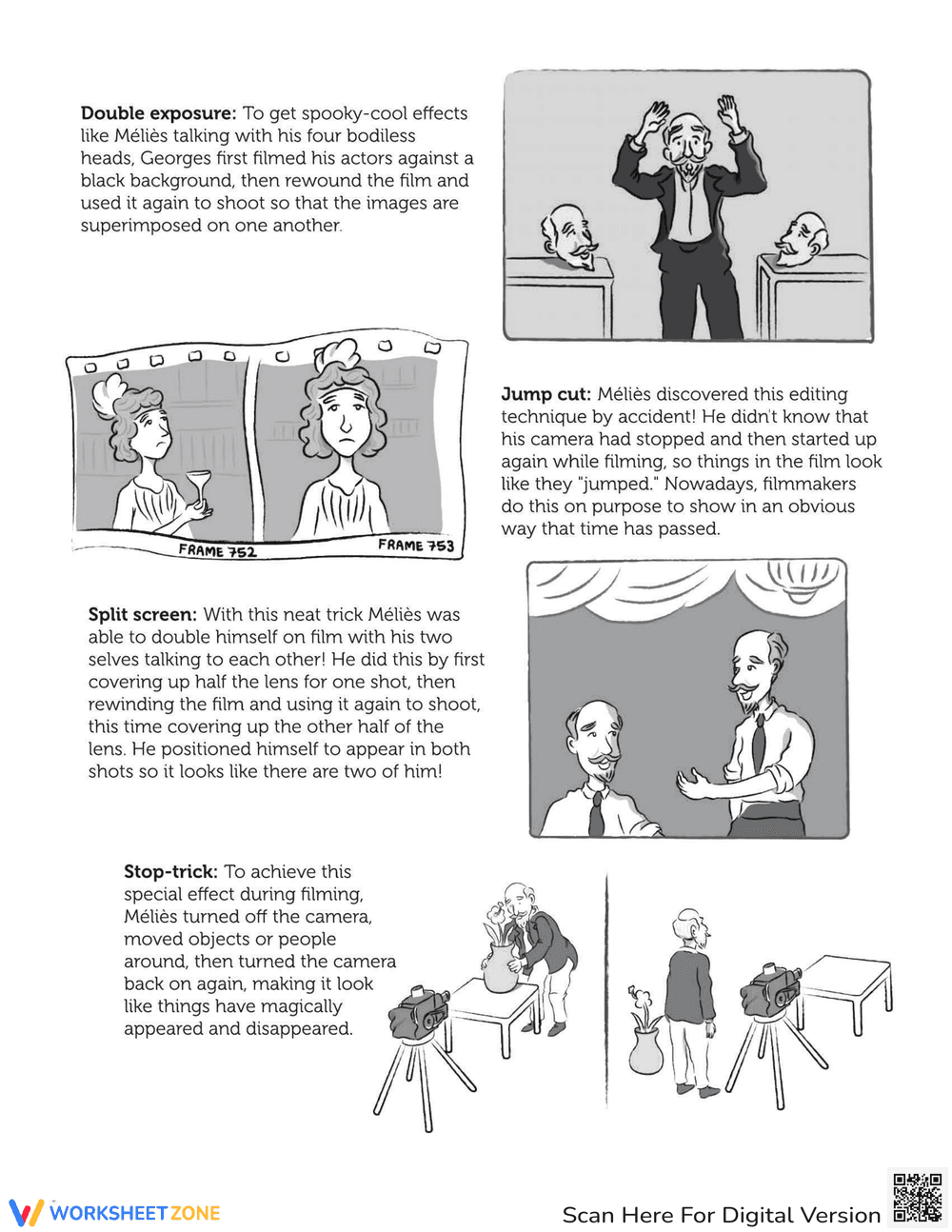
This three-page packet contains a biographical passage detailing Georges Méliès and his contributions to cinematography. The text defines five key special effects: dissolve, double exposure, jump cut, split screen, and stop-trick. The final page features three open-ended review questions prompting students to define vocabulary and analyze film clips, followed by a bonus movie-watching extension.
Skill Progression
- Guided practice begins with the text, where students read about Méliès' early life.
- Supported practice occurs as students examine illustrated examples of five special effects.
- Independent practice challenges students to answer three critical thinking questions, requiring them to synthesize the text and apply understanding to real-world film examples.
This gradual-release model ensures students build deep comprehension of the historical text.
Standards Alignment
This resource aligns with standard CCSS.ELA-LITERACY.RI.5.3. Students explain the relationships between Georges Méliès, his camera techniques, and the evolution of special effects. Additionally, it supports CCSS.ELA-LITERACY.RI.5.4 by encouraging students to determine the meaning of domain-specific words. Both standard codes can be copied directly into lesson plans, IEP goals, or district curriculum mapping tools.
How to Use It
Use this worksheet during direct instruction to model identifying key details, or assign it as independent reading. To use it as a formative assessment, observe how accurately students define "cinemagician" using context clues. Students will need approximately 25 to 35 minutes to read the passage and complete the written responses.
Who It's For
This activity is designed for fifth-grade students analyzing informational texts, but also serves as an extension for fourth graders or review for sixth graders. It benefits visual learners who profit from the illustrated diagrams of early camera tricks. Pair this worksheet with a short screening of Méliès' classic film, A Trip to the Moon.
This informational reading activity supports advanced literacy skills in fifth-grade students. By engaging with historical narratives and technical vocabulary, students build background knowledge. Research from Fisher & Frey (2014) on the gradual release of responsibility shows that scaffolding informational texts with visual aids and structured prompts helps students transition from guided reading to independent analysis. The worksheet addresses CCSS.ELA-LITERACY.RI.5.3 by requiring students to explain the relationship between historical innovations and modern cinematic techniques. Through 3 structured tasks, learners practice extracting evidence, defining domain-specific terms, and reflecting on media history. This integration of reading and media literacy aligns with modern educational standards emphasizing multi-modal learning. Educators can integrate this resource into their ELA curriculum to support student mastery of informational text structures and historical analysis.


