




























Views
Downloads
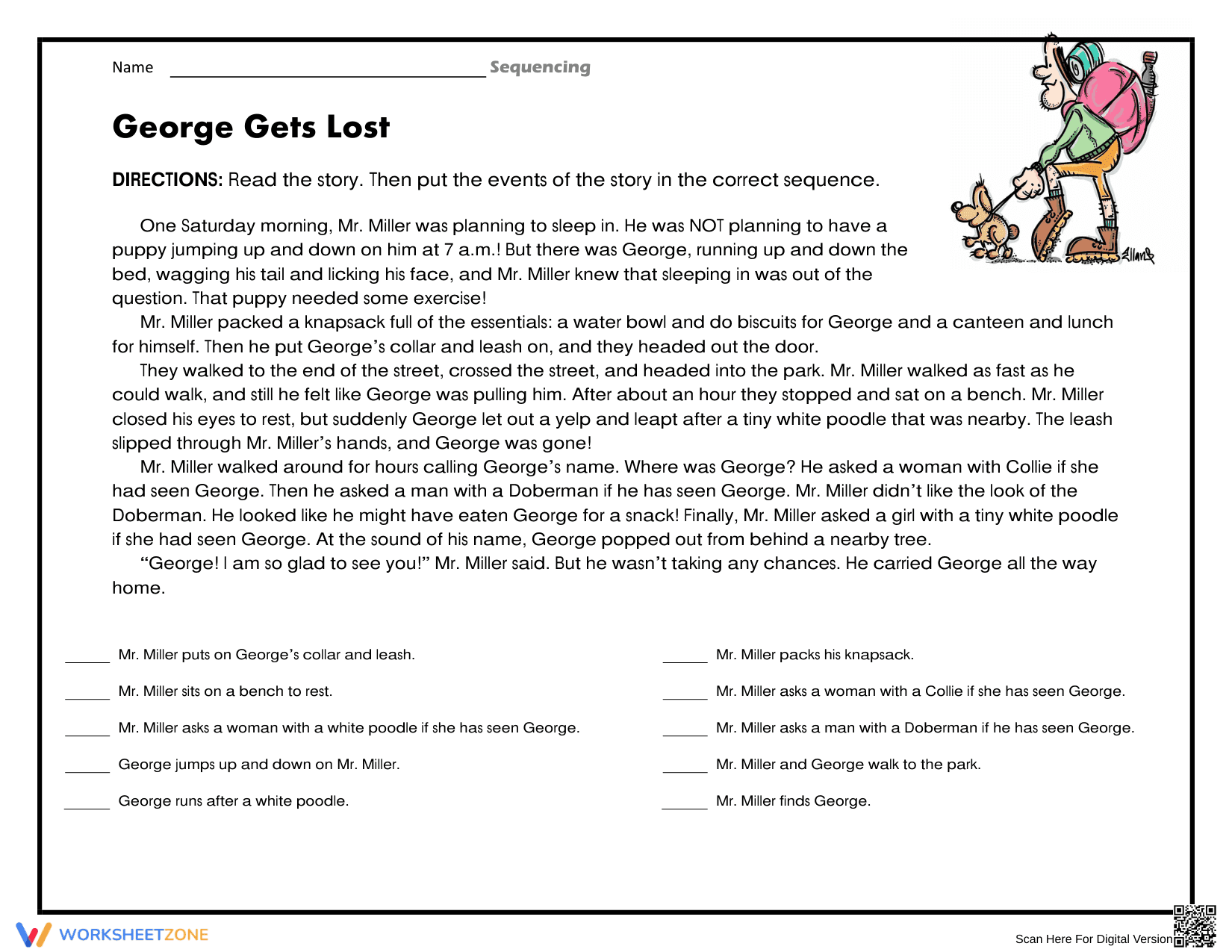

George Gets Lost Sequencing | Essential Grade 2 Worksheet

Paste this activity's link or code into your existing LMS (Google Classroom, Canvas, Teams, Schoology, Moodle, etc.).
Students can open and work on the activity right away, with no student login required.
You'll still be able to track student progress and results from your teacher account.
This George Gets Lost reading comprehension worksheet offers a targeted approach for young readers to master narrative sequencing. Through the story of Mr. Miller and his energetic puppy, students practice identifying chronological markers and logical progression, a foundational skill for advanced literacy. The activity bridges literal reading with structural understanding, enabling students to track character development across a complete narrative.
At a Glance
- Grade: 2 · Subject: English Language Arts
- Standard:
CCSS.ELA-LITERACY.RL.2.2— Recount stories and determine the sequence of major events- Skill Focus: Chronological Sequencing
- Format: 1 page · 10 problems · Answer key included · PDF
- Best For: Independent Literacy Centers
- Time: 15–20 minutes
Inside this printable resource, you will find a narrative text titled "George Gets Lost," detailing a puppy's park adventure. Following the story, 10 clear sequencing tasks require students to number events chronologically. The clean, spacious layout minimizes distractions for early readers, and a comprehensive answer key allows for rapid grading or self-correction.
This worksheet boasts a zero-prep workflow for maximum classroom efficiency. Simply print the single-page PDF, distribute it as a bell-ringer or literacy block component, and use the included answer key for immediate feedback, requiring minimal teacher preparation. It’s an ideal choice for emergency sub plans or last-minute instructional needs.
Strictly aligned with CCSS.ELA-LITERACY.RL.2.2, this worksheet focuses on recounting stories and determining the sequence of events. By identifying the beginning, middle, and end of George's journey, students demonstrate their ability to track character motivations and plot developments using key textual details, ensuring compliance with state and national frameworks.
Use this worksheet as a formative assessment after teaching transition words like "first," "next," and "finally." It's highly effective in small groups, where teachers can observe students using textual evidence. Most second-graders should complete the reading and 10 sequencing items within 20 minutes, making it a reliable, academically rigorous activity that keeps students engaged.
Tailored for Grade 1 and Grade 2 students transitioning to full paragraph comprehension, this resource is also particularly beneficial for English Language Learners (ELLs) needing structured practice with narrative flow and vocabulary in context. Pair it with passages about pets or anchor charts on story elements to deepen the connection between skill and content, fostering a multi-sensory approach to reading mastery.
According to Fisher & Frey (2014), sequencing events is vital for reading comprehension, helping students build mental models of text. This Grade 2 ELA worksheet directly addresses CCSS.ELA-LITERACY.RL.2.2 by tasking students to accurately recount "George Gets Lost" plot points. Through 10 specific sequencing problems, learners develop cognitive stamina to track narrative shifts and character actions. Research shows explicit story structure practice significantly improves independent retelling and summarizing. This printable PDF is a robust, evidence-based tool for instruction, providing scaffolding for students to master complex structures, ensuring mastery at their own pace.


