


























Views
Downloads


Essential Grade 6 Geometry Quiz: Shapes & Angles | Aligned
Paste this activity's link or code into your existing LMS (Google Classroom, Canvas, Teams, Schoology, Moodle, etc.).
Students can open and work on the activity right away, with no student login required.
You'll still be able to track student progress and results from your teacher account.
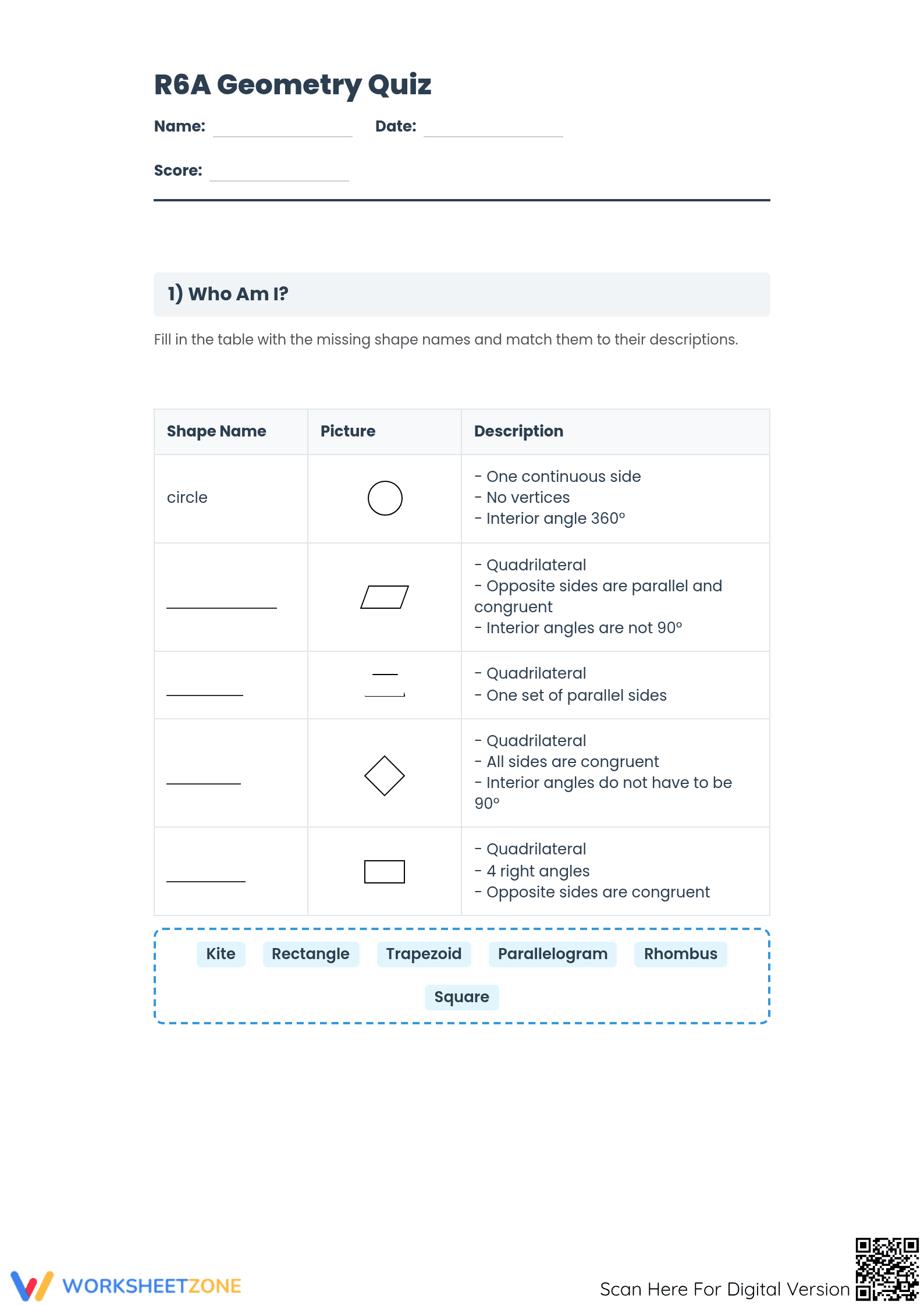
This comprehensive Grade 6 geometry quiz provides a robust assessment of shape identification and angle properties. Students progress through five distinct sections that evaluate their ability to classify quadrilaterals, identify angle types, and solve complex algebraic geometry problems. It ensures learners can apply geometric logic to find missing values in various figures, preparing them for advanced middle school mathematics.
At a Glance
- Grade: Grade 6 · Subject: Math
- Standard:
CCSS.MATH.CONTENT.6.G.A.1— Apply geometric properties to solve mathematical problems in figures- Skill Focus: Shape classification and angle calculation
- Format: 3 pages · 17 problems · Answer key included · PDF
- Best For: Summative assessment or end-of-unit review
- Time: 30–45 minutes
What's Inside
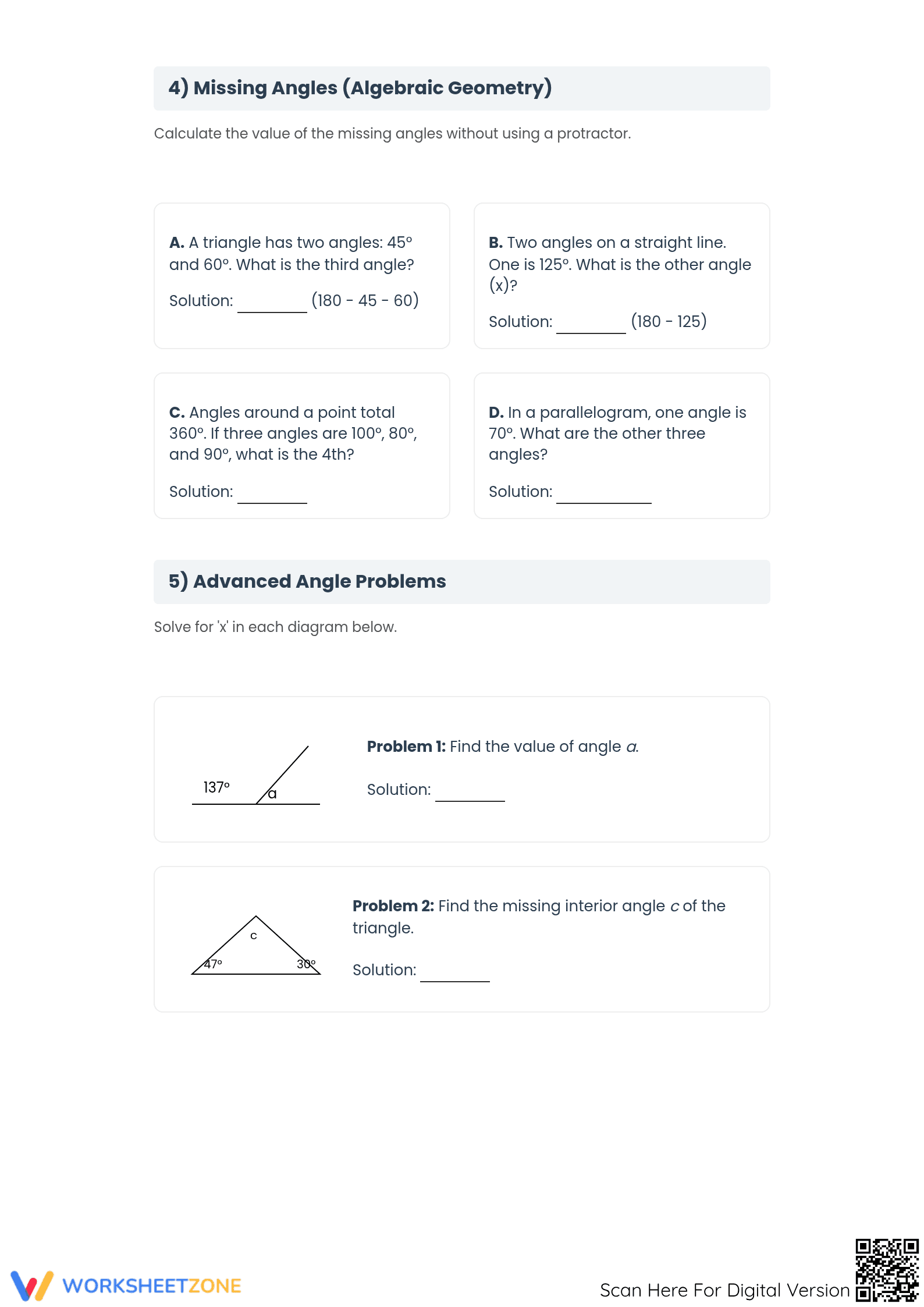
This three-page assessment features seventeen multi-step problems designed for clarity and depth. The worksheet includes a shape-matching table with a word bank for quadrilaterals, visual angle classification charts (right, acute, obtuse, straight, and reflex), and dedicated space for algebraic solutions. A comprehensive answer key is provided to facilitate rapid grading and provide students with immediate feedback on their geometric reasoning and calculation accuracy.
Mastery Evidence
The tasks are structured to provide clear evidence of student mastery across three tiers of geometric proficiency. The initial shape and angle identification sections confirm foundational knowledge (Approaching). The measuring and simple missing angle tasks evaluate the application of geometric rules (Meeting). Finally, the algebraic geometry and advanced solve-for-x problems require students to synthesize multiple properties, demonstrating a higher-order understanding of interior angle sums (Exceeding). Scores can be directly mapped to progress reports or IEP goals.
Standards Alignment
This worksheet is primarily aligned to CCSS.MATH.CONTENT.6.G.A.1, focusing on the properties of polygons and their components. It also supports CCSS.MATH.CONTENT.6.EE.B.7 by requiring students to write and solve equations for missing angle measurements in triangles and parallelograms. Both standard codes can be copied directly into lesson plans, IEP goals, or district curriculum mapping tools to ensure rigorous instructional tracking.
How to Use It
Deploy this worksheet as a summative assessment at the conclusion of your geometry unit to gauge student retention. For a formative approach, use Section 4 as a "ticket-to-leave" activity after direct instruction on triangle angle sums. Teachers should observe whether students correctly identify the relationship between supplementary angles in Section 5, which serves as a critical indicator of readiness for 7th-grade geometry and algebraic problem-solving.
Who It's For
This resource is ideal for general education 6th-grade students, but it also serves as an excellent enrichment tool for 5th-graders or a remediation guide for 7th-grade learners. It is particularly useful for students who benefit from visual scaffolds, such as the included word bank and clear diagrammatic representations of acute, obtuse, and reflex angles, ensuring that all learners can access the curriculum effectively.
According to a RAND AIRS 2024 study on middle school mathematics, the integration of algebraic reasoning into geometric tasks significantly improves student retention of spatial properties. This Grade 6 worksheet implements these findings by requiring learners to calculate missing interior angles (CCSS.MATH.CONTENT.6.G.A.1) through algebraic substitution rather than simple measurement. By bridging the gap between identifying shapes like trapezoids and parallelograms and solving for unknown variables 'x', the curriculum design aligns with the NAEP framework for mathematical complexity. Fisher & Frey (2014) highlight that structured quizzes with gradual release patterns—moving from matching to independent calculation—support the development of cognitive endurance in STEM subjects. This assessment provides 17 scaffolded tasks that ensure students can accurately measure, classify, and solve for angles on a straight line or within triangles, providing a data-rich snapshot of geometric competency for gradebook entry or IEP tracking.


