


























Views
Plays
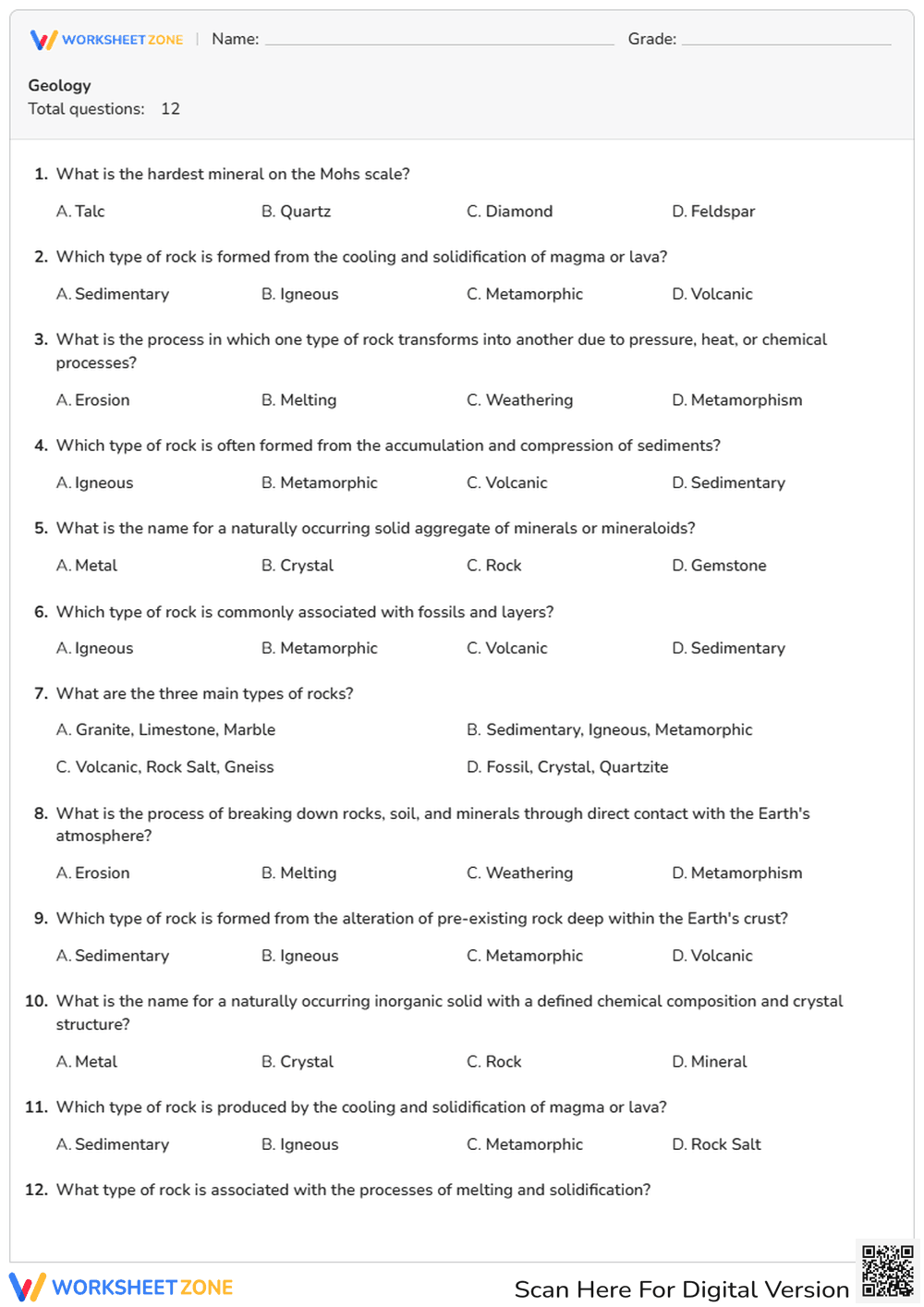


Geology Quiz Worksheet | Grade 4 Science Printable
Paste this activity's link or code into your existing LMS (Google Classroom, Canvas, Teams, Schoology, Moodle, etc.).
Students can open and work on the activity right away, with no student login required.
You'll still be able to track student progress and results from your teacher account.
This Grade 4 geology worksheet provides a comprehensive review of Earth's materials, focusing on the identification of rock types and the properties of minerals. Students demonstrate mastery by distinguishing between igneous, sedimentary, and metamorphic formations while applying knowledge of the Mohs scale. It serves as an efficient tool for verifying student comprehension of the rock cycle.
At a Glance
- Grade: 4 · Subject: Science
- Standard:
4-ESS1-1— Identify evidence from patterns in rock formations to explain changes over time- Skill Focus: Rock classification and mineral properties
- Format: 1 page · 12 problems · Answer key included · PDF
- Best For: Quick formative assessment or unit review
- Time: 15–20 minutes
The worksheet contains 12 high-quality multiple-choice questions spread across a single, clean page. It covers essential vocabulary including magma, lava, fossils, and the specific processes of pressure and heat. The layout is designed for readability, ensuring students can focus on the scientific content without visual distraction. A complete answer key is provided for rapid grading and immediate student feedback.
This resource is designed for a zero-prep classroom environment. Step 1: Print the single-page PDF (30 seconds). Step 2: Distribute to students as a bell ringer or exit ticket (1 minute). Step 3: Review the 12 answers using the included key to provide immediate feedback (5 minutes). Total teacher preparation time is under 2 minutes, making it an ideal solution for substitute plans or unexpected schedule shifts.
This resource is aligned with 4-ESS1-1, which requires students to identify evidence from patterns in rock formations. By understanding how different rocks form—such as sedimentary rocks from compression or igneous rocks from cooling—students build the prerequisite knowledge to interpret geological history. This standard code can be copied directly into lesson plans, IEP goals, or district curriculum mapping tools.
Use this worksheet as a summative quiz after a unit on Earth materials or as a pre-assessment to gauge prior knowledge. During the activity, observe if students struggle with the distinction between weathering and erosion, as this is a common area for intervention. Expect students to complete the 12 questions within a 15 to 20-minute window depending on their reading level.
This resource is tailored for upper elementary students in grades 3 through 5 who are exploring Earth Science. It is particularly effective for students who benefit from structured, closed-ended questions. Pair this worksheet with a physical rock collection or a Mohs scale testing kit to bridge the gap between theoretical knowledge and hands-on observation in the science lab.
According to the RAND AIRS 2024 report on elementary science instruction, frequent low-stakes retrieval practice significantly improves long-term retention of domain-specific vocabulary, such as the distinction between igneous, sedimentary, and metamorphic rocks. This geology worksheet utilizes a structured multiple-choice format to assess student understanding of the rock cycle and mineral properties, aligning with the 4-ESS1-1 standard. By isolating specific geological processes like weathering and solidification, the resource allows educators to identify specific misconceptions in Earth Science before moving to complex modeling. Research from Fisher & Frey (2014) suggests that such targeted checks for understanding are essential components of a gradual release of responsibility framework. This 12-question assessment provides the necessary data points for teachers to adjust instruction in real-time, ensuring that students master the foundational concepts of geology required for middle school Earth systems curricula and future standardized testing success.


