


























Views
Plays

Printable Economics & Geography Quiz | Grade 6
Paste this activity's link or code into your existing LMS (Google Classroom, Canvas, Teams, Schoology, Moodle, etc.).
Students can open and work on the activity right away, with no student login required.
You'll still be able to track student progress and results from your teacher account.
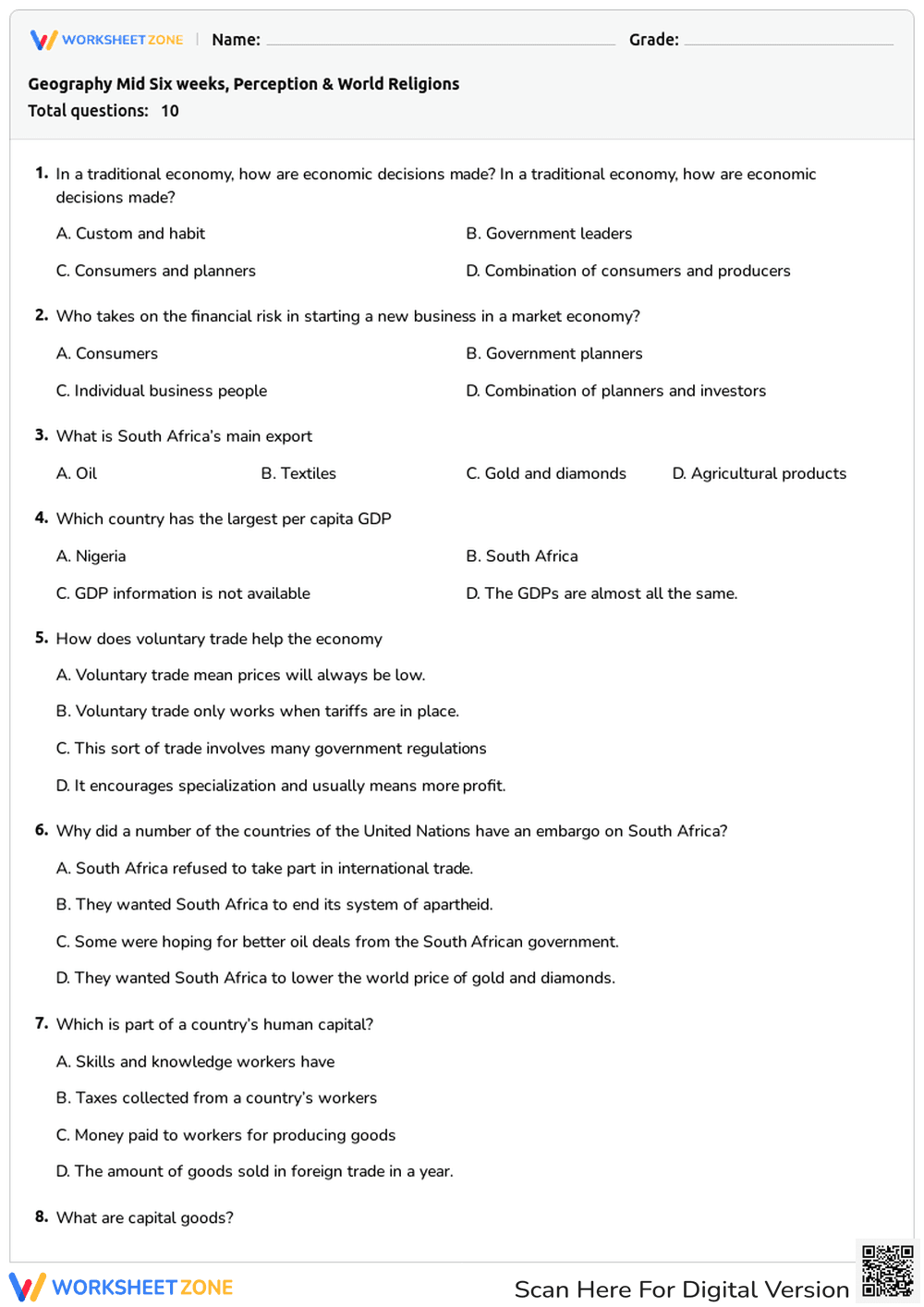
This Grade 6 social studies worksheet evaluates student understanding of global economic systems and South African history. By answering targeted multiple-choice questions, students demonstrate their grasp of traditional versus market economies, human capital, and the historical impact of trade embargoes.
At a Glance
- Grade: 6 · Subject: Social Studies
- Standard:
TEKS 6.7(A)— Compare how societies organize production and distribution- Skill Focus: Economic Systems & South Africa
- Format: 2 pages · 10 problems · Answer key included · PDF
- Best For: Formative assessment or review
- Time: 15–20 minutes
What's Inside
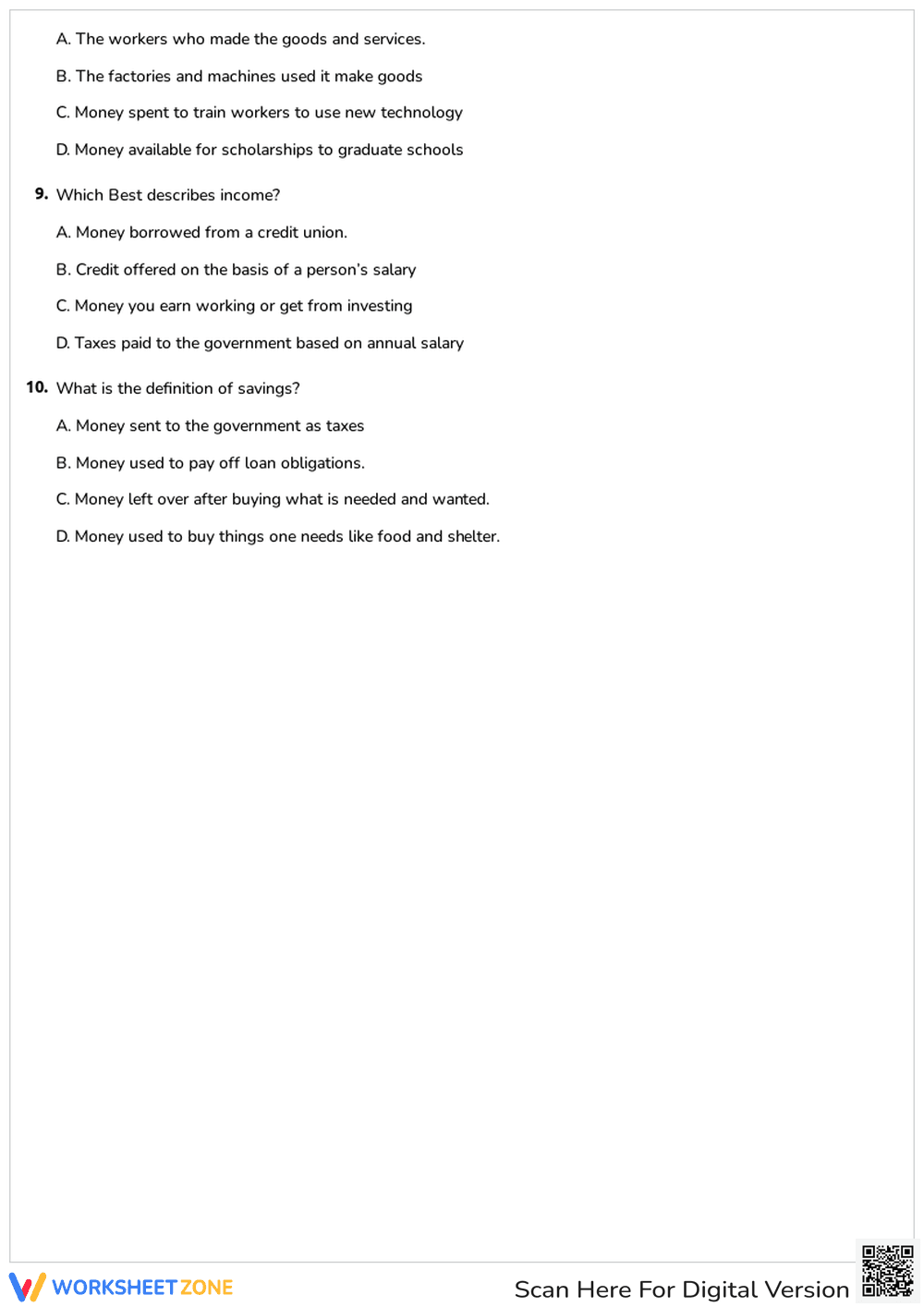
Inside this resource, educators will find a streamlined, two-page assessment featuring ten multiple-choice questions. The layout is clean and easy to read, minimizing distractions so students can focus on the content. The questions cover a range of foundational economic concepts, including GDP, voluntary trade, capital goods, and income, alongside specific historical applications related to South Africa. A complete answer key is provided to ensure accurate and efficient grading.
Zero-Prep Workflow
- Print (1 minute): Simply download the PDF and print a class set. The black-and-white design is highly ink-friendly.
- Distribute (1 minute): Hand out the two-page quiz at the beginning or end of your social studies block.
- Review (3 minutes): Use the included answer key to quickly grade submissions or guide a whole-class review session.
With under two minutes of total teacher prep time required, this worksheet is an excellent option for busy educators or as a reliable emergency sub plan.
Standards Alignment
Aligned to TEKS 6.7(A), this worksheet asks students to compare ways in which various societies organize the production and distribution of goods and services. It also touches on the role of human and capital resources in economic development. Both standard codes can be copied directly into lesson plans, IEP goals, or district curriculum mapping tools.
How to Use It
This versatile quiz works perfectly as a mid-unit formative assessment to check for understanding after direct instruction on economic systems. Alternatively, assign it as an independent homework task to reinforce vocabulary like "human capital" and "traditional economy." While students work, teachers can circulate and observe which specific economic terms are causing confusion, allowing for immediate, targeted reteaching before a major unit exam. Expected completion time is 15 to 20 minutes.
Who It's For
This resource is designed for 6th-grade social studies students, though it can easily be adapted for 5th or 7th-grade classrooms covering similar economic geography standards. The straightforward multiple-choice format provides built-in scaffolding for students who struggle with open-ended writing tasks. It pairs exceptionally well with introductory anchor charts on the factors of production or a direct instruction lesson on South African history.
Integrating structured assessments on economic principles is vital for developing middle school social studies proficiency. By aligning with TEKS 6.7(A) to compare how societies organize production and distribution, this resource ensures students build a foundational understanding of global markets. According to a 2024 report by EdReports, high-quality instructional materials that explicitly connect abstract economic concepts to real-world historical contexts significantly improve student retention and analytical skills. This worksheet applies that principle by linking general economic vocabulary directly to the historical context of South Africa's economy and international trade embargoes. Providing students with clear, multiple-choice formats allows educators to quickly gauge comprehension and adjust instruction accordingly, fostering a more responsive and effective learning environment.


