


























Views
Downloads
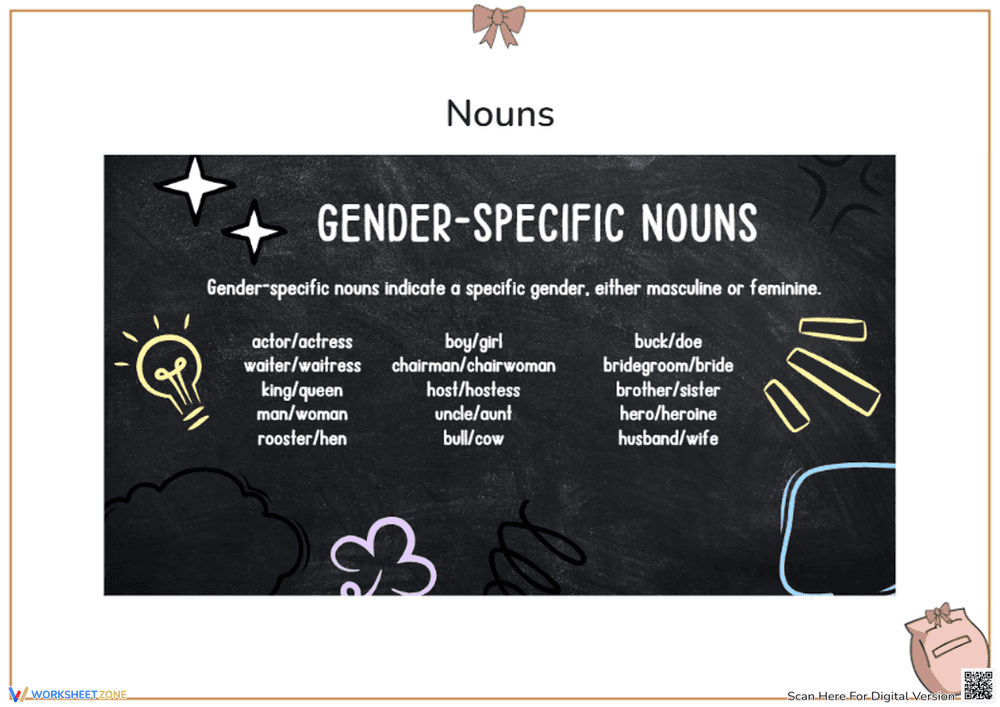

Grade 3 Gender-Specific Nouns — Printable No-Prep Worksheet
Paste this activity's link or code into your existing LMS (Google Classroom, Canvas, Teams, Schoology, Moodle, etc.).
Students can open and work on the activity right away, with no student login required.
You'll still be able to track student progress and results from your teacher account.
This printable grammar worksheet equips third-grade students to identify and apply gender-specific nouns accurately in reading and writing. By analyzing masculine and feminine noun pairings, learners expand vocabulary and strengthen their grasp of noun functions. The structured format provides immediate clarity, helping students master essential grammar conventions without requiring extensive teacher preparation.
At a Glance
- Grade: 3 · Subject: English Language Arts
- Standard:
CCSS.ELA-LITERACY.L.3.1— Identify and use regular and irregular nouns correctly in writing- Skill Focus: Identifying gender-specific nouns
- Format: 1 page · 15 problems · Answer key included · PDF
- Best For: Independent grammar practice and review
- Time: 15–20 minutes
This single-page resource features a visual reference chart paired with 15 structured noun identification tasks. Students explore masculine and feminine pairings, including common examples like actor/actress, host/hostess, and buck/doe. The layout functions as both an anchor chart and a practice sheet, complete with an answer key for quick grading.
Zero-Prep Classroom Workflow
This worksheet minimizes teacher setup while maximizing student engagement. The streamlined workflow ensures smooth execution during busy instructional days:
- Print (30 seconds): Generate the single-page PDF and answer key instantly.
- Distribute (30 seconds): Hand out sheets directly to students. Clear instructions allow learners to begin immediately.
- Review (1 minute): Use the provided answer key to verify responses quickly.
With total teacher preparation time under two minutes, this resource is highly effective for substitute teacher plans, morning work, or literacy centers.
Standards Alignment
This resource aligns directly with primary standard CCSS.ELA-LITERACY.L.3.1, requiring students to demonstrate command of standard English grammar conventions. Additionally, it supports CCSS.ELA-LITERACY.L.3.3 by helping students use knowledge of language conventions when writing and reading. Both standard codes can be copied directly into lesson plans, IEP goals, or district curriculum mapping tools.
How to Use It
Teachers can deploy this worksheet during two distinct instructional moments: as guided practice immediately after direct instruction, or as an independent review task during literacy centers. As a formative assessment observation tip, teachers should monitor whether students correctly match irregular pairings like bull/cow versus regular suffix additions like host/hostess. Expected completion time ranges from 15 to 20 minutes.
Who It's For
This resource is tailored for third-grade general education students developing foundational grammar skills. For differentiation, English language learners benefit from explicit pairing of masculine and feminine vocabulary, which clarifies English gender conventions. This worksheet pairs naturally with an introductory direct instruction lesson on nouns or a classroom anchor chart.
Mastering grammar conventions through explicit vocabulary categorization is essential for developing proficient reading and writing skills in elementary education. This worksheet targets CCSS.ELA-LITERACY.L.3.1 by focusing on the plain-English skill of identifying and using gender-specific nouns correctly. According to research from Fisher & Frey (2014), providing structured visual scaffolds and explicit vocabulary instruction significantly enhances student retention of grammatical concepts. When students engage with direct pairings of masculine and feminine nouns, they develop a deeper awareness of word relationships and morphological structures. This systematic approach reduces cognitive load, allowing young writers to apply correct noun forms accurately within their independent writing. By integrating targeted grammar practice into daily literacy routines, educators ensure robust language acquisition and support long-term academic success across all communication domains.


