


























Views
Downloads
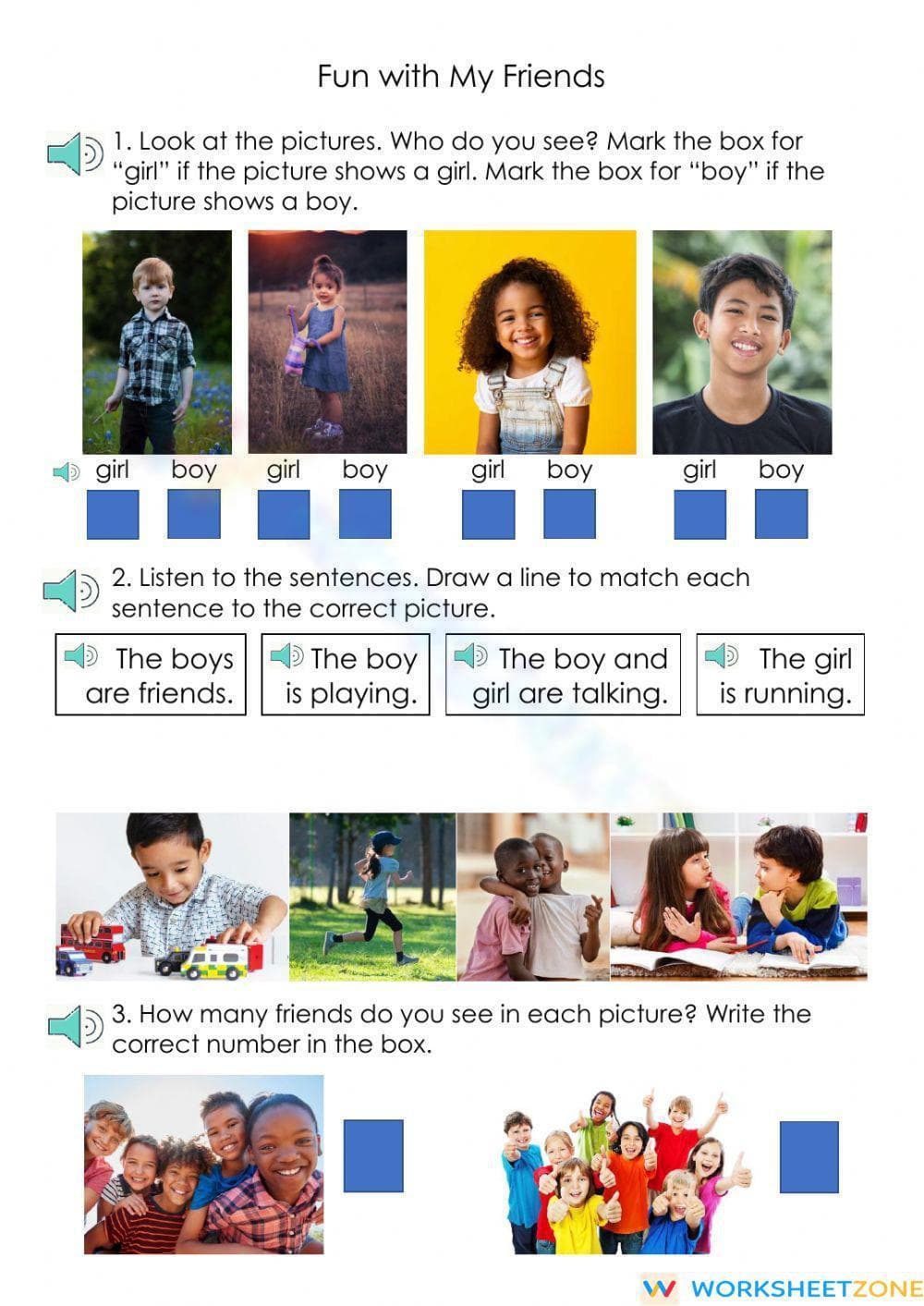

Printable Fun with My Friends Worksheet | Kindergarten ELA
Paste this activity's link or code into your existing LMS (Google Classroom, Canvas, Teams, Schoology, Moodle, etc.).
Students can open and work on the activity right away, with no student login required.
You'll still be able to track student progress and results from your teacher account.
The Fun with My Friends worksheet provides a foundational introduction to social vocabulary for early learners. By focusing on observable traits and common actions, students build the linguistic tools necessary to describe their peers. This resource effectively bridges the gap between visual recognition and verbal expression through structured, age-appropriate literacy activities.
At a Glance
- Grade: Kindergarten · Subject: English Language Arts
- Standard:
CCSS.ELA-LITERACY.L.K.5.A— Sort common objects into categories to gain a sense of the concepts the categories represent.- Skill Focus: Gender identification and action vocabulary
- Format: 1 page · 10 problems · Answer key included · PDF
- Best For: Early literacy centers and vocabulary building
- Time: 15–20 minutes
Inside this resource, students engage with three distinct activity types. The first section requires gender identification using photographs, followed by a matching task connecting sentences like "The girl is running" to visuals. The final section introduces integrated numeracy by asking students to count friends in group settings, providing a holistic approach to childhood development.
The zero-prep workflow for this worksheet is designed for maximum efficiency. First, print the single-page PDF (30 seconds). Second, distribute copies and read the auditory-cued instructions aloud (1 minute). Finally, review the visual matches as a group to provide immediate feedback. This process requires less than two minutes of teacher preparation, making it ideal for busy classrooms.
This resource is strictly aligned to `CCSS.ELA-LITERACY.L.K.5.A`, which emphasizes sorting objects into categories to understand conceptual relationships. By distinguishing between "boy" and "girl" and matching actions to subjects, students demonstrate a command of basic English grammar. This standard code can be copied directly into lesson plans, IEP goals, or district curriculum mapping tools.
Use this worksheet as a formative assessment during a community unit to gauge understanding of personal identifiers and action verbs. Instructors should circulate while students work on the matching section to observe if they identify keywords like "playing" or "talking." The expected completion time is approximately 15 to 20 minutes, depending on the level of teacher-led guidance.
This activity is tailored for Preschool and Kindergarten students, including English Language Learners who benefit from strong visual scaffolding. It serves as an excellent companion to an anchor chart depicting classroom actions or a read-aloud session about friendship. The combination of photography and simple text ensures that pre-readers can participate successfully through teacher-led instruction.
The transition from visual recognition to categorical sorting is a critical milestone in early cognitive development. Research from Fisher & Frey (2014) indicates that purposeful scaffolding—moving from concrete images to abstract structures—is essential for vocabulary retention. This worksheet applies these principles by requiring students to utilize the `CCSS.ELA-LITERACY.L.K.5.A` standard to categorize peers accurately. By integrating counting tasks with literacy goals, the resource reflects NAEP recommendations for multi-disciplinary learning in foundational grades. The 10 structured tasks provide sufficient data points for educators to determine mastery of basic social identifiers and action-based predicates. This citation-ready resource ensures that classroom practice is grounded in proven pedagogical strategies while maintaining high engagement through relatable, friend-focused content. Educators can confidently implement this tool to support the diverse developmental needs of young learners in inclusive educational environments.


