


























Views
Downloads
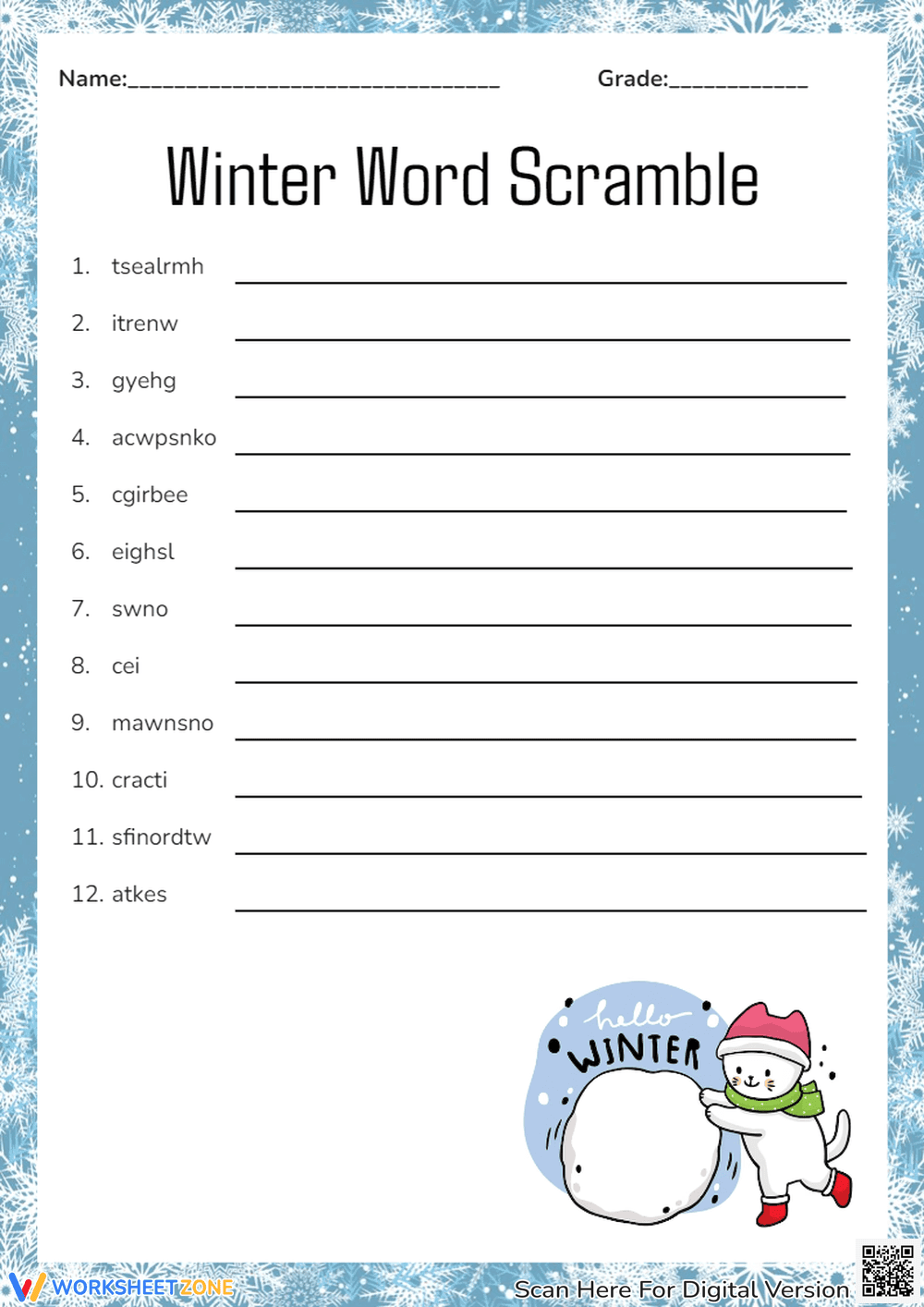

Winter Word Scramble Printable | Grade 4 ELA
Paste this activity's link or code into your existing LMS (Google Classroom, Canvas, Teams, Schoology, Moodle, etc.).
Students can open and work on the activity right away, with no student login required.
You'll still be able to track student progress and results from your teacher account.
This winter word scramble worksheet builds essential spelling and vocabulary skills by challenging students to decode seasonal terms. Fourth and fifth graders strengthen their orthographic mapping and pattern recognition as they unscramble twelve distinct words. This targeted practice reinforces correct spelling habits while keeping learners highly engaged during the winter months.
At a Glance
- Grade: 4 · Subject: ELA
- Standard:
CCSS.ELA-LITERACY.L.4.2.D— Spell grade-appropriate words correctly- Skill Focus: Spelling and vocabulary
- Format: 1 page · 12 problems · Answer key included · PDF
- Best For: Independent morning work
- Time: 10–15 minutes
This single-page printable features twelve scrambled winter-themed vocabulary words, such as "snowman," "winter," and "iceberg." Each problem provides a jumbled letter sequence alongside a blank line for students to write the correct spelling. The layout includes clear, readable fonts and a fun winter cat illustration to maintain student interest. A complete answer key is provided to ensure rapid grading and immediate feedback.
Zero-Prep Workflow
- Print (1 minute): Send the PDF to your copier. The black-and-white design ensures crisp printing without draining ink.
- Distribute (1 minute): Hand out as students enter. No additional materials or teacher setup required.
- Review (3 minutes): Use the answer key to check responses or project answers for self-grading.
Total prep time is under 2 minutes, making this ideal for a sub plan.
Standards Alignment
This activity aligns directly with CCSS.ELA-LITERACY.L.4.2.D, which requires students to spell grade-appropriate words correctly, consulting references as needed. By decoding scrambled letters, learners actively apply their knowledge of English orthography and syllable patterns. It also supports CCSS.ELA-LITERACY.L.5.2.E by reinforcing spelling accuracy for fifth graders. Both standard codes can be copied directly into lesson plans, IEP goals, or district curriculum mapping tools.
How to Use It
Deploy this worksheet as morning work before direct instruction. It settles students while activating language skills. Alternatively, place it in an early-finisher folder. As a formative assessment observation tip, watch how students tackle longer words; students grouping common digraphs demonstrate stronger phonics mastery than those guessing randomly. Expected completion time is ten to fifteen minutes.
Who It's For
This resource is designed primarily for fourth and fifth-grade students developing their spelling fluency. The visual simplicity and familiar winter theme make it accessible for English Language Learners who are building their seasonal vocabulary. For differentiation, allow students struggling with spelling to use a winter word bank or dictionary. Pair this activity naturally with a winter-themed reading passage or a direct instruction lesson on compound words to maximize thematic learning.
Effective spelling instruction requires active cognitive engagement rather than passive memorization. When students interact with CCSS.ELA-LITERACY.L.4.2.D to spell grade-appropriate words correctly, they strengthen their orthographic mapping capabilities. According to Fisher & Frey (2014), providing structured, independent practice opportunities allows learners to consolidate their understanding of word patterns and phonics rules. Scrambled word tasks force the brain to analyze letter sequences and retrieve correct spellings from long-term memory, reinforcing the neural pathways associated with reading fluency. This specific cognitive demand ensures that vocabulary acquisition is both deep and durable. By integrating these targeted exercises into daily routines, educators can systematically improve overall literacy outcomes. Consistent exposure to thematic vocabulary further contextualizes the learning, making the spelling practice highly relevant and immediately applicable for elementary students. This approach aligns perfectly with evidence-based literacy frameworks that prioritize explicit word study and continuous review.


