


























Views
Downloads

Printable Number 5 Worksheet | Grade K Math
Paste this activity's link or code into your existing LMS (Google Classroom, Canvas, Teams, Schoology, Moodle, etc.).
Students can open and work on the activity right away, with no student login required.
You'll still be able to track student progress and results from your teacher account.
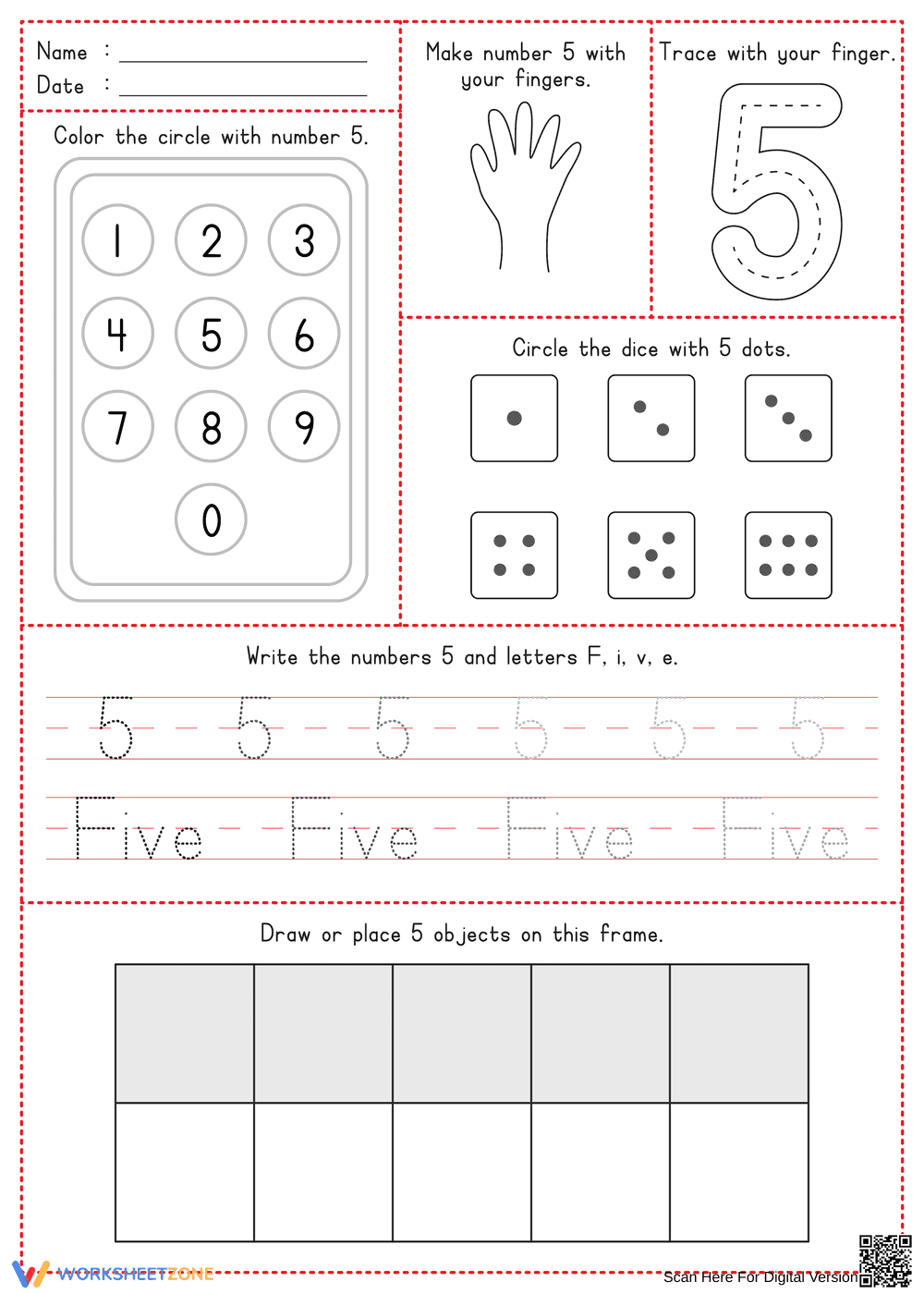
This printable Kindergarten math worksheet helps students master the number 5 through targeted, multi-sensory practice. Young learners will build foundational number sense by tracing, writing, counting, and identifying the number 5 in various formats, ensuring they confidently connect the written numeral to its physical quantity.
At a Glance
- Grade: K · Subject: Math
- Standard:
CCSS.MATH.CONTENT.K.CC.A.3— Write numbers and represent quantities- Skill Focus: Number 5 recognition and writing
- Format: 1 page · 6 problems · No answer key · PDF
- Best For: Independent practice or morning work
- Time: 10–15 minutes
This comprehensive single-page resource features six distinct task types designed to reinforce number recognition and formation. Students will identify the number 5 on a keypad, model it using finger counting, trace the large numeral, subitize by finding the dice showing five dots, practice handwriting for both the digit and the word "five," and finally represent the quantity by drawing objects within a ten-frame structure.
Designed for immediate classroom implementation, this worksheet requires absolutely zero teacher preparation.
- Print (1 minute): Simply download the PDF and print a class set. The black-and-white design saves ink.
- Distribute (1 minute): Hand out to students during math centers or morning routines. The visual instructions make it highly intuitive.
- Review (3 minutes): Quickly scan student ten-frames and handwriting lines to assess understanding.
With under two minutes of total prep time, this is an ideal emergency sub plan or quick-fill activity for early finishers.
This activity is directly aligned to CCSS.MATH.CONTENT.K.CC.A.3: "Write numbers from 0 to 20. Represent a number of objects with a written numeral 0-20 (with 0 representing a count of no objects)." It also supports early subitizing and cardinality skills. Both standard codes can be copied directly into lesson plans, IEP goals, or district curriculum mapping tools.
Deploy this worksheet during your core math block as independent practice immediately following direct instruction on the number 5. Alternatively, use it as a targeted intervention tool for students struggling with number reversals or one-to-one correspondence. While students are working, observe how they populate the ten-frame—this provides an excellent formative assessment opportunity to see if they naturally fill the top row first. Expected completion time ranges from 10 to 15 minutes depending on the child's fine motor skills.
This resource is primarily designed for Kindergarten students, though it serves as excellent review for early first graders or specialized practice for pre-K learners showing advanced math readiness. The varied visual supports, like the hand graphic and dice, naturally differentiate the task for visual and kinesthetic learners. Pair this worksheet with physical manipulatives, allowing students to place actual counters on the ten-frame before drawing them.
Developing strong early number sense, specifically the ability to write numbers and represent quantities as outlined in CCSS.MATH.CONTENT.K.CC.A.3, is a critical predictor of future mathematical achievement. According to a comprehensive EdReports 2024 analysis of early childhood math curricula, students who engage in multi-modal number practice—combining tracing, subitizing, and physical representation—demonstrate significantly higher retention rates than those using rote memorization alone. This worksheet integrates these evidence-based practices by requiring learners to interact with the number 5 across six different cognitive modalities, from fine motor handwriting to spatial reasoning within a ten-frame. By providing repeated, varied exposures to a single digit, educators can effectively solidify foundational cardinality concepts, ensuring young learners build the robust numerical fluency required for subsequent addition and subtraction tasks.


