




























Views
Downloads

Grade 6-7 Cash Flow Worksheet | Printable Essential Guide

Paste this activity's link or code into your existing LMS (Google Classroom, Canvas, Teams, Schoology, Moodle, etc.).
Students can open and work on the activity right away, with no student login required.
You'll still be able to track student progress and results from your teacher account.
This comprehensive financial literacy worksheet empowers students in Grade 6 and Grade 7 to master the fundamentals of cash flow management. By engaging with real-world scenarios and structured ledger practice, learners develop the essential ability to track income and expenses while understanding the critical difference between a surplus and a deficit. This resource transforms abstract economic concepts into tangible, actionable skills.
At a Glance
- Grade: 6–7 · Subject: Financial Literacy & ELA
- Standard:
CCSS.ELA-LITERACY.L.6.6— Use grade-appropriate domain-specific words to track money coming in and going out- Skill Focus: Cash flow ledger management
- Format: 3 pages · 14 problems · Answer key included · PDF
- Best For: Introduction to basic personal finance and vocabulary
- Time: 25–35 minutes
What's Inside
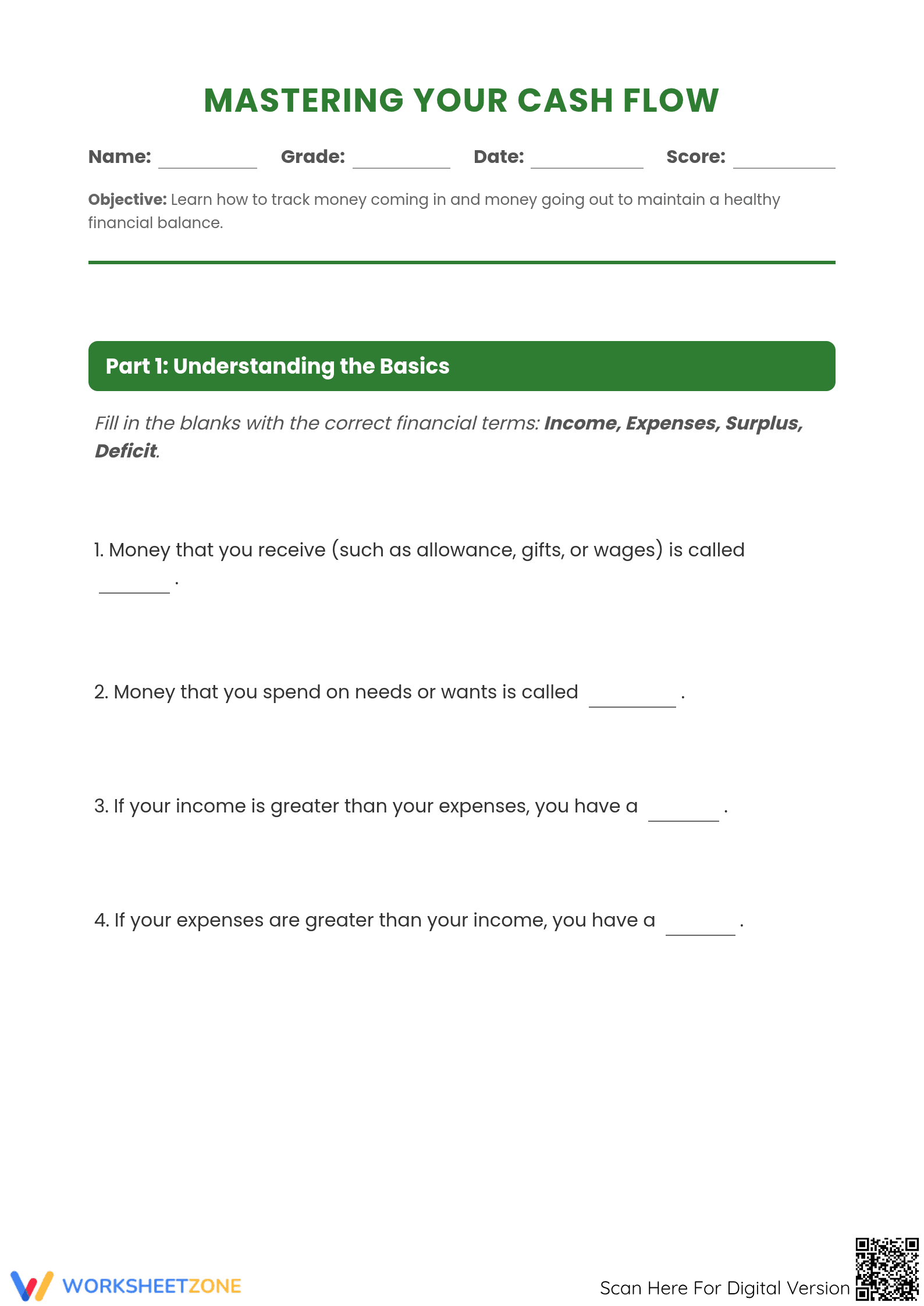
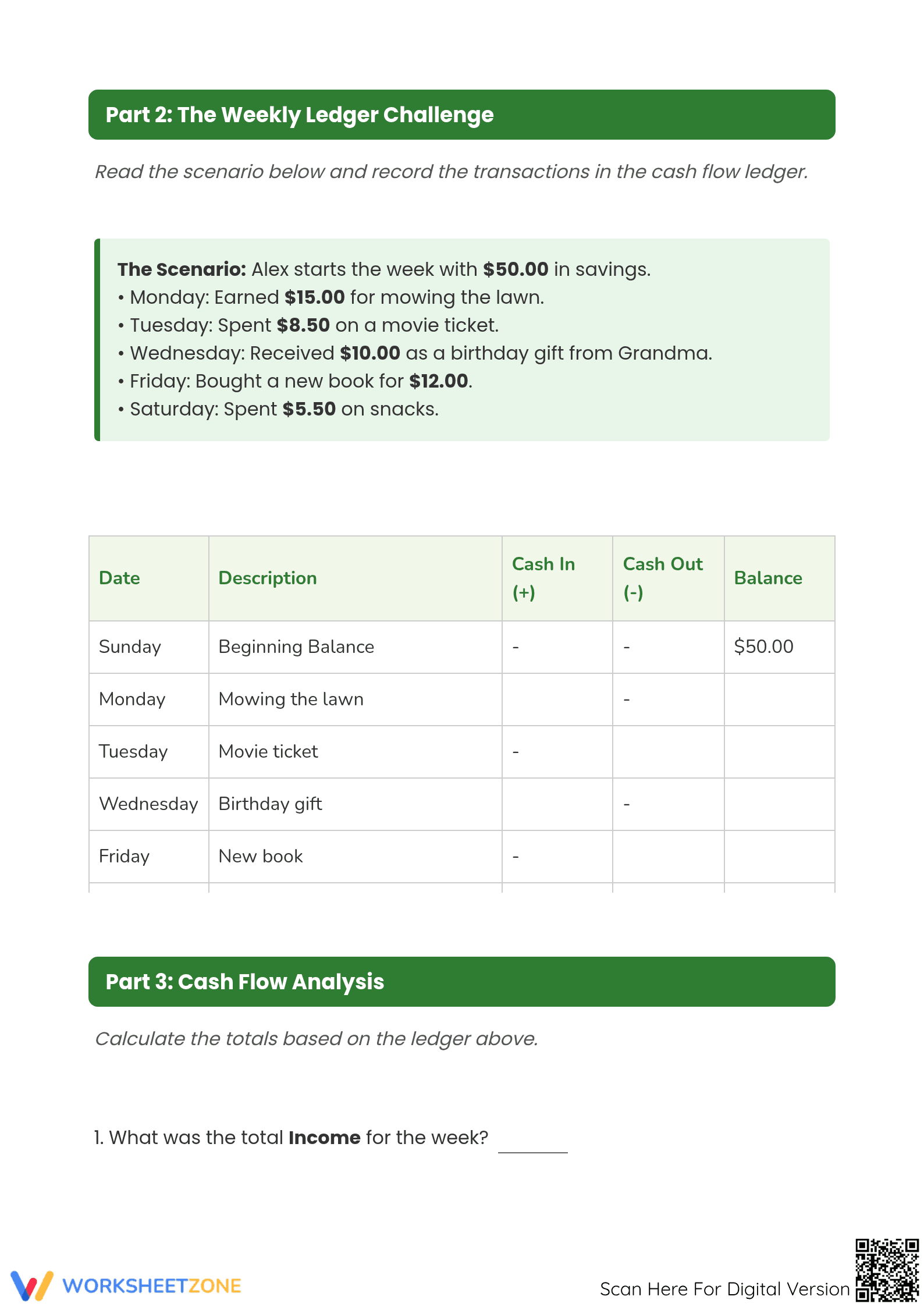
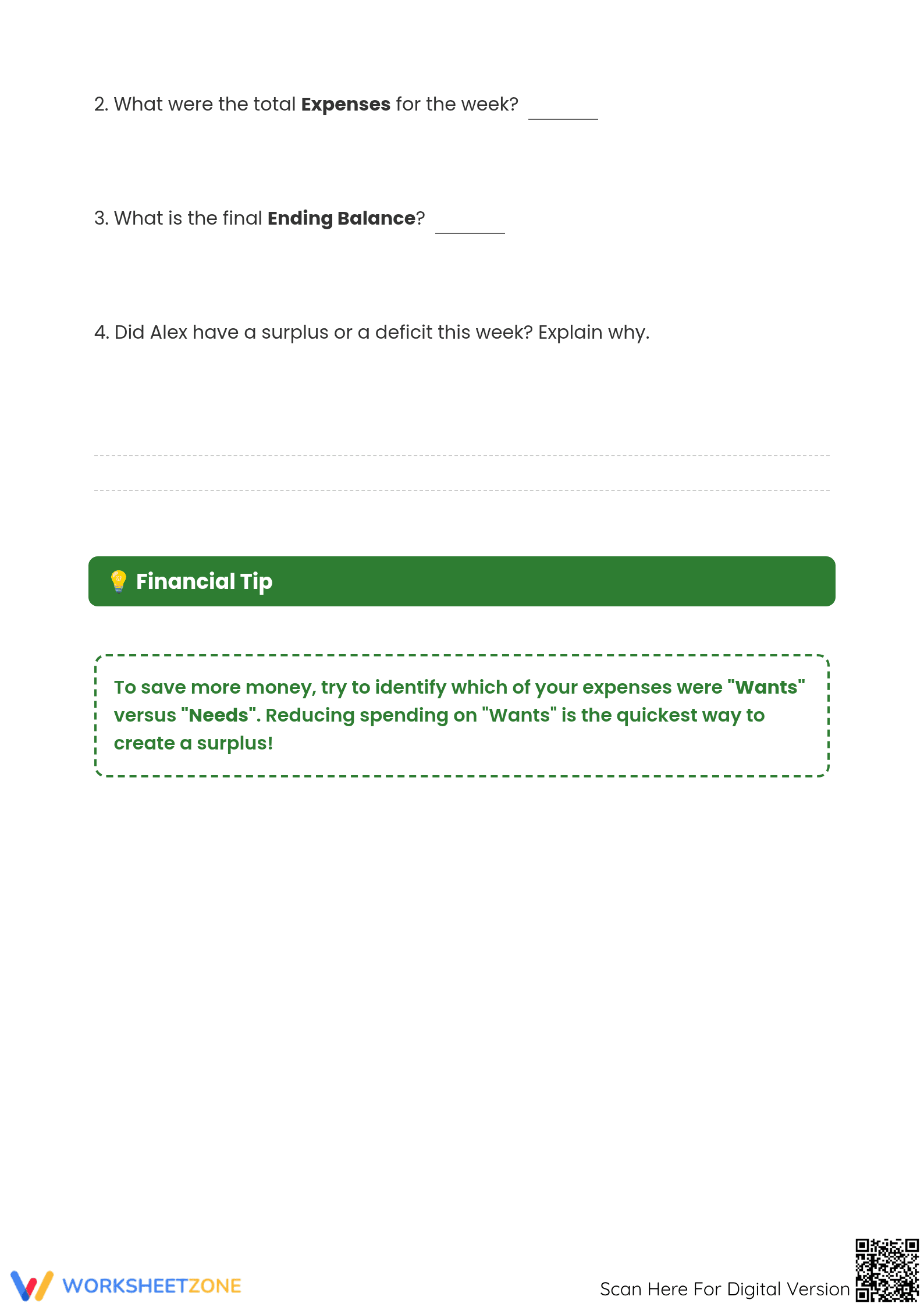
This 3-page instructional resource begins with a vocabulary-building section where students define four core financial terms: Income, Expenses, Surplus, and Deficit. The second page presents "The Weekly Ledger Challenge," a narrative scenario requiring students to populate a transaction table with dates, descriptions, and values. The final page features a four-part analysis section that requires students to calculate totals and justify their financial conclusions based on the data provided in the ledger.
Zero-Prep Workflow
- Step 1: Print (30 seconds) — Simply print the 3-page PDF for each student or group. No scissors or glue required.
- Step 2: Distribute (1 minute) — Hand out the worksheets and a calculator if desired for the ledger addition and subtraction tasks.
- Step 3: Review (5 minutes) — Use the included full-color answer key to walk students through the ledger entries and analysis questions for immediate feedback. This sequence makes it ideal for substitute plans.
Standards Alignment
The primary focus is CCSS.ELA-LITERACY.L.6.6, which requires students to acquire and use accurately domain-specific words such as surplus and deficit. By applying these terms to a ledger scenario, students demonstrate mastery of academic language in a functional context. This standard code can be copied directly into lesson plans, IEP goals, or district curriculum mapping tools to ensure compliance with middle school ELA and social studies frameworks.
How to Use It
Use this as a summative assessment after a unit on personal finance or as a standalone activity for Career and Technical Education (CTE). One formative observation tip: watch for students who struggle to correctly categorize "birthday gifts" as income versus "movie tickets" as expenses, as this reveals a breakdown in category conceptualization. It works excellently as a partner activity to encourage peer-to-peer discussion about financial decisions.
Who It's For
This resource is designed for middle school students, including those needing extra support with organizational skills or basic arithmetic. It pairs naturally with a classroom discussion on "Wants vs. Needs" or a short passage regarding the history of banking and personal savings accounts. The clear layout and scaffolded ledger make it accessible for diverse learners who benefit from structured data entry and logical analysis.
Drawing on research by Fisher & Frey (2014), this worksheet integrates domain-specific vocabulary into practical, real-world applications, a cornerstone of effective literacy instruction. It directly addresses CCSS.ELA-LITERACY.L.6.6, moving beyond rote memorization by placing terms like income and deficit within a weekly ledger scenario. Students define, calculate, and analyze cash flow, building cognitive bridges between academic language and functional life skills. Research shows that scenario-based financial tasks improve retention of economic concepts. This guide prepares learners for higher-level discussions and offers teachers an evidence-based tool for vocabulary and mathematical reasoning within ELA.


