


























Views
Downloads

Printable April Fool's Day Tricky Quiz | Grade 3-12
Paste this activity's link or code into your existing LMS (Google Classroom, Canvas, Teams, Schoology, Moodle, etc.).
Students can open and work on the activity right away, with no student login required.
You'll still be able to track student progress and results from your teacher account.
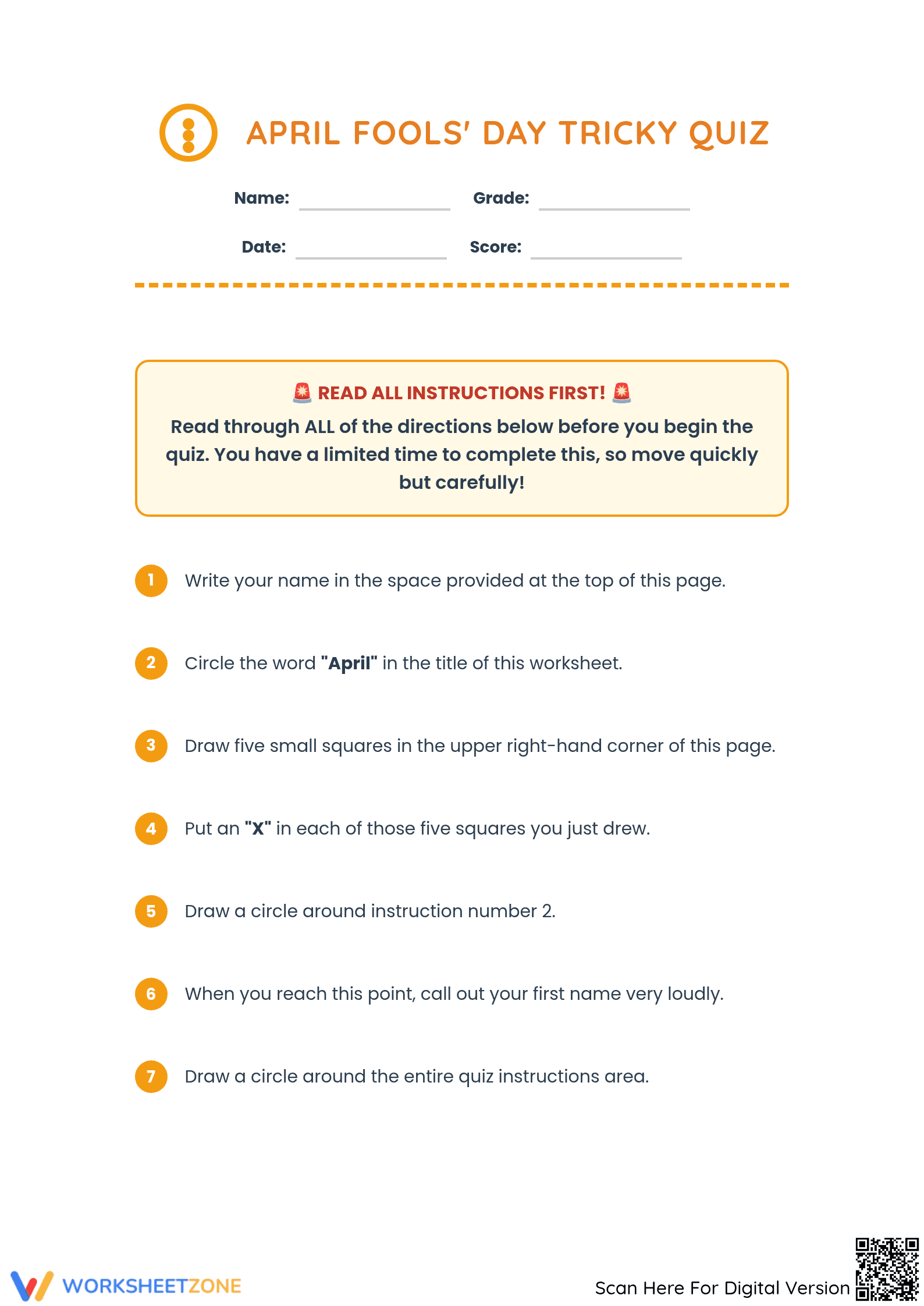
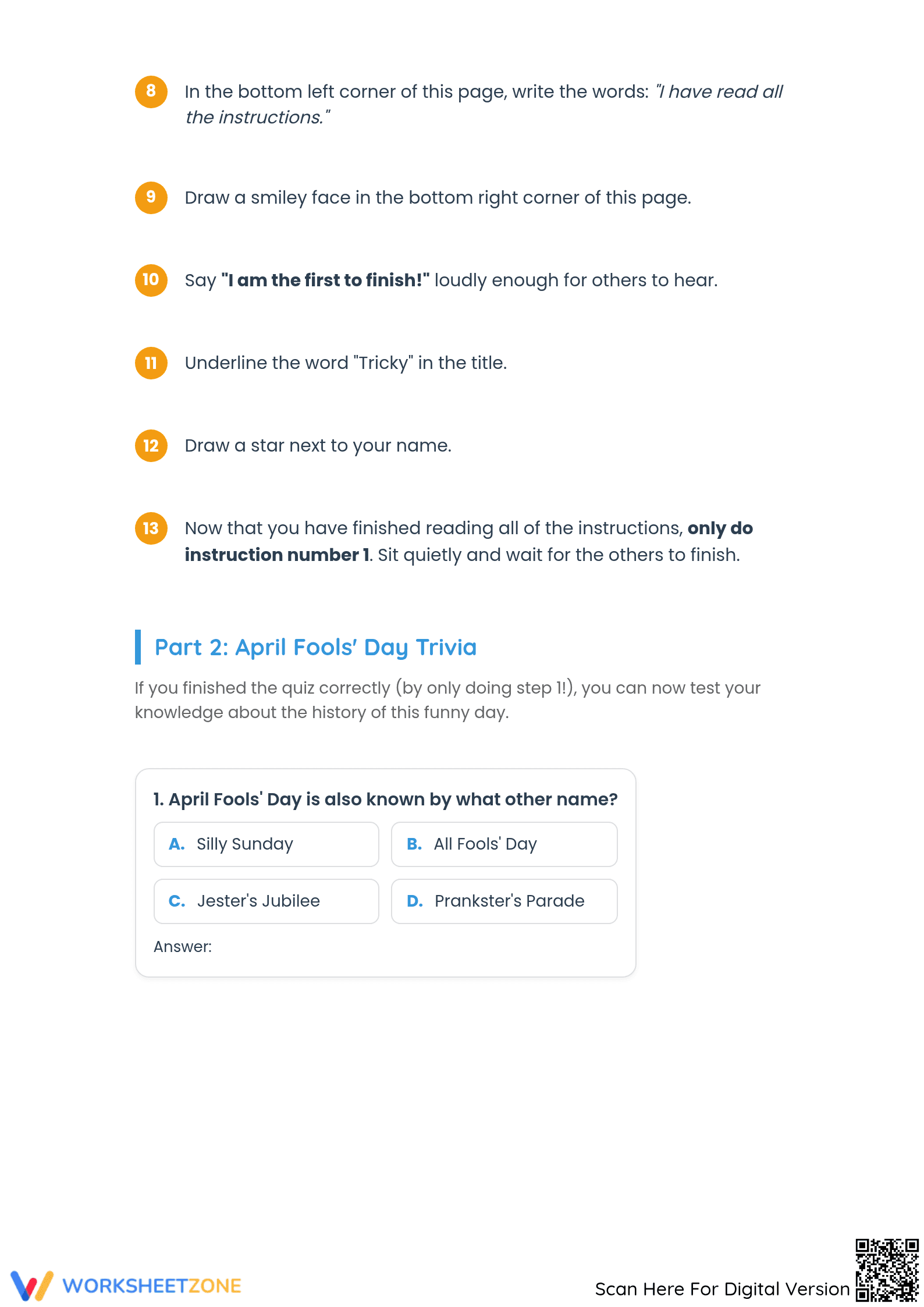
This April Fool's Day Tricky Quiz is a classic classroom activity designed to teach students the critical importance of reading all instructions before beginning any academic task. Students are challenged to navigate a series of 13 increasingly silly directives, only to discover at the end that they should have only completed the first one.
At a Glance
- Grade: 3-12 · Subject: English
- Standard:
CCSS.ELA-LITERACY.RI.5.1— Quote accurately from a text when explaining what the text says explicitly- Skill Focus: Following Complex Directions
- Format: 3 pages · 17 problems · Answer key included · PDF
- Best For: April Fool's Day Bell Ringer
- Time: 10–15 minutes
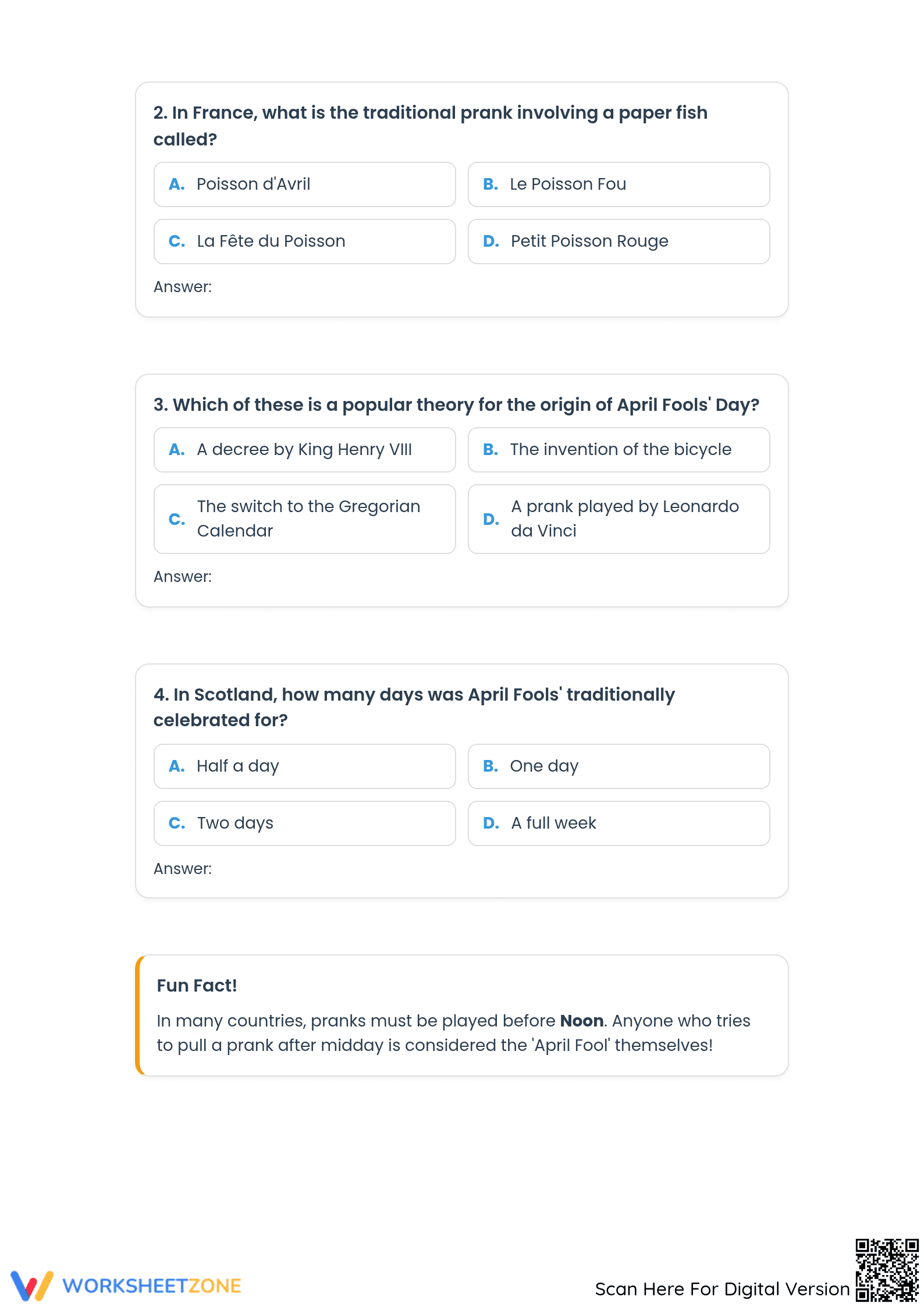
The packet contains three comprehensive pages. The first two pages feature the 13-step "Tricky Quiz" that uses humor and physical actions to engage students. The final page provides a 4-question April Fool's Day Trivia set covering historical origins and cultural traditions in France and Scotland. A complete answer key is provided to facilitate quick grading or self-correction.
Zero-Prep Workflow
- Print: Teachers can print the 3-page PDF in approximately 30 seconds.
- Distribute: Pass out the quiz directly to the class without any prior setup or explanation.
- Review: The activity runs autonomously, and the "trick" reveals itself once the first student reaches the final instruction.
This resource is ideal for sub plans or as a quick transition activity that requires under 2 minutes of teacher preparation time.
Standards Alignment
The primary focus is `CCSS.ELA-LITERACY.RI.5.1`, requiring students to quote accurately and follow explicit textual evidence. By failing to read the final instruction, students demonstrate a breakdown in literal comprehension and evidence-based execution. Supporting standards include `CCSS.ELA-LITERACY.L.5.1` regarding the command of English grammar and instructional language. Both standard codes can be copied directly into lesson plans, IEP goals, or district curriculum mapping tools.
How to Use It
Use this as a high-engagement bell ringer on April 1st to set a lighthearted tone while delivering a meaningful lesson on reading comprehension. It also serves as an excellent formative assessment tool; observe which students jump straight into the tasks versus those who read the entire document first. This observation provides immediate data on who may struggle with complex, multi-step directions in more serious academic contexts.
Who It's For
This worksheet is appropriate for students from Grade 3 through Grade 12, as the humor and the "lesson learned" resonate across all age groups. It is particularly effective for students who tend to rush through assignments without verifying requirements. Pair this activity with a short informational passage about the history of the Gregorian calendar to deepen the educational impact of the holiday.
The pedagogical value of "trick" quizzes like this April Fool's Day activity is supported by Fisher & Frey (2014) in their research on the gradual release of responsibility and the necessity of independent reading stamina. By creating a low-stakes environment where the consequence of a comprehension error is a humorous realization rather than a failing grade, students develop a more reflexive habit of scanning entire documents before beginning work. This aligns with findings from RAND AIRS 2024, which emphasizes that metacognitive strategies—such as pre-reading instructions—are foundational to advanced literacy across disciplines. The trivia portion further bridges the gap between fun and functional reading, requiring students to extract specific historical facts (CCSS.ELA-LITERACY.RI.5.1) about global traditions. This integrated approach ensures that the worksheet remains a valuable educational asset rather than a mere prank, reinforcing high-utility reading behaviors that transition into standardized testing environments.


