


























Views
Downloads
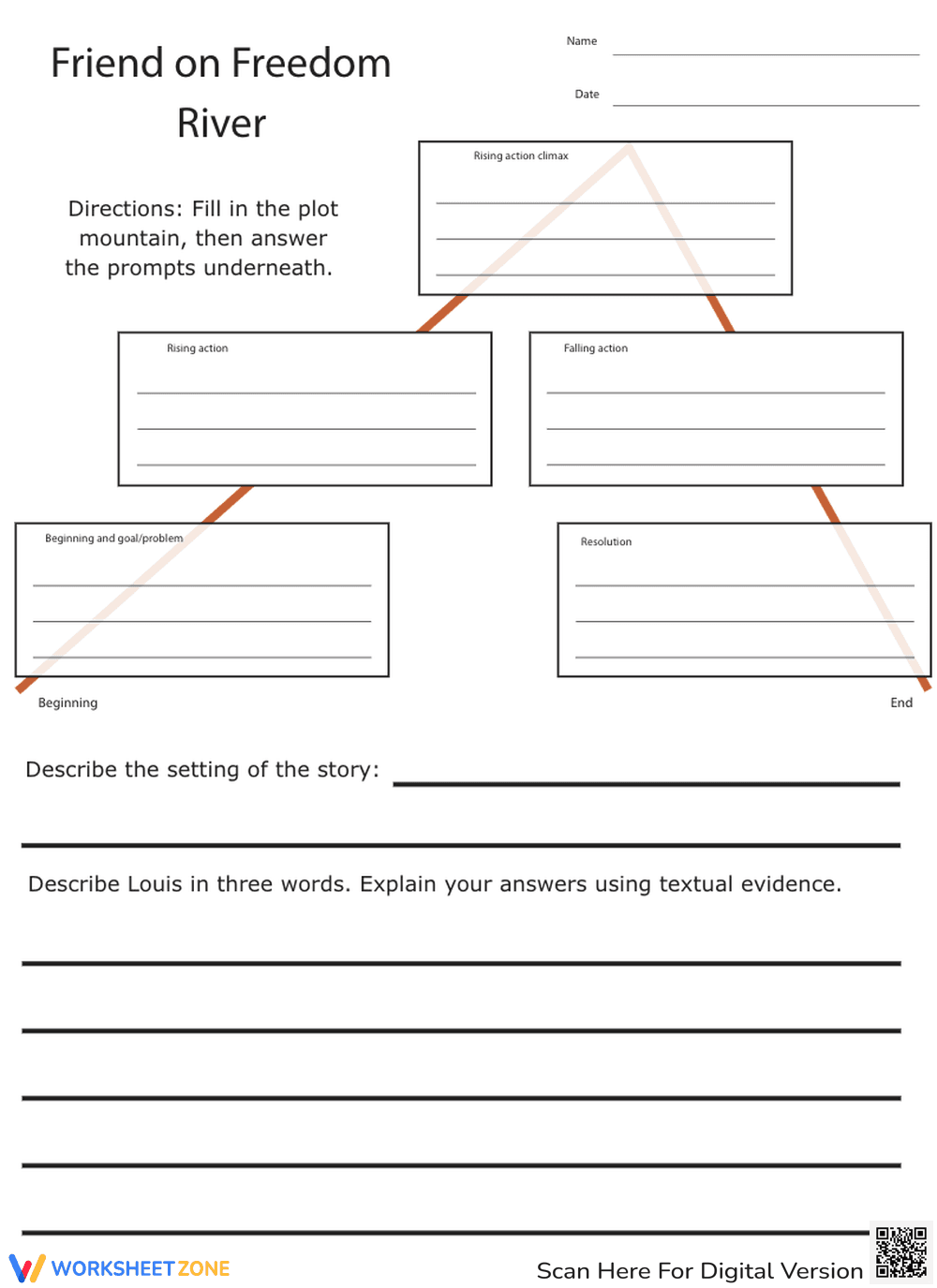

Grade 5 Plot Diagram — Printable No-Prep Worksheet
Paste this activity's link or code into your existing LMS (Google Classroom, Canvas, Teams, Schoology, Moodle, etc.).
Students can open and work on the activity right away, with no student login required.
You'll still be able to track student progress and results from your teacher account.
This Grade 5 ELA worksheet provides a structured framework for students to analyze the narrative arc of Gloria Whelan's "Friend on Freedom River." By mapping the plot mountain and examining character traits, learners develop a deeper understanding of story structure and textual evidence. It is an essential tool for literature circles or independent reading assessments.
At a Glance
At a Glance
- Grade: 5 · Subject: ELA
- Standard:
CCSS.ELA-LITERACY.RL.5.3— Compare and contrast characters, settings, or events using specific textual details- Skill Focus: Plot Structure & Character Analysis
- Format: 1 page · 7 problems · Answer key not included · PDF
- Best For: Post-reading comprehension and story mapping
- Time: 20–30 minutes
What's Inside
The worksheet features a visual plot mountain with five distinct sections: beginning/goal, rising action, climax, falling action, and resolution. Below the diagram, students find two critical thinking prompts. One requires a descriptive analysis of the setting, while the other asks for a three-word characterization of Louis, supported by specific textual evidence. This single-page PDF is designed for immediate distribution.
Zero-Prep Workflow
This resource is designed for a high-efficiency classroom workflow. Teachers can print the single-page PDF in under 30 seconds, distribute it to the class in 1 minute, and review student responses during a 5-minute wrap-up session. Total teacher preparation time is less than 2 minutes, making it an ideal choice for emergency sub plans or quick formative assessments during a novel study.
Standards Alignment
The primary focus is `CCSS.ELA-LITERACY.RL.5.3`, which requires students to draw on specific details in the text to explain relationships between characters and events. By requiring textual evidence for the character analysis of Louis, the worksheet also supports RL.5.1. Both standard codes can be copied directly into lesson plans, IEP goals, or district curriculum mapping tools.
How to Use It
Use this worksheet as a summative assessment after finishing the book to gauge student grasp of the narrative arc. Alternatively, assign it during a guided reading session to help students track the rising action in real-time. Teachers should observe whether students can distinguish between the climax and falling action, providing a quick formative check on their comprehension of story pacing. Completion typically takes 20 to 30 minutes.
Who It's For
This resource is tailored for fifth-grade students reading "Friend on Freedom River." It provides enough structure for struggling readers while offering open-ended prompts that allow advanced learners to provide sophisticated textual analysis. It pairs naturally with a character anchor chart or a direct instruction lesson on the historical context of the Underground Railroad.
According to Fisher & Frey (2014), visual organizers like plot mountains are essential for scaffolding complex narrative comprehension in upper elementary grades. This worksheet aligns with CCSS.ELA-LITERACY.RL.5.3 by requiring students to synthesize story events and character motivations into a cohesive structural map. Research from the NAEP indicates that students who regularly engage in evidence-based character analysis demonstrate higher proficiency in reading comprehension assessments. By integrating 7 specific tasks that bridge the gap between plot summary and character inference, this resource ensures that Grade 5 learners meet rigorous literacy benchmarks. The inclusion of a setting description prompt further reinforces the multi-dimensional nature of literary analysis required by modern standards. This printable PDF serves as a reliable instrument for measuring student progress toward mastery of narrative elements and evidence-based writing.


