


























Views
Downloads

Friction Physics Worksheet | Grade 11 Science Printable
Paste this activity's link or code into your existing LMS (Google Classroom, Canvas, Teams, Schoology, Moodle, etc.).
Students can open and work on the activity right away, with no student login required.
You'll still be able to track student progress and results from your teacher account.
This high school physics worksheet provides comprehensive practice on static and kinetic friction. Students will complete guided notes and solve complex force problems using coefficients of friction, mass, and acceleration. Designed for Grade 11 science classes, this resource helps learners master Newton's laws through rigorous, real-world scenarios.
At a Glance
- Grade: 11 · Subject: Science
- Standard:
HS-PS2-1— Calculate net force, mass, and acceleration relationships- Skill Focus: Static and kinetic friction calculations
- Format: 2 pages · 16 problems · Answer key included · PDF
- Best For: Independent practice and homework
- Time: 45–60 minutes
What's Inside
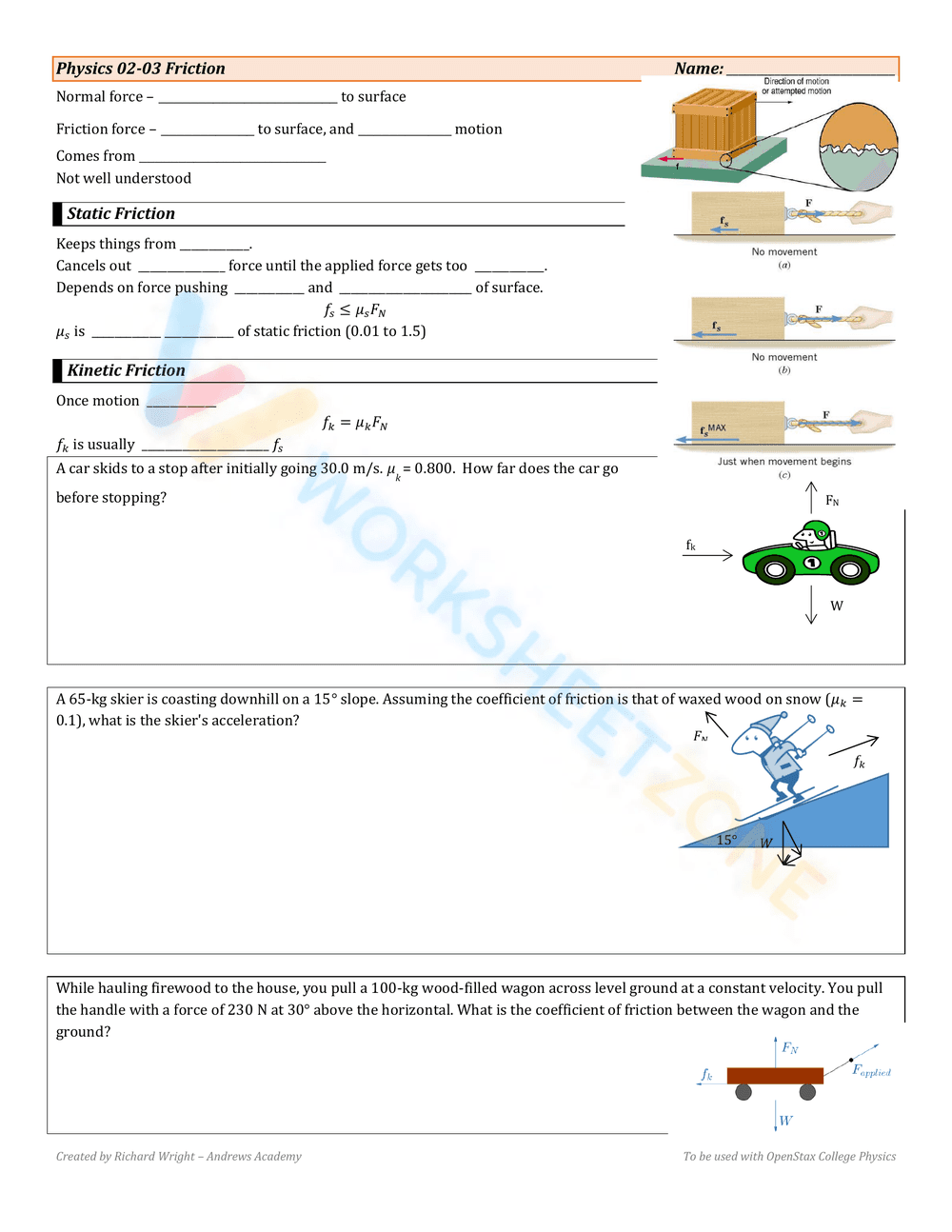
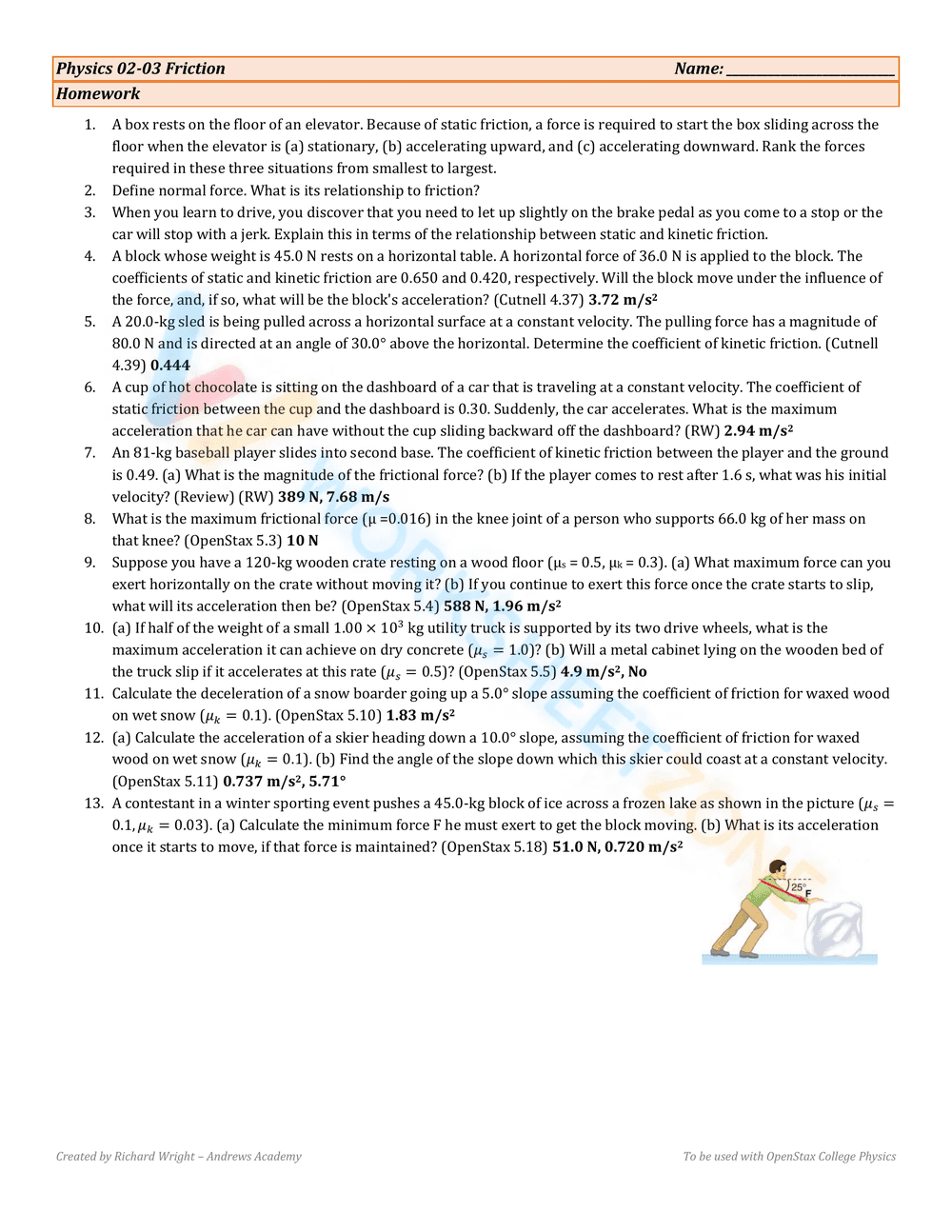
This two-page resource features a structured layout that begins with fill-in-the-blank guided notes on normal force, static friction, and kinetic friction. The first page includes three modeled word problems with detailed free-body diagrams to scaffold student understanding. The second page delivers a 13-question homework set containing a mix of conceptual ranking tasks and multi-step mathematical calculations. Numerical answers are conveniently embedded at the end of each homework question for immediate self-checking.
Skill Progression
- Guided practice: Students complete foundational notes and review essential formulas to establish core concepts.
- Supported practice: Three initial word problems feature visual diagrams to help students map out forces before calculating.
- Independent practice: A robust 13-question homework section challenges students to apply their knowledge to varied scenarios, including angled forces and moving vehicles.
This gradual-release approach ensures students build confidence before tackling complex, multi-step physics equations independently.
Standards Alignment
Aligned to primary standard HS-PS2-1: Analyze data to support the claim that Newton's second law of motion describes the mathematical relationship among the net force on a macroscopic object, its mass, and its acceleration. This worksheet specifically targets the frictional forces component of net force calculations. Both standard codes can be copied directly into lesson plans, IEP goals, or district curriculum mapping tools.
How to Use It
Deploy the first page during direct instruction to guide students through the fundamental definitions and initial practice problems. The visual diagrams make excellent discussion points for drawing free-body diagrams as a class. Assign the second page as independent homework or a collaborative in-class activity. As a formative assessment tip, observe how students set up their trigonometric components for the angled force problems to identify early misconceptions. Expect the full packet to take 45 to 60 minutes to complete.
Who It's For
This resource is designed for high school physics students, typically in 11th or 12th grade, who are currently studying dynamics and Newton's laws. To differentiate for learners needing extra support, provide a pre-filled formula sheet or work through the first five homework problems together. It pairs perfectly with hands-on laboratory experiments measuring the coefficient of friction using spring scales and wooden blocks.
Mastering the mathematical relationships between force and motion requires structured, sequential problem-solving opportunities. Standard HS-PS2-1 requires students to calculate net force, mass, and acceleration relationships accurately in diverse physical systems. According to a ScienceDirect TpT Analysis, providing immediate feedback through embedded answer keys significantly improves student self-efficacy and reduces cognitive overload during complex physics calculations. By integrating guided notes with progressively difficult word problems, this worksheet supports the development of robust mental models for static and kinetic friction. The inclusion of visual scaffolds, such as free-body diagrams for inclined planes and horizontal pulling forces, further bridges the gap between abstract mathematical formulas and concrete physical phenomena. This targeted practice ensures students can confidently analyze real-world forces, ultimately leading to higher retention rates and better performance on summative dynamics assessments.


