




























Views
Downloads




Free Real-World Membrane Worksheet | Grades 7‑12 Science

Paste this activity's link or code into your existing LMS (Google Classroom, Canvas, Teams, Schoology, Moodle, etc.).
Students can open and work on the activity right away, with no student login required.
You'll still be able to track student progress and results from your teacher account.
Opening Paragraph
Students use this 4‑page worksheet to connect cell‑membrane structure with real‑world phenomena, from drug delivery to plant health and disease. By working through 25 targeted tasks, they practice labeling, data interpretation, and explanatory writing, building confidence in applying biology concepts to everyday situations.
At a Glance
- Grade: Grades 7‑12 · Subject: Science
- Standard:
— Students apply cell‑membrane structure and function to everyday and scientific scenarios- Skill Focus: Real‑world application of cell membrane concepts, linking biology to health, technology, and environment
- Format: 4 pages of clear layout · 25 multi‑step problems · Answer key included · Printable PDF
- Best For: Classroom labs, review sessions, test‑prep, interdisciplinary projects
- Time: Approximately 15–25 minutes of focused work
What’s Inside
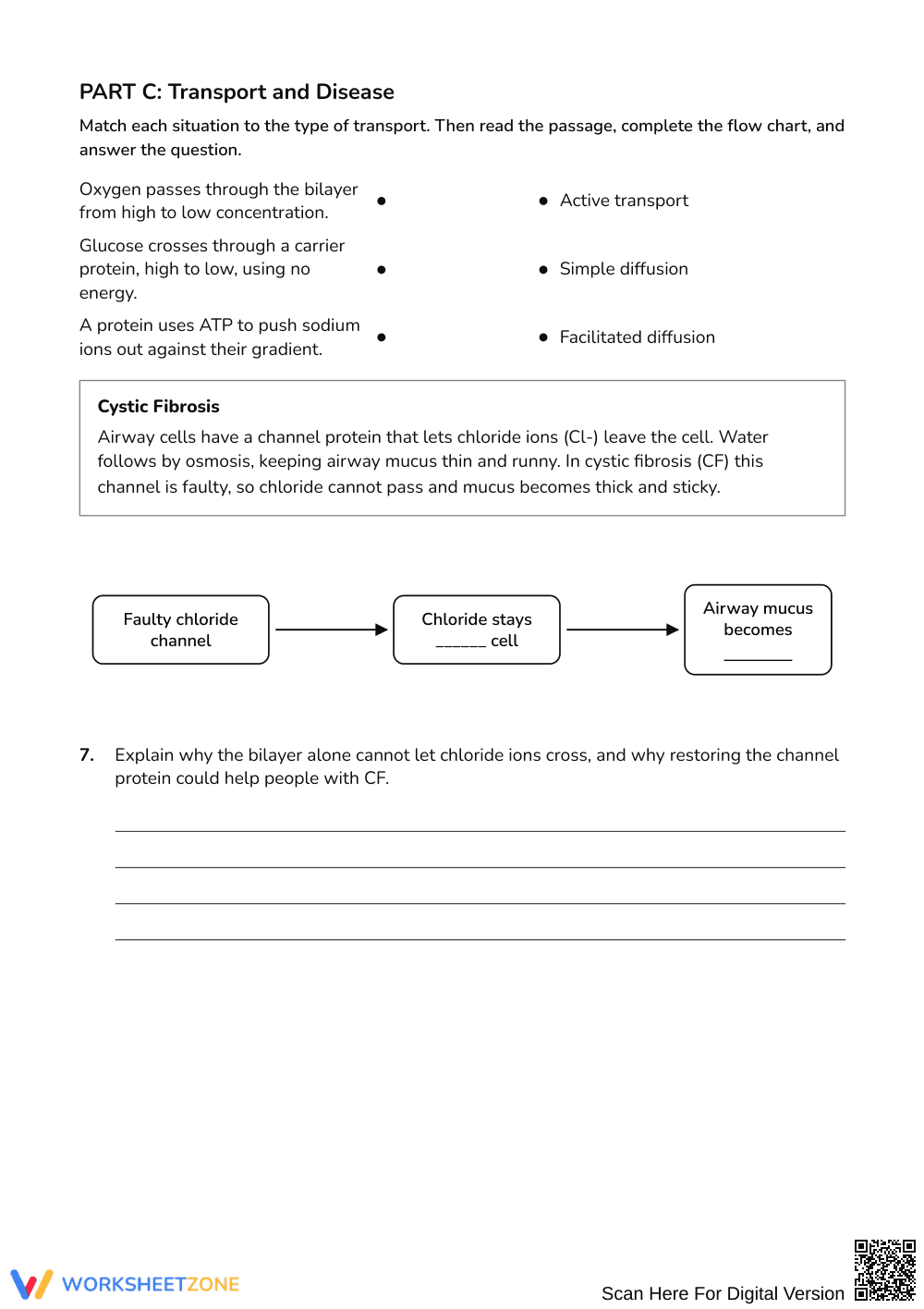
The worksheet spans four pages and includes a model‑labeling activity, osmotic data table, transport matching, disease case study, and oral‑rehydration scenario. A word bank, sentence frames, and a complete answer key are provided for seamless grading.
Skill Progression
- Guided practice – 8 labeling problems with a word bank and step‑by‑step hints.
- Supported practice – 9 data‑interpretation and short‑answer items with sentence frames to scaffold reasoning.
- Independent practice – 8 application questions requiring full sentences and real‑world explanations, no scaffolds.
The sequence follows the classic I Do, We Do, You Do release.
Standards Alignment
` ` (No specific code provided). Students explore how membrane structure governs selective transport, osmosis, and disease mechanisms, meeting NGSS expectations for high‑school life sciences. Both concepts can be copied directly into lesson plans, IEP goals, or district curriculum mapping tools.
How to Use It
Use the labeling activity as a quick warm‑up before a lecture on membrane structure, then collect student responses for immediate formative feedback. Follow the data‑analysis section during a lab on osmosis, letting groups record observations and discuss real‑world implications; allocate 10–15 minutes for discussion. The worksheet fits into a 45‑minute class block or as homework for reinforcement.
Who It’s For
Designed for secondary‑school science students in grades 7‑12, the tasks support diverse learners with clear scaffolds and extension questions. Pair it with a membrane‑model poster or an interactive simulation for a multimodal lesson.
Research shows that connecting abstract biology concepts to authentic contexts improves retention and transfer (Fisher & Frey 2014). This worksheet embodies that principle by guiding students to label membrane structures, interpret osmotic data, and explain disease mechanisms such as cystic fibrosis, all within everyday scenarios like drug delivery and plant health. The 25‑item sequence aligns with curriculum expectations for secondary science, encouraging analytical writing and evidence‑based reasoning. By providing a complete answer key, teachers can offer rapid feedback, supporting formative assessment cycles. The activity’s real‑world focus mirrors findings from NAEP that students who see relevance in science perform better on applied questions. Furthermore, the inclusion of a disease case study aligns with health‑science integration recommendations, fostering interdisciplinary connections that are valued in modern curricula. Teachers can also adapt the open‑ended prompts for project‑based learning, extending inquiry beyond the worksheet.


