


























Views
Downloads

Equivalent Fractions Models Worksheet | Grade 4 Printable
Paste this activity's link or code into your existing LMS (Google Classroom, Canvas, Teams, Schoology, Moodle, etc.).
Students can open and work on the activity right away, with no student login required.
You'll still be able to track student progress and results from your teacher account.
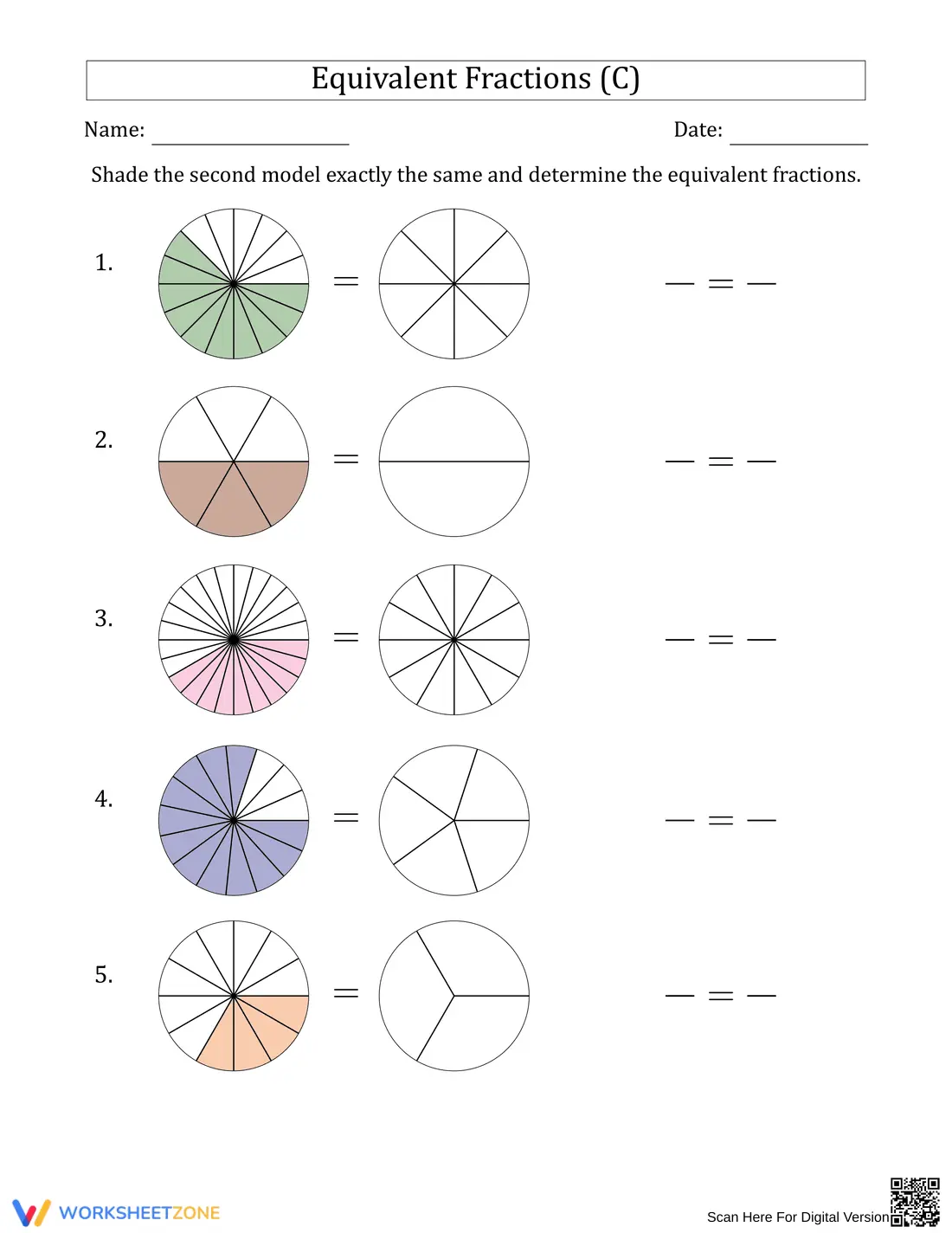
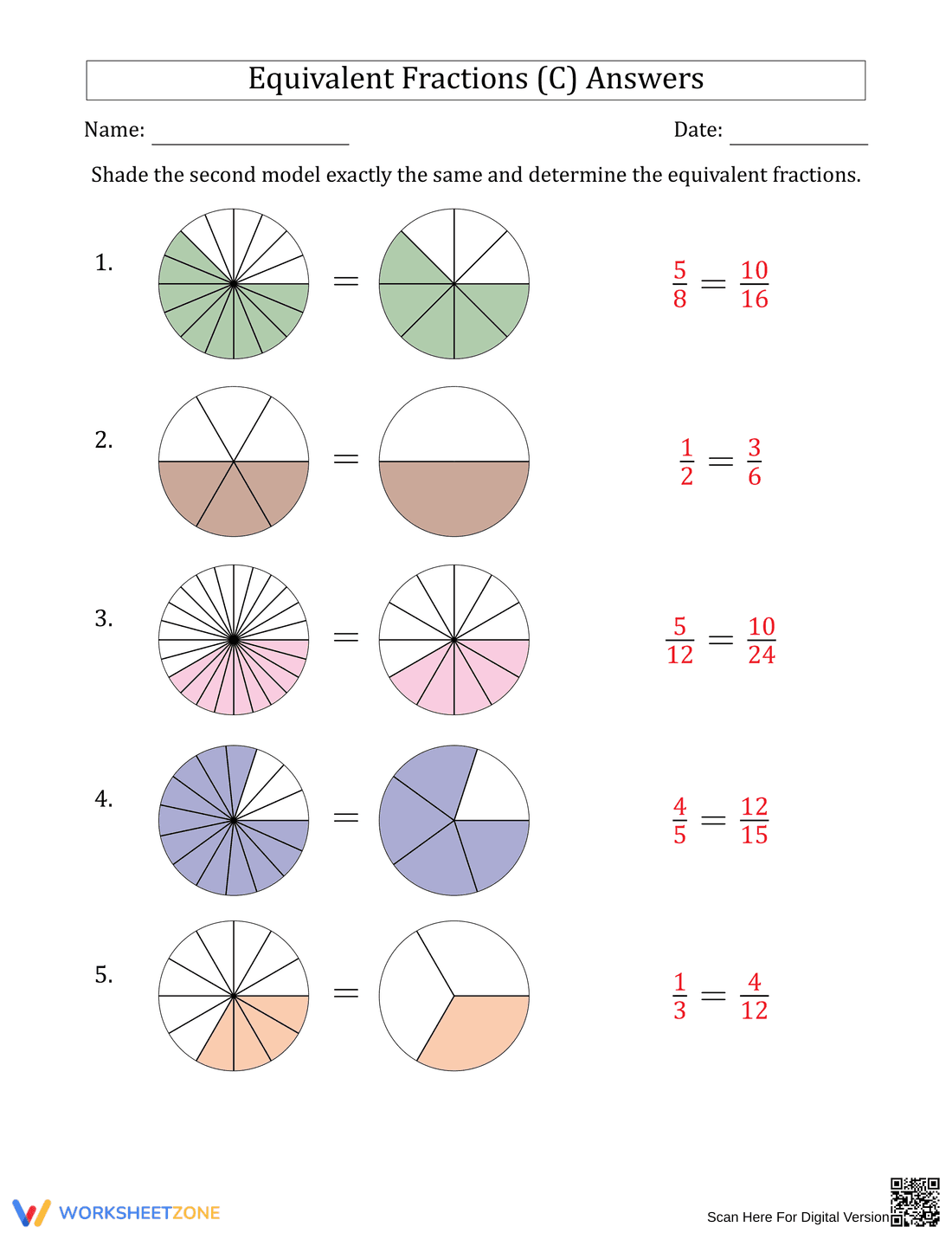
This Grade 4 math worksheet helps students master equivalent fractions using clear visual models. Students observe a shaded fraction circle, shade a corresponding blank model to match the proportion, and write the numerical equivalent. This visual approach bridges the gap between concrete understanding and abstract numerical representation.
At a Glance
- Grade: 4 · Subject: Math
- Standard:
CCSS.MATH.CONTENT.4.NF.A.1— Recognize and generate equivalent fractions using visual models.- Skill Focus: Equivalent Fractions
- Format: 1 page · 5 problems · Answer key included · PDF
- Best For: Independent practice or homework
- Time: 10–15 minutes
Inside this printable resource, educators will find a single-page assignment featuring five distinct fraction model problems. Each task presents a pre-shaded circle paired with a blank circle divided into larger fractional parts. Students shade the second circle to match the visual area of the first, then write the corresponding fraction equation. An answer key is included.
Zero-Prep Workflow
This resource is designed for immediate classroom implementation.
- Print (1 min): Download the PDF and print. The black-and-white design saves ink.
- Distribute (1 min): Hand out as independent practice. Instructions are self-explanatory.
- Review (3 min): Use the answer key to quickly check student work.
Total teacher prep time is under two minutes, making this an excellent option for sub plans.
Standards Alignment
This worksheet aligns to CCSS.MATH.CONTENT.4.NF.A.1: Explain why a fraction a/b is equivalent to a fraction (n × a)/(n × b) by using visual fraction models. It supports foundational skills for adding fractions with unlike denominators. Both standard codes can be copied directly into lesson plans, IEP goals, or district curriculum mapping tools.
How to Use It
Deploy this worksheet during independent practice, after students have used hands-on manipulatives. It serves as an effective formative assessment. While students work, observe whether they accurately count the shaded and total sections to form their fractions. Expected completion time is 10 to 15 minutes.
Who It's For
This resource is designed for fourth-grade math students developing their understanding of fraction equivalence. It is also effective for fifth-grade remediation. For differentiation, provide physical fraction circles to students needing concrete support. Pair this worksheet with a direct instruction lesson on multiplying numerators and denominators.
Mastering equivalent fractions through visual representation is a critical milestone in elementary mathematics. This resource targets CCSS.MATH.CONTENT.4.NF.A.1, requiring students to recognize and generate equivalent fractions using visual models. According to the RAND AIRS 2024 report on mathematics instruction, students who consistently engage with visual fraction models demonstrate a significantly higher retention rate in advanced rational number concepts compared to peers who rely solely on algorithmic instruction. By requiring learners to physically shade corresponding areas on differently partitioned circles, this worksheet reinforces the concept that equivalent fractions represent the exact same proportion of a whole, despite having different numerators and denominators. This foundational understanding is absolutely essential for future success in algebra and proportional reasoning. Integrating these targeted visual tasks ensures a deeper, more conceptual grasp of fraction equivalence across diverse learning profiles.


