


























Views
Downloads


Printable Comparing Fractions Worksheet | Grades 7-9 Math
Paste this activity's link or code into your existing LMS (Google Classroom, Canvas, Teams, Schoology, Moodle, etc.).
Students can open and work on the activity right away, with no student login required.
You'll still be able to track student progress and results from your teacher account.
Master Fraction Comparison with this Comprehensive Worksheet
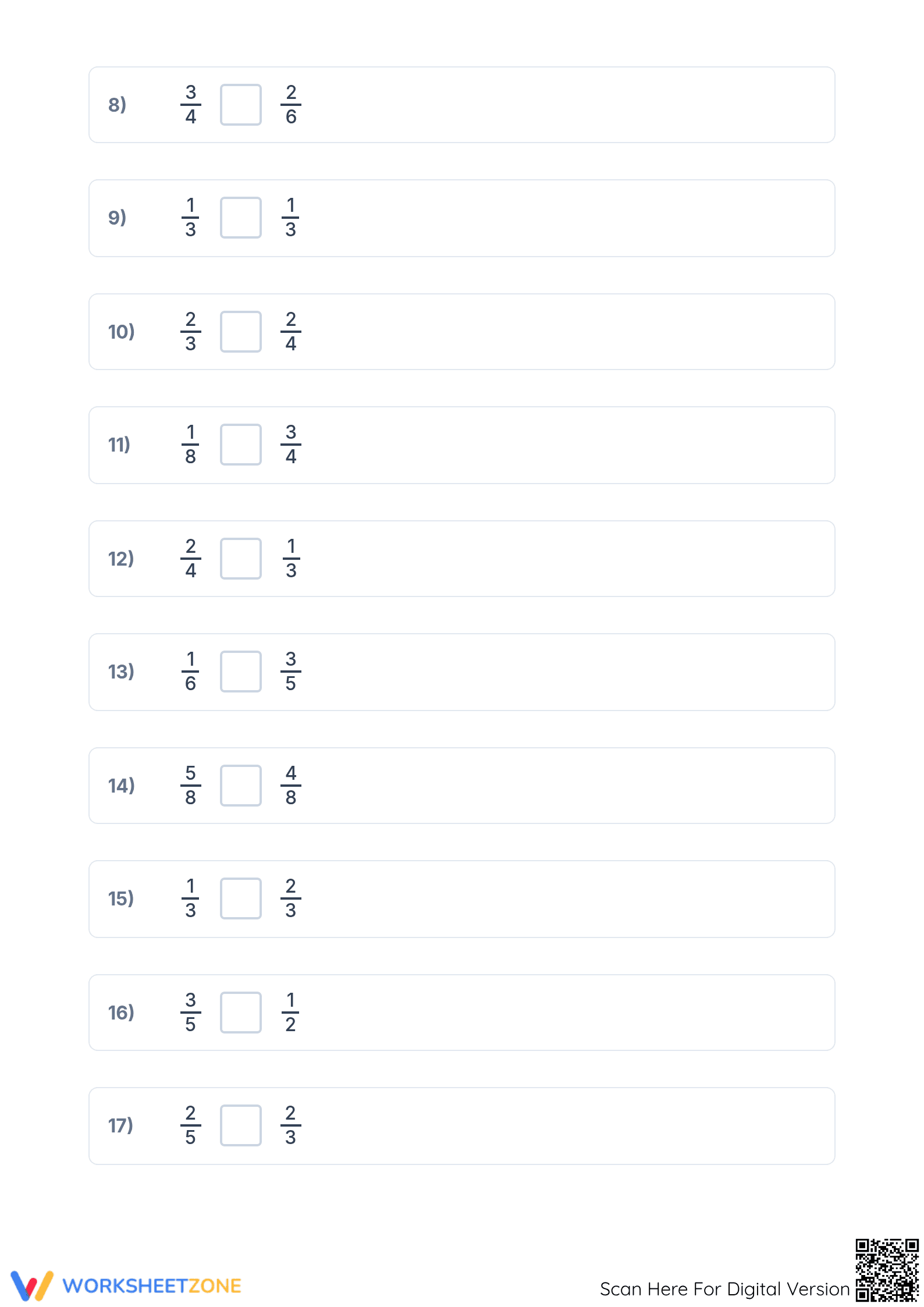
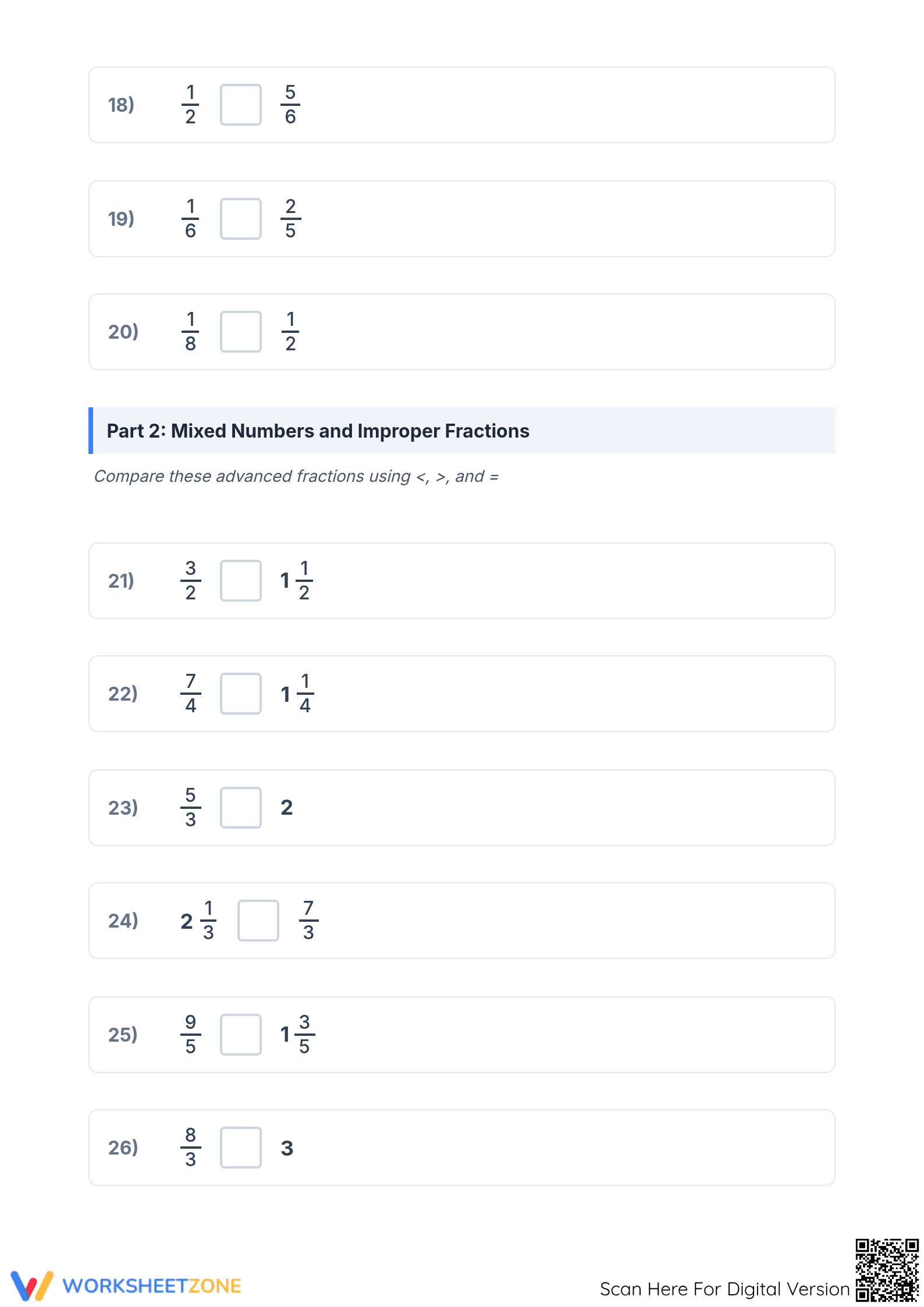
This worksheet offers focused practice to help students in Grades 7, 8, and 9 develop a strong conceptual understanding of comparing fractions. Through a structured series of 45 problems, learners will solidify their ability to determine the relative size of different fractions, a critical skill for success in higher-level mathematics. The exercises are designed to build procedural fluency from a conceptual foundation, ensuring students can confidently work with rational numbers in various contexts.
At a Glance
- Grade: 7–9 · Subject: Math
- Standard:
CCSS.MATH.CONTENT.4.NF.A.2— Compare two fractions with different numerators and different denominators.- Skill Focus: Comparing Fractions
- Format: 4 pages · 45 problems · Answer key included · PDF
- Best For: Skill reinforcement, homework, or formative assessment
- Time: 20–30 minutes
What's Inside
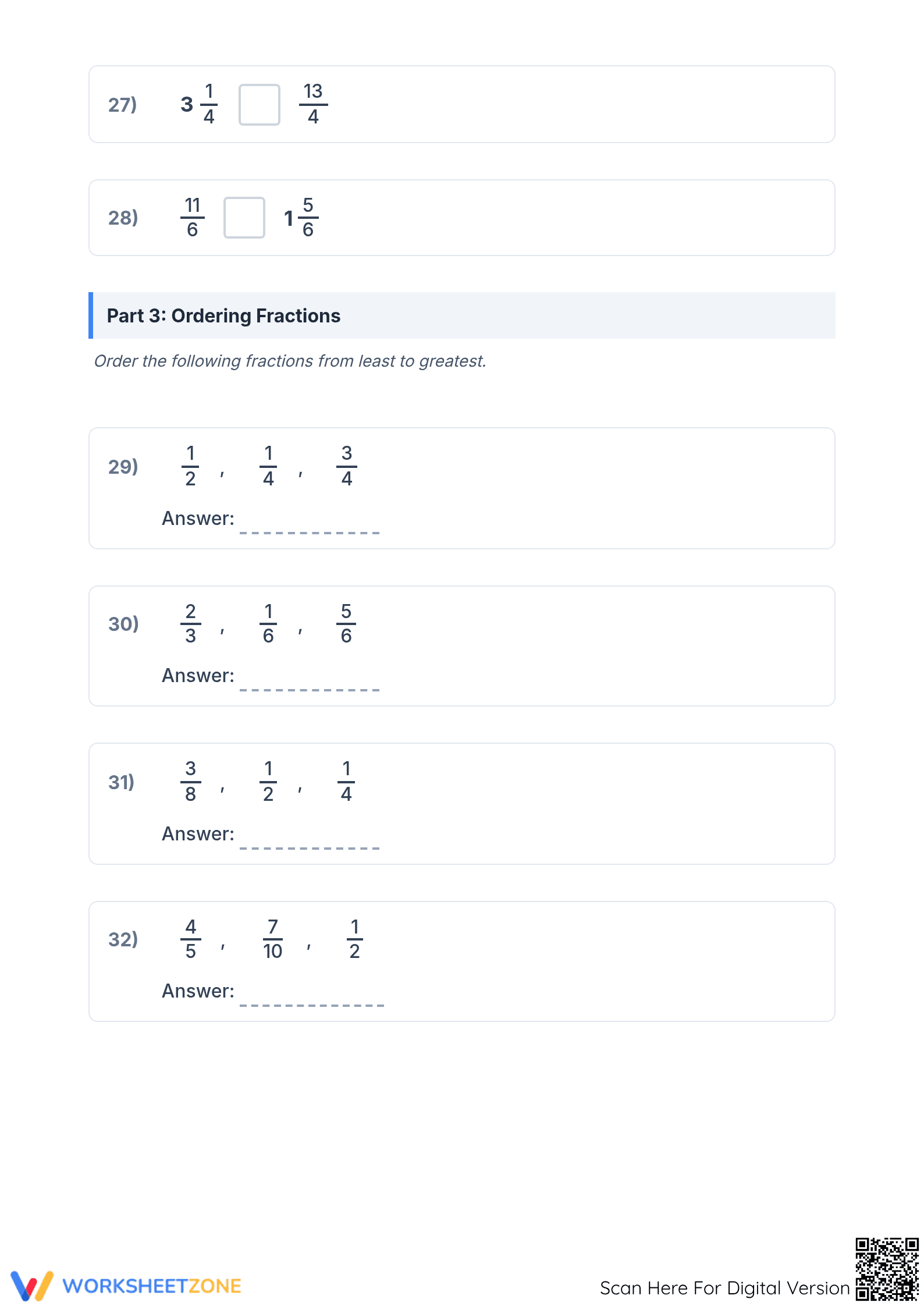
This resource includes a four-page worksheet containing a total of 45 fraction comparison problems. The layout is clean and organized, providing ample space for students to show their work. A complete, easy-to-read answer key is provided for all pages, facilitating quick grading and student self-assessment. The packet progresses logically, allowing students to build confidence as they move through the material.
A Structured Skill Progression
The worksheet follows a gradual-release model to support student learning, moving from foundational concepts to more complex applications. This progression helps ensure that students of all levels can access the material and build toward mastery.
- Guided Practice: The first page presents 12 problems focused on comparing fractions with like denominators and common numerators, reinforcing foundational rules.
- Supported Practice: The next two pages introduce fractions with unlike denominators, requiring students to find common denominators or use benchmark fractions. These 24 problems provide the core practice.
- Independent Practice: The final page challenges students with 9 problems that mix various types of comparisons, requiring them to flexibly apply different strategies to solve efficiently.
Standards Alignment
This worksheet is directly aligned with the foundational standard CCSS.MATH.CONTENT.4.NF.A.2, which requires students to "Compare two fractions with different numerators and different denominators, e.g., by creating common denominators or numerators, or by comparing to a benchmark fraction like 1/2." While this is a 4th-grade standard, its mastery is essential for success in middle school math, particularly for operations with rational numbers (7.NS.A). Both standard codes can be copied directly into lesson plans, IEP goals, or district curriculum mapping tools.
How to Use It
This versatile worksheet can be used in various instructional settings. Assign it as independent practice after a direct instruction lesson on comparing fractions to give students the repetitions they need. It also serves as an effective homework assignment for reinforcement. Alternatively, use the first page as a warm-up and the final page as an exit ticket to quickly gather formative assessment data on student understanding. The expected completion time is between 20 and 30 minutes, making it easy to fit into a class period.
Who It's For
This resource is designed for middle school students (Grades 7-9) who need a structured review of comparing fractions. It is ideal for closing skill gaps before tackling more advanced topics like proportional reasoning or solving equations with rational numbers. The clear progression makes it suitable for use in intervention settings or for targeted reteaching. For a complete lesson, pair this worksheet with an anchor chart of fraction comparison strategies.


